Join us on a literary world trip!
Add this book to bookshelf
Grey
Write a new comment Default profile 50px
Grey
Subscribe to read the full book or read the first pages for free!
All characters reduced
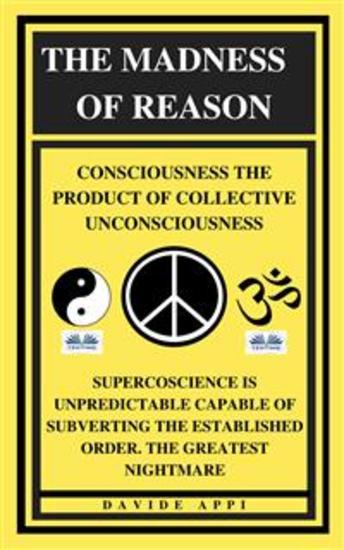
The Madness Of Reason Consciousness The Product Of Collective Unconsciousness - SUPERCOSCIENCE IS Unpredictable Capable Of Subverting The Established Order The Greatest Nightmare - cover

The Madness Of Reason Consciousness The Product Of Collective Unconsciousness - SUPERCOSCIENCE IS Unpredictable Capable Of Subverting The Established Order The Greatest Nightmare

davide appi

Publisher: Tektime

  • 0
  • 0
  • 0

Summary

CONSCIOUSNESS OR SUPERCONSCIOUSNESS THIS IS THE DILEMMA The present society continues to run like a mad elephant, toward global catastrophe. Why do we continue on this road that leads us to a dead end, with end view our own self-destruction? The answer to this question lies in human consciousness itself, the cause of every problem, while Superconsciousness is the solution to every difficulty. What is the difference between consciousness and Superconsciousness? Superconsciousness consciously connects us with everything that exists, and to understand it better we can make the analogy of a network: everything in existence is like a node that can have the illusion of being separate from the rest of the network. Most people are like that, they feel like a node separated from the rest, like a single individual separated from the rest of Humanity. This feeling of separation is the mode in which consciousness operates.CONSCIOUSNESS OR SUPERCOSCIENCE THAT IS THE DILEMMA The present society continues to run like a mad elephant, toward global catastrophe. Why do we continue on this road that leads us to a dead end, with end view our own self-destruction? The answer to this question lies in human consciousness itself, the cause of every problem, while Superconsciousness is the solution to every difficulty. What is the difference between consciousness and Superconsciousness? Superconsciousness consciously connects us with everything that exists, and to understand it better we can make the analogy of a network: everything in existence is like a node that can have the illusion of being separate from the rest of the network. Most people are like this, feeling like a knot separated from the rest, like a single individual separated from the rest of Humanity. This feeling of separation is the mode in which consciousness operates. So it is ”normal” for a world dominated by consciousness to be in perpetual conflict, consciousness can only do so much by being a principle of division and separation. And as long as it is the same that decides both our personal and Humanity's fate, we will always be at risk of self-destruction. We can even say, ”The very nature of consciousness, directed toward separation and competition, can only inevitably lead us into conflict with others.” It is the very nature of ordinary consciousness that leads us to violence and war! Superconsciousness knows that it is both the node and the global network itself at the same time, so it knows that it is deeply connected and interconnected to the Whole, while consciousness thinks it is a node unto itself, separate from the rest of the network. Superconsciousness thus opens us to a wider reality than that of ordinary consciousness, and we get a taste of it in moments of deep Inner Peace, when the silent mind allows us to enjoy to the fullest the spectacle of the present moment. Why is consciousness on the world's bridge of command and Superconsciousness all but ignored? Superconsciousness is something unpredictable and original capable of subverting the established order. The emergence on this planet, of a minimum sufficient number of awakening Superconsciousnesses, is the greatest nightmare for the system and for the Anti-Awakening Dark Powers that rule the world. This is the problem, the ruling elites do not want Superconsciousness awakening because it would put an end to their millennial earthly Power. Only by electing Superconsciousness, as the Supreme Commander of human life, will it be possible to change human destiny and put the extraordinary scientific progress implemented by consciousness no longer at the service of consciousness itself in command, which we might rather describe as ”unconsciousness ruling the world,” but to put technological progress at the service of Superconsciousness, the only one capable of fostering development that is healthy, sensible, and truly aimed at the welfare of Humanity. When we use consciousness we are slPUBLISHER: TEKTIME
Available since: 10/29/2022.


Other books that might interest you

  • How to Focus Your Mind: 7 Easy Steps to Master Concentration Techniques Attention Management & Staying Focused - cover

    How to Focus Your Mind: 7 Easy...

    Troye Bates

    • 0
    • 0
    • 0
    Do you wish you could learn to better focus your mind during those crucial moments when you need to? 
      
    Paying attention in a world filled with distractions today is a constant challenge that many are faced with. 
      
    Yet, there is a solution to the problem: An easy to follow 7-step solution to master concentration techniques and enhance your powers of focus today! 
      
    YOU WILL LEARN: 
    • Why goals matter to build a foundation for focus. 
    • The way your environment impacts your ability to concentrate. 
    • How to enhance your mental prowess. 
    • Why it is energy management, not time, that matters. 
    • How to shut down distractions, enhance your attention, and more. 
      
    No matter what stage in life you are or where you aim to be, better focus is the way to get you to every goal you’ve ever set for yourself. 
      
    The power of focus and concentration doesn’t have to be an elusive superpower reserved only for the few who have mastered the secret to success. 
      
    You’ve got the opportunity to do the same right now!
    Show book
  • The Devil's Garden - Rommel's Desperate Defense of Omaha Beach on D-Day - cover

    The Devil's Garden - Rommel's...

    Steven J Zaloga

    • 0
    • 0
    • 0
    A military historian’s account of the German fortifications at Omaha Beach explains the huge American losses during this key WWII conflict.   In this fresh look at D-Day—one of World War II's pivotal battles—author Steven Zaloga draws on original research, including recently discovered German artillery maps, and offers well-supported evidence for why the U.S. Army suffered such enormous casualties on Omaha Beach.  Focusing on Erwin Rommel, the Desert Fox, who oversaw German defenses in Normandy, Zaloga covers little-known aspects of the war, such as the German patrols who were tasked with shooting down pigeons the French resistance used to send messages to the Allies, offering up conclusions that are sure to spark debate. 
    Show book
  • Global Burning - Rising Antidemocracy and the Climate Crisis - cover

    Global Burning - Rising...

    Eve Darian-Smith

    • 0
    • 0
    • 0
    Recent years have seen out of control wildfires rage across remote Brazilian rainforests, densely populated California coastlines, and major cities in Australia. What connects these separate events is more than immediate devastation and human loss of life. In Global Burning, Eve Darian-Smith contends that using fire as a symbolic and literal thread connecting different places around the world allows us to better understand the parallel, and related, trends of the growth of authoritarian politics and climate crises and their interconnected global consequences. 


    As political leaders and big business work together in the pursuit of profits and power, anti-environmentalism has become an essential political tool enabling the rise of extreme right governments and energizing their populist supporters. These are the governments that deny climate science, reject environmental protection laws, and foster exclusionary worldviews that exacerbate climate injustice. 


    The widespread fires demand acknowledgment of the global systems of inequality that undergird them, connecting the political erosion of liberal democracy with the corrosion of the environment. In thinking through wildfires as environmental and political phenomenon, Global Burning challenges listeners to confront the interlocking powers that are ensuring our future ecological collapse.
    Show book
  • The Tolerant Populists - Kansas Populism and Nativism - cover

    The Tolerant Populists - Kansas...

    Walter Nugent

    • 0
    • 0
    • 0
    A political movement rallies against underregulated banks, widening gaps in wealth, and gridlocked governments. Sound familiar? More than a century before Occupy Wall Street, the People’s Party of the 1890s was organizing for change. They were the original source of the term “populism,” and a catalyst for the later Progressive Era and New Deal. Historians wrote approvingly of the Populists up into the 1950s. But with time and new voices, led by historian Richard Hofstadter, the Populists were denigrated, depicted as demagogic, conspiratorial, and even anti-Semitic. In a landmark study, Walter Nugent set out to uncover the truth of populism, focusing on the most prominent Populist state, Kansas. He focused on primary sources, looking at the small towns and farmers that were the foundation of the movement. The result, The Tolerant Populists, was the first book-length, source-based analysis of the Populists. Nugent’s work sparked a movement to undo the historical revisionism and ultimately found itself at the center of a controversy that has been called “one of the bloodiest episodes in American historiography.” This timely re-release of The Tolerant Populists comes as the term finds new currency—and new scorn—in modern politics. A definitive work on populism, it serves as a vivid example of the potential that political movements and popular opinion can have to change history and affect our future.
    Show book
  • Buddhism in a Value-changing Society - cover

    Buddhism in a Value-changing...

    P. D. Premasiri

    • 0
    • 0
    • 0
    This is an audiobook of Bodhi Leaves No. 148 by P. D. Premasiri, Buddhism in a Value-changing Society narrated by Jayashree Tata Nagaraj. The print edition can be found in the Pariyatti Edition of Collected Bodhi Leaves Vol. 5. The eBook of Bodhi Leaves No. 148 can be downloaded from the BPS website.
     
    Excerpt:
     
    Values can be approached from two different standpoints. Most social scientists prefer to take the standpoint that may be called sociological relativism in dealing with questions of value in relation to different societies. The social scientist’s approach does not involve any absolute standard for judging the goodness or badness of the norms upheld by a particular society. The application of such an approach to examine the existing values of a traditional Buddhist society involves merely a description of the social behaviour of its people and a causal explanation of such behaviour.
     
    The subject under investigation in the present discussion is the question of the relationship between Buddhism and changing values. Where doesBuddhism stand in a value-changing world? Here, we have admitted in some sense that we are living in a world in which values are changing. In this connection it may be questioned whether values themselves are changing or whether it is only our beliefs about values that are changing. I made the point that our beliefs about facts do change. But is there a sense in saying that facts changes?
    Show book
  • Finding the Gem: Discover and Ignite Your Child’s Talents - cover

    Finding the Gem: Discover and...

    Aariv Wadhwa, Anshumala Singh

    • 0
    • 0
    • 0
    Every child is born with a spark—a unique gift waiting to shine. As parents, we often marvel at the small things our children do. A scribble that tells a story, a question that shows deep curiosity, a dance that seems to come from the heart—these moments are more than just childhood innocence. They are glimpses of the gem within. 
    But how often do we pause to truly observe? In the rush of daily life, it’s easy to miss the subtle signals that hint at a child’s hidden talents. What if, with a little patience and a lot of love, we could unearth those treasures and help our children thrive in ways we never imagined? 
    This book is not about turning children into prodigies or pressuring them to succeed. It’s about discovery—finding the joy in helping your child explore their passions, strengths, and unique potential. It’s about listening to the unspoken language of their play, their choices, and their dreams. 
    "Finding the Gem" is your guide to this journey. Through practical techniques, inspiring stories, and thoughtful insights, you’ll learn how to observe, nurture, and support your child in ways that let their natural abilities shine. This is not a roadmap to perfection; it’s an invitation to partner with your child on their journey of growth and self-discovery. 
    Every gem is unique, and so is every child. Let’s begin the adventure of finding and polishing the gem within your child, so they can sparkle in a way that is truly their own.
    Show book