Join us on a literary world trip!
Add this book to bookshelf
Grey
Write a new comment Default profile 50px
Grey
Subscribe to read the full book or read the first pages for free!
All characters reduced
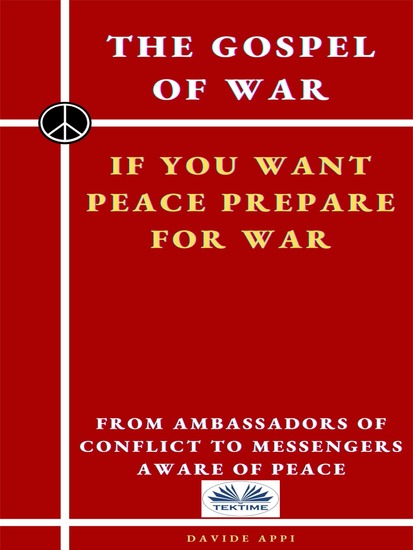
The Gospel Of War If You Want Peace Prepare For War - From Ambassadors Of Conflict To Messengers Aware Of Peace - cover

The Gospel Of War If You Want Peace Prepare For War - From Ambassadors Of Conflict To Messengers Aware Of Peace

davide appi

Translator Ivan Alexandra

Publisher: Tektime

  • 0
  • 0
  • 0

Summary

The Gospel of War, if you want Peace prepare for war
From ambassadors of conflict to messengers aware of peace
True Peace is not only the absence of war, but also of all the emotional negativity of the human being. Harmony and serenity already dwell in us, as well as truth and positive qualities, it is only necessary to hear again, to listen in silence, and all the most precious inner treasures will blossom in unison.
The actual armed confrontation is only the visible tip of the iceberg, a striking aspect of the war, the one that moves the minds that suddenly rise from the sofa and say: ”Putin is a criminal, it is not acceptable to invade a foreign country and make massacres of innocent women and children”. But these people need to understand that, the tanks that invade a country, is just the final act of something that is being prepared day by day, starting from our consciousnesses, the war is a social structure, a way by which we have organized the entire society, because education itself is separating and teaches conflict.
So the war has become a philosophical, spiritual, psychological, social, cultural and economic structure, born of our own consciousness, of our ”false self” that feels separated from itself, from others, and this is the feeling of division that is the source of war.
To be pacifist does not mean to go to the streets to protest against the war or to be indignant before the television, for the criminal invasion perpetrated by the despotic of the moment, but to work on ourselves to dissolve that nature of conflict that we already have inside, that we express in our daily lives, when we clash with the people around us, and show aggression towards those who attack us.
True Peace is first of all a journey within us, in search of all those stimuli, in most cases unconscious, that make us react aggressively when we feel attacked. It’s a huge but essential work, we should base a new education on this key of inner pacification that further on will transmits outside as well.
Can we change the fate of our destiny?
Currently the world we live in seems to be addicted to violence, and like the worst addict, it requires stupidly, unconsciously, and automatically its dose of cruelty, of arrogance, of malevolence, and the drug system itself is not interested in the destructive consequences of these behaviors, for him the priority is to appease his addiction.
But war is a self-destructive choice born from a sick conscience, incapable of understanding itself and its own models of functioning.
Faced with this situation, the pacifists seem to be silenced, unable to respond to the completely rational and logical discourses of those who preach: ”let us take up arms to defend ourselves” or ”If you want peace prepare the war”. It seems more than ever  to be back in fashion the famous: ”Let's arm ourselves and go”, while the patriotic heroism regains strength as in the good times...
But now let’s ask ourselves carefully, ”It's truly like this?”
Must we convert to the logic of violence, brush up from the museum of prehistory the eye for an eye, tooth for a tooth of Mosaic memory?
Can we ever live in a peaceful world?
What can we do against the war?
Available since: 02/17/2023.
Print length: 381 pages.

Other books that might interest you

  • When the War Never Ends - The Voices of Military Members with PTSD and Their Families - cover

    When the War Never Ends - The...

    Leah Wizelman

    • 0
    • 0
    • 0
    Veterans with PTSD speak: “Anyone wanting to understand what it is to have a ‘flashback’ will learn more from these firsthand accounts than from any textbook.” ―The British Journal of Psychiatry   The chances of service members developing PTSD after military-related traumas is, according to a U.S. study, at least thirty percent. The effects can be devastating, ranging from distressing flashbacks to nightmares, sleep disorders, physical symptoms, irritability, aggressions, and memory and concentration problems. These symptoms often cause severe impairment in all areas of life and may lead to despair and hopelessness. PTSD is neither a localized nor a temporary problem.    Here, Leah Wizelman relates the true stories of service members from different service branches and ranks from the United States, Canada, Australia, and Germany, who were participants in various wars (Vietnam, Gulf War, Iraq, Afghanistan, Grenada) and peace missions (Kosovo, Bosnia, Croatia, Cambodia, Somalia, Cyprus, Haiti). They talk openly about their lives after trauma and share their fates with the reader. Spouses of affected military members also tell their stories. They talk about the challenges loved ones face when living with a partner with PTSD, how it affects their children, and how they manage to cope.    As these stories show all too vividly, military-related PTSD has not been dealt with effectively or with enough empathy or sympathy. Those affected by PTSD will realize that they are not alone in their suffering—and others will gain insight into the realities of this challenging disorder.   “I highly recommend this volume to all who seek to understand combat-related PTSD.” —Kathryn M. Magruder, MPH., PhD, Department of Psychiatry & Behavioral Sciences, Military Science Division, Medical University of South Carolina
    Show book
  • Positive Thinking Hypnotherapy Audio - cover

    Positive Thinking Hypnotherapy...

    Natasha Taylor

    • 0
    • 0
    • 0
    This hypnotherapy for positive thinking session is aimed at people who feel like they’re stuck in a rut of negative thinking. Every emotion is valid but if you feel like it’s time to shake up your perspective and learn some more automatic positive responses, then this hypnotherapy for positive thinking session is just what you need. This hypnotherapy audio is designed to break the habit of  dwelling on worst case scenarios and to stop allowing those persistent negative thought patterns to affect your wellbeing.So How Can I Think More Positively?Thinking negatively is simply a habit. Your subconscious mind works really hard to keep you in your habits but these can be unlearned and hypnotherapy is one of the fastest most effective ways to break a habit and create a new more positive way of thinking. By listening to our audio you will be gently welcomed in to a deeply relaxed state. Your brainwaves will then be altered and we will therefore be able to talk directly to your subconscious mind to rewire those old thought patterns of negativity and instead help you to naturally and easily form more positive thoughts.Instead of thinking ‘how can I think more positively?’, you’ll be training your mind to naturally have a much more positive mindset, to automatically anticipate happiness, health and success as your mind will be learning to naturally adopt an abundance mindset and to cultivate success and positivity.We recommend that you listen to our session at least four times so you can really compound the positive messaging, override the old beliefs and help your mind to create new neural pathways to think and feel much more positively.
    Show book
  • Summary of Sam Quinones’s The Least of Us - cover

    Summary of Sam Quinones’s The...

    Falcon Press

    • 0
    • 0
    • 0
    Buy now to get the main key ideas from Sam Quinones’s The Least of Us 
      
    Sam Quinones’s The Least of Us (2021) is an in-depth analysis of drug use and addiction in America, and how it has been exacerbated by Mexican smugglers, drug traffickers, and pharmaceutical companies. Quinones chronicles the American opioid epidemic and explores the far-reaching damage generated by the meth and fentanyl crises. This follow-up to his bestseller Dreamland is a powerful combination of scientific research and new insights into the reality of drug use.  
    From real-life experiences of drug victims and addicts, Quinones tells stories of pain, weakness, and wreckage. He also reveals how food chains and international corporations indirectly use the language of drugs to target consumers and satisfy their cravings. 
     
    Show book
  • When the World Closed Its Doors - The Covid-19 Tragedy and the Future of Borders - cover

    When the World Closed Its Doors...

    Laurie Trautman, Edward Alden

    • 0
    • 0
    • 0
    More people traveled internationally in 2019 than in any year in history. After COVID began its rapid spread throughout the world, though, international travel plummeted, and nations across the world hardened their borders. For the first time, governments took the same tools that have been used against less privileged migrants and asylum seekers and turned them on citizens from countries that had long enjoyed relatively unfettered travel—and sometimes on their own citizens. 


    In When the World Closed Its Doors, Edward Alden and Laurie Trautman tell the story of how nearly every country in the world shut its borders and explain how this global shock to the system ended up transforming state border policies around the world. They detail the consequences of the COVID border restrictions and explain why governments used their harshest containment measures on those coming from outside. Throughout, Alden and Trautman focus on human stories to show the multiple impacts that states' increasing restrictiveness has had—economic, demographic, social, and political. 


    A sweeping overview of the re-bordering of the world, both during and after 2020, this synthetic, wide-angle view of a singular shock to the international systems of travel and migration highlights why citizens need better protections and governments more robust guardrails.
    Show book
  • The Brothers of the Shining Robe - cover

    The Brothers of the Shining Robe

    Manly P. Hall

    • 0
    • 0
    • 0
    In this rare and mystical work, Manly P. Hall unveils the hidden thread of spiritual brotherhood that guides the evolution of humanity from behind the veil. The Brothers of the Shining Robe refers to the invisible order of Initiates, Sages, and Adepts who, throughout the ages, have silently labored for the advancement of truth, beauty, and enlightenment on Earth. 
    Through poetic symbolism and philosophical insight, Hall traces the legacy of these hidden guardians—from ancient Egypt and Greece to the esoteric schools of the East and the secret societies of the modern West. He explores their doctrines, their sacred duty to the soul of the world, and their constant battle against ignorance and materialism. 
    More than a history, this book is a spiritual call to remembrance: that there are still those who wear the shining robe—not of cloth, but of light—and who work for the regeneration of the human spirit. Their presence is known not by words, but by their silent wisdom and unwavering service.
    Show book
  • The Republic (Hero Classics) - cover

    The Republic (Hero Classics)

    Plato

    • 0
    • 0
    • 0
    Part of the Hero Classics series 
    “I am the wisest man alive, for I know one thing, and that is that I know nothing.” 
    The Republic, a pioneering work of political philosophy, is a dialogue that does not feature Plato directly as at the heart is Socrates – his teacher. Even though the conversations between Socrates and Athenians as well as foreigners take place thousands of years ago, the questions Plato addresses in the volume are far from archaic. Should men and women have equal rights? Should rulers be responsible for the well-being of their citizens and the healthcare system in general? Is it ever acceptable to lie, especially if it is a so-called ‘noble lie’? And of course, how far can we stretch social mobility? Although many of Plato’s ideas are utopian and will be regarded as immensely positive aspirations by contemporary society, some conclusions drawn by the thinker might arouse our questioning or even disdain. In particular, Plato argues that censorship can underpin the citizens’ goodness and orderly life of the whole community – an affirmation that is unlikely to be embraced by modern-day democracies. 
    Because the philosopher prefers to construct an imaginary city in order to regard his ideas, his political ruminations can be read with a pragmatic mind but also for its artistic richness and literary thrill as Plato does not shy away from metaphors and allegories. The text is one of the most studied and referenced after the Bible and akin to the Holy text it does not have to be read in a single sitting but rather carefully revised and meditated upon to grasp its nuances and their applicability to our modern lives. It is an insight into the history of human civilization and the functionings of an individual within society – the read that is likely to be worthwhile for an advanced bibliophile and casual reader alike. 
    The Hero Classics series:MeditationsThe ProphetA Room of One’s OwnIncidents in the Life of a Slave GirlThe Art of WarThe Life of Charlotte BronteThe RepublicThe PrinceNarrative of the Life of Frederick Douglass, an American SlaveUtopia
    Show book