Join us on a literary world trip!
Add this book to bookshelf
Grey
Write a new comment Default profile 50px
Grey
Subscribe to read the full book or read the first pages for free!
All characters reduced
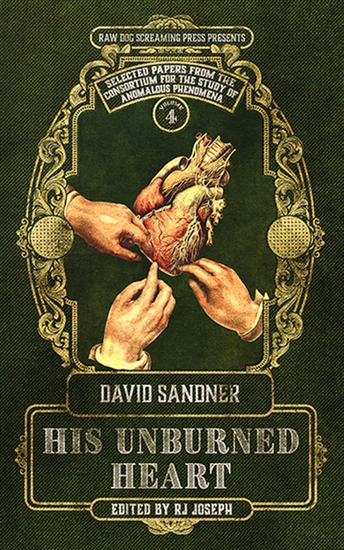
His Unburned Heart - cover

His Unburned Heart

David Sandner

Publisher: Raw Dog Screaming Press

  • 0
  • 0
  • 0

Summary

His Unburned Heart tells the story of Mary Shelley’s quest to retrieve her husband’s heart from his publisher. History tells us that Percy Shelley was cremated, though his heart failed to burn, but the rest of the details are lost to time. Sandner has channeled Mary Shelley herself to share the story with us. That story is paired here with a second, related, piece. The Journal of Sorrow is named after Mary Shelley’s personal journal, and imagines Percy Shelley’s demise.
 
“Sandner presents a tender examination on the nature of grief as a literary icon speculates on her lover's demise and the strange effort to recover the last physical remnant of her dead poet. Compelling and very moving prose.” --Tim McGregor, author of Wasps in the Ice Cream and Eynhallow
Available since: 05/09/2024.
Print length: 94 pages.

Other books that might interest you

  • Evening Guest An - From their pens to your ears genius in every story - cover

    Evening Guest An - From their...

    Alexander Kuprin

    • 0
    • 0
    • 0
    Alexander Kuprin was born in Narovchat, Penza in Russia on 7th September 1870. 
    At 3 his Father died and he and mother moved to Moscow. By 10 he was enrolled at the Second Moscow Military High School and there his interest in literature began. The Alexander Military Academy followed and two years later he was a sub-lieutenant and posted to an Infantry Regiment for a further four years. 
    Despite his duties he was a now a keen writer and published his first short story at this time. His military duties also garnered him experiences for his breakthrough work ‘The Duel’.  Leaving the military he left for Kiev to work for local newspapers.  He continued to publish both stories and novels and by 1901 he was in St Petersburg becoming part of a group that included Chekhov, Ivan Bunin, Maxim Gorky and Leonid Andreyev.  
    In the years that followed further controversial works and acclaim followed.  His comments on the regime meant he was also put under secret police surveillance.   
    As World War I erupted, Kuprin opened a military hospital but was then given command of an infantry company in Finland. He was soon discharged on grounds of ill health.  
    The October Revolution saw him praise Lenin, but he warned that the Bolsheviks threatened Russian culture and might cause further widespread suffering to the peasants.  As Civil War raged he took his family to Helsinki and then on to Paris. 
    Exile saw his talents decline further and his succumbing to alcoholism. He became lonely and withdrawn. The family's poverty increased his malaise.   
    In May 1937, the Kuprin’s returned to Moscow.  He now saw his work published but wrote almost nothing new.  In 1938 his health rapidly deteriorated.  Already suffering from a kidney problems and sclerosis, he had now developed cancer of the oesophagus.  
    Alexander Kuprin died on 25th August 1938.
    Show book
  • The Double - cover

    The Double

    Fyodor Dostoyevsky

    • 0
    • 0
    • 0
    The Double was published in 1846. A classic of doppelgänger literature, it is conidered one of Dostoyvesky's most significant shorter works.
    
    Our protagonist, Golyadkin senior, is persecuted by his double, Golyadkin junior, who resembles him closely in almost every detail. The latter abuses the former with mounting scorn and brutality as the tale proceeds toward its frightening denouement.
    Fyodor Dostoyevsky was a Russian novelist, journalist, and short-story writer who had an immense influence on 20th-century fiction. He is commonly regarded as one of the finest novelists who ever lived, penning classics that include: Crime and Punishment, The Idiot, Demons, and The Brothers Karamazov. His ideas profoundly shaped literary modernism, existentialism, and various schools of psychology, theology, and literary criticism.
    Show book
  • The Phantom of the Opera - cover

    The Phantom of the Opera

    Gaston Leroux

    • 1
    • 0
    • 0
    A voice in the darkness. A masked genius in the shadows. A love twisted into obsession.
    Deep beneath the Paris Opera House, a brilliant but tormented figure watches from the catacombs—teaching, manipulating, and haunting the young soprano Christine Daaé. As his passion grows and his jealousy turns dangerous, the opera becomes a stage for secrets, deception, and a terrifying ultimatum that threatens everyone above.
    
    Praised as "one of the most captivating gothic mysteries ever written," Gaston Leroux's classic blends romance, suspense, and haunting atmosphere into a story that has enthralled readers for over a century. Its unforgettable characters and emotional tension continue to inspire countless adaptations.
    
    If you crave dark romance, dramatic twists, and a mystery wrapped in music and shadow, this timeless novel will hold you spellbound.
    
    Open the book—and descend into the labyrinth where beauty meets terror.
    Show book
  • Dracula - cover

    Dracula

    Bram Stoker

    • 0
    • 0
    • 0
    "I could feel the soft, shivering touch of the lips on the super-sensitive skin of my throat and the hard dents of two sharp teeth, just touching and pausing there. I closed my eyes in a languorous ecstasy and waited waited with beating heart." 
    In equal measures mesmerizing as it is diabolical, Dracula, told in epistolary format, is the story of Count Dracula and his attempt to move from Transylvania to England and the battle between him and a small team of people led by Professor Abraham Van Helsing.
    Show book
  • Les Misérables: Volume 5: Jean Valjean - Book 3: Mud But the Soul (Unabridged) - cover

    Les Misérables: Volume 5: Jean...

    Victor Hugo

    • 0
    • 0
    • 0
    Victor-Marie Hugo (26 February 1802 - 22 May 1885) was a French poet, novelist, essayist, playwright, and dramatist of the Romantic movement. During a literary career that spanned more than sixty years, he wrote abundantly in an exceptional variety of genres: lyrics, satires, epics, philosophical poems, epigrams, novels, history, critical essays, political speeches, funeral orations, diaries, and letters public and private, as well as dramas in verse and prose.
    BOOK 3: MUD BUT THE SOUL: The transition was an unheard-of one. In the very heart of the city, Jean Valjean had escaped from the city, and, in the twinkling of an eye, in the time required to lift the cover and to replace it, he had passed from broad daylight to complete obscurity, from midday to midnight, from tumult to silence, from the whirlwind of thunders to the stagnation of the tomb, and, by a vicissitude far more tremendous even than that of the Rue Polonceau, from the most extreme peril to the most absolute obscurity.
    Show book
  • The Nightingale And the Rose - cover

    The Nightingale And the Rose

    Oscar Wilde

    • 0
    • 2
    • 0
    A nightingale finds a young romantic student in tears because he cannot find a red rose for his beautiful ball partner. There are no red roses in the garden. The nightingale visits all the rose-trees in the area, and one of the roses tells her there is a way to produce a red rose, but only if the nightingale is prepared to sing the sweetest song for the rose all night with her heart pressing into a thorn, sacrificing her life. Seeing the student in tears, and valuing his human life above her bird life, the nightingale carries out the ritual. Read in English by Josh Verbae, unabridged.
    Show book