Join us on a literary world trip!
Add this book to bookshelf
Grey
Write a new comment Default profile 50px
Grey
Subscribe to read the full book or read the first pages for free!
All characters reduced
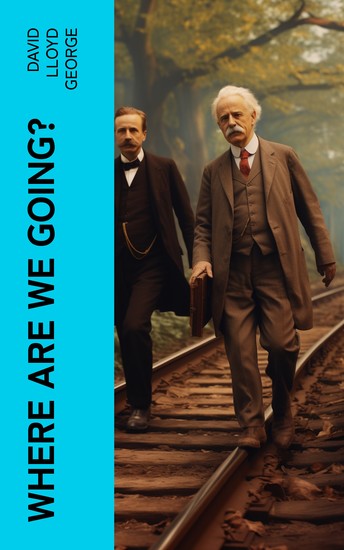
Where Are We Going? - cover

Where Are We Going?

David Lloyd George

Publisher: e-artnow

  • 0
  • 0
  • 0

Summary

"Where Are We Going?" is an astonishing, historically prescient memoir by British Prime Minister David Lloyd George, written after the death of American President Woodrow Wilson. In the memoir, Lloyd George is looking ahead to the political future of Europe. Based on the taunting advance of technology on all fronts, he predicts WW II. It is similar to his other work, "Is It Peace?" The book was written with the help and advice of the great British playwright George Bernard Shaw.
Available since: 12/12/2023.
Print length: 177 pages.

Other books that might interest you

  • The Elements of Style - cover

    The Elements of Style

    William Strunk Jr.

    • 0
    • 0
    • 0
    "Make every word tell."
    
    William Strunk Jr. had one mission: to kill bad writing at the source. The original Elements of Style is a concentrate of linguistic discipline. It does not suggest; it commands. Strunk provides eight elementary rules of usage and ten principles of composition that remain the "Golden Rules" for anyone who wants to be understood. From his fierce defense of the active voice to his legendary insistence on brevity, Strunk's original text is a masterclass in literary efficiency. This is the book that taught a generation of writers that to be "vigorous," one must be "concise."
    
    The Rules of Usage: Strunk tackles the mechanics of English with surgical precision. He settles the placement of the possessive apostrophe, the use of the serial comma, and the proper handling of the dash. These are the non-negotiables of the English language, presented in a format that can be memorized in a single afternoon.
    
    The Philosophy of the Active Voice: "The active voice is usually more direct and vigorous than the passive." This single observation revolutionized modern communication. Strunk demonstrates how shifting the subject of a sentence can breathe life into stagnant text, turning a dull report into a compelling narrative.
    
    Why It Is a Timeless Tool: The 1918 original is preferred by purists for its brevity and its unapologetic "tough love" approach to the English language. It is the perfect desk companion for students, editors, and professionals who want to strip away the fluff and communicate with maximum impact.
    
    Master the architecture of the sentence. Purchase the original "Elements of Style" today.
    Show book
  • Jugurthine War The: The History of the Roman Republic’s Controversial Conflict with the Numidians - cover

    Jugurthine War The: The History...

    Editors Charles River

    • 0
    • 0
    • 0
    Before the Numidians were conquered by the Romans and Numidia was officially made part of Roman Africa, they developed a culture that was as sophisticated and unique as any in the ancient world. The Numidians were a Berber people who emerged from the edge of the desert in the late 2nd millennium BCE, and despite the harshness of their environment (or perhaps because of it), they eventually became the most powerful people in North Africa. The Numidians found success on the backs of horses, which they rode to countless military victories, and when they could not defeat their enemies with conventional tactics, they were not afraid to resort to asymmetrical warfare.  
    	The most famous conflict with the Romans was the Jugurthine War, even though the Romans do not appear to have officially declared war on Numidia. The Romans entered Numidia determined to defeat Jugurtha and his Numidian army in a very conventional way, but having fought alongside and against the Numidians in the Punic Wars, the Romans should have known better, as Jugurtha knew that he had little chance of defeating the Romans in head-to-head combat. Numidia was rich, but it was not as rich as Rome in resources or people, and although the Numidian military was among the best in the Mediterranean at the time, it was not equipped to defeat the Romans.  
    	The most significant aspect of the Jugurthine War was the rivalry that it produced between Marius and Sulla. As was tradition, the commander, Marius, received the credit for the victory, but Sulla resented that his own part was downplayed, in particular his personal success in taking Jugurtha into custody. Sulla had a celebratory ring made to commemorate the event, and he, and the aristocratic faction that supported him, did all they could to enhance the role he had played while minimizing that of Marius.
    Show book
  • The Mythology of Atlantis - Searching for the Lost Civilization - cover

    The Mythology of Atlantis -...

    Odessa Nightshade

    • 0
    • 0
    • 0
    The legend of Atlantis has fascinated historians, philosophers, and adventurers for centuries. First described by the ancient Greek philosopher Plato, Atlantis was said to be a powerful and advanced civilization that mysteriously vanished beneath the sea. Despite being written over 2,000 years ago, Plato’s account continues to inspire countless theories, books, and even modern expeditions in search of this lost world. But was Atlantis ever real, or was it simply a metaphor for human folly? Understanding the origins of this myth is crucial to separating historical possibility from pure fantasy.  
      
    Plato’s dialogues, Timaeus* and *Critias, provide the earliest known description of Atlantis. According to him, the island was a technologically superior and wealthy society that existed around 9,000 years before his time. It was said to be located beyond the "Pillars of Hercules," now known as the Strait of Gibraltar. However, due to the moral corruption of its people, the gods allegedly punished Atlantis by submerging it beneath the waves. This dramatic tale has led to endless speculation about whether Plato based it on real events or simply crafted it as an allegory about the dangers of hubris and imperial overreach.  
      
    Interestingly, Atlantis is not the only story of a lost civilization. Cultures around the world have myths of great lands that disappeared under the ocean. In Hindu mythology, the ancient city of Dwarka was said to have been swallowed by the sea. The biblical tale of the Great Flood and even the legends of Lemuria and Mu suggest a shared human fascination with lost worlds. Some researchers argue that these stories could be echoes of real historical disasters, such as the sudden sinking of landmasses due to earthquakes, tsunamis, or rising sea levels. Could Atlantis be another version of these global flood myths? 
    Show book
  • The Russian FSB - A Concise History of the Federal Security Service - cover

    The Russian FSB - A Concise...

    Kevin P. Riehle

    • 0
    • 0
    • 0
    Since its founding in 1995, the FSB, Russia's Federal Security Service, has regained the majority of the domestic security functions of the Soviet-era KGB. Under Vladimir Putin, who served as FSB director just before becoming president, the agency has grown to be one of the most powerful and favored organizations in Russia. The FSB not only conducts internal security but also has primacy in intelligence operations in former Soviet states. Their activities include anti-dissident operations at home and abroad, counterintelligence, counterterrorism, criminal investigations of crimes against the state, and guarding Russia's borders. 


    In The Russian FSB, Kevin P. Riehle provides a brief history of the FSB's origins, placed within the context of Russian history, the government's power structure, and Russia's wider culture. He describes how the FSB's mindset and priorities show continuities from the tsarist regimes and the Soviet era. The book's chapters analyze origins, organizational structure, missions, leaders, international partners, and cultural representations such as the FSB in film and television. 


    Based on both English and Russian sources, this book is a well-researched introduction to understanding the FSB and its central role in Putin's Russia.
    Show book
  • Emotional Intelligence - Mastering the Skills of Self-Awareness Empathy and Relationship Management - cover

    Emotional Intelligence -...

    May Francis

    • 0
    • 0
    • 0
    Emotional Intelligence is a groundbreaking book that explores the concept of emotional intelligence and how it can be used to improve relationships, communication, and overall success in life.  
    This book delves into the key components of emotional intelligence, including self-awareness, empathy, and relationship management.  
    Through a combination of research, real-life examples, and practical exercises, readers will learn how to develop and enhance their emotional intelligence, leading to better relationships, more effective communication, and greater success in both their personal and professional lives.  
    Whether you are looking to improve your relationships with friends and family, excel in your career, or simply become a more well-rounded individual, Emotional Intelligence is the perfect guide to help you achieve your goals.
    Show book
  • Erich Hartmann: The Life and Legacy of the Luftwaffe’s Top Fighter Ace during World War II - cover

    Erich Hartmann: The Life and...

    Editors Charles River

    • 0
    • 0
    • 0
    The Third Reich's Luftwaffe began World War II with significant advantages over other European air forces, playing a critical role in the German war machine's swift, powerful advance. By war's end, however, the Luftwaffe had been decimated by combat losses and crippled by poor decisions at the highest levels of military decision-making, and it proved unable to challenge Allied air superiority despite a last-minute upsurge in German aircraft production. 
    Few people personified the advancements and abilities of the Luftwaffe like Erich Hartmann, the most successful ace in the history of warfare. His records are made all the more remarkable by the fact that he came late to the Second World War. It had already been underway for more than three years when, on October 14, 1942, at the furthest extremity of Germany’s advance into Russia, he strapped himself into the cockpit of his Messerschmitt 109 for his first combat mission. Born in April 1922, he was still just 20, but he was certainly prepared and ready. He had been flying gliders since his early teens - including as a glider instructor with the Hitler Youth - and he received a pilot’s license for powered aircraft in 1937.  
    Over the course of the war, Hartmann was credited with shooting down 352 enemy aircraft, 345 of which were Russian and seven being American, making him the most successful combat fighter of all time. In fact, the number is so incredible that it has inevitably come under intense criticism and scrutiny over the years, with some suggesting outright that the figure is falsified, while others have pointed to the unique combat circumstances of the Russian front and suggested that aerial combat there was somehow easier.
    Show book