Join us on a literary world trip!
Add this book to bookshelf
Grey
Write a new comment Default profile 50px
Grey
Subscribe to read the full book or read the first pages for free!
All characters reduced
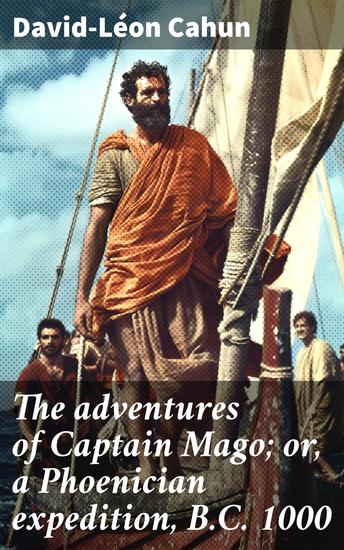
The adventures of Captain Mago; or a Phoenician expedition BC 1000 - Voyages of Ancient Seas: A Phoenician Saga - cover

The adventures of Captain Mago; or a Phoenician expedition BC 1000 - Voyages of Ancient Seas: A Phoenician Saga

David-Léon Cahun

Translator Ellen Elizabeth Frewer

Publisher: Good Press

  • 0
  • 0
  • 0

Summary

In "The Adventures of Captain Mago; or, a Phoenician Expedition, B.C. 1000," David-Léon Cahun weaves a captivating narrative set against the backdrop of ancient maritime exploration. Through a rich tapestry of vivid descriptions and imaginative storytelling, Cahun delves into the world of the Phoenicians, blending historical facts with his own creative insights. The literary style is marked by its adventurous tone and a keen sense of the historical context, inviting readers to voyage alongside Captain Mago as he navigates the waters of the Mediterranean, uncovering new lands and cultures. This work not only entertains but also serves as a reflection on the spirit of exploration that defined the Phoenician civilization. David-Léon Cahun, a prominent figure in 19th-century French literature, was deeply influenced by his passion for history and archaeology. His scholarly pursuits extended beyond mere storytelling; he sought to illuminate the past and revive forgotten narratives that shaped humanity's voyage. Cahun's fascination with the Phoenicians, known for their seafaring prowess, is evident in this work, which merges his historical knowledge with a flair for adventure, echoing the curiosity of his own time. I wholeheartedly recommend "The Adventures of Captain Mago" to both history enthusiasts and lovers of adventure literature. Cahun's ability to transport readers to a bygone era, coupled with his engaging prose, makes this book a compelling addition to any literary collection. Whether you seek to understand the legacy of the Phoenicians or simply wish to partake in an exciting journey through ancient waters, this novel is sure to enrich your reading experience.
Available since: 10/12/2023.
Print length: 301 pages.

Other books that might interest you

  • Big Two-Hearted River - The Centennial Edition - cover

    Big Two-Hearted River - The...

    Ernest Hemingway

    • 0
    • 0
    • 0
    Ernest Hemingway’s landmark short story of a veteran’s solo fishing trip in Michigan’s rugged Upper Peninsula, featuring a revelatory foreword by John N. Maclean. 
    “A century since its publication in the collection In Our Time, “Big Two-Hearted River” has helped shape language and literature in America and across the globe, and its magnetic pull continues to draw readers, writers, and critics. The story is the best early example of Ernest Hemingway’s now-familiar writing style: short sentences, punchy nouns and verbs, few adjectives and adverbs, and a seductive cadence. Easy to imitate, difficult to match. The subject matter of the story has inspired generations of writers to believe that fly fishing can be literature. More than any of his stories, it depends on his ‘iceberg theory’ of literature, the notion that leaving essential parts of a story unsaid, the underwater portion of the iceberg, adds to its power. Taken in context with his other work, it marks Hemingway’s passage from boyish writer to accomplished author: nothing big came before it, novels and stories poured out after it.” —from the foreword by John N. Maclean
    Show book
  • The Woman Who Rode Away - cover

    The Woman Who Rode Away

    D H Lawrence

    • 0
    • 0
    • 0
    ‘The Woman Who Rode Away’ is a dark, troubling story set in the wilderness of South America. What makes this story compelling is that the woman is at the end of her personal tether and the Indians are at the end of their cultural one, They seek one another out for terrible but perhaps predictable uses. Each of them looks to the other for "salvation" in a way that expresses the desperation and futility of their situation.
    Show book
  • Occurrence at Owl Creek Bridge An - cover

    Occurrence at Owl Creek Bridge An

    Ambrose Bierce

    • 0
    • 0
    • 0
    An Occurrence at Owl Creek Bridge by Ambrose Bierce is a gripping short story that masterfully blends psychological suspense with the brutal realities of war. Set during the American Civil War, the narrative follows Peyton Farquhar, a Southern planter condemned to hang from a railroad bridge for attempting to sabotage Union forces. As the noose tightens, Farquhar experiences a vivid and surreal escape that blurs the line between illusion and reality. Bierce’s haunting prose and twist ending make this tale a classic of American literature, renowned for its exploration of time, perception, and the cruel ironies of fate.
    Show book
  • Whimsical Wonders - 50 Tales of Fictional Fun - cover

    Whimsical Wonders - 50 Tales of...

    Derick Chibilu

    • 0
    • 0
    • 0
    Whimsical Wonders: 50 Tales of Fictional Fun is a delightful collection of stories that will capture your imagination and transport you to a world of whimsy and wonder. These stories are a product of the creative mind of Mr. Derick Chibilu, a lover of fun and fanciful tales. 
    Whether you're a child or an adult, you'll find something to love in this collection. The stories are crafted to be engaging, entertaining, and imaginative, providing a much-needed escape from the stresses of everyday life. 
    Mr. Chibilu has poured his heart and soul into creating these tales, and it shows in the quality of the writing. Each story is unique and original, with colorful characters, surprising plot twists, and a healthy dose of humor. From talking animals to enchanted forests, from brave heroes to mischievous fairies, these stories will captivate your imagination and leave you wanting more. 
    This collection is perfect for reading on the go - whether you're on a long flight, waiting at the doctor's office, or taking a break from the hustle and bustle of daily life. The stories are also ideal for bedtime reading, as they are suitable for all ages and will inspire sweet dreams and playful imaginations. 
    If you're looking for a collection of fun and lighthearted stories that will make you smile, Whimsical Wonders: 50 Tales of Fictional Fun is the book for you. So why not pick up a copy today and join Mr. Chibilu on a journey through his imaginative world of whimsy and wonder? You won't be disappointed!
    Show book
  • Ink and Daggers - cover

    Ink and Daggers

    George Pelecanos, Lavie Tidhar,...

    • 0
    • 0
    • 0
    An enthralling anthology of 20 CWA Dagger Award-shortlisted gripping and thrilling stories for the most hardened crime fan. 
     
    Featuring bestselling authors such as Neil Gaiman, Ann Cleeves, Christopher Fowler and Val McDermid. 
     
    OVER TWENTY CWA DAGGER AWARD-WINNING SHORT STORIES FROM THE BEST OF THE BEST IN CRIME FICTION 
     
    Legendary editor, Maxim Jakubowski, delivers another chilling anthology collecting stories of cold-blooded murder, revenge and crimes-gone-wrong from the best of the best in crime fiction. Spine-chilling and gripping, these tales will grip you with their devious narrators and crafty twists. 
     
    Featuring classic stories from Neil Gaiman, Ann Cleeves, Christopher Fowler, Val McDermid, Lavie Tidhar, Chris Simms, Christine Poulson, James Sallis, Victoria Selman, Conrad Williams, Stuart Neville, George Pelecanos, Simon Brett, John Lawton, Ken Bruen, Mickey Spillane & Max Allan Collins, Peter Robinson, Martyn Waites and Kevin Wignall.
    Show book
  • Alexander Pushkin - A Short Story Collection - Born in Moscow with African roots Pushkin is considered by many to be the founder of modern Russian literature - cover

    Alexander Pushkin - A Short...

    Alexander Pushkin

    • 0
    • 0
    • 0
    Alexander Sergeyevich Pushkin was born on 26th May 1799 in Moscow into a family of Russian nobility. 
     
    Raised by nursemaids and French tutors in French he learnt Russian only via the household staff. 
     
    He graduated from the prestigious Imperial Lyceum, near St Petersburg and plunged into the vibrant and raucous intellectual youth culture of what was then the capital of the Russian Empire.  
     
    In 1820, he published his first long poem, ‘Ruslan and Ludmila’, with much controversy about both subject and style.  Pushkin was heavily influenced by the French Enlightenment and gravitated, with other literary radicals, towards social reform angering the Government. 
     
    His early literary work and reputation was poetic and written as he travelled around the Empire or engaged himself in various rebellions against the Ottoman Empire.  A clash with his own government after his poem, ‘Ode to Liberty’, was found among the belongings of the Decembrist Uprising rebels meant two years of internal exile at his mother's rural estate.  His friends and family continually petitioned for his release, sending letters and meeting with Tsar Alexander I and then Tsar Nicholas I.   
     
    In 1825, whilst at his Mother’s estate, Pushkin wrote his most famous play, the drama ‘Boris Godunov’.  
     
    Upon meeting with Tsar Nicholas I, Pushkin obtained his release and began work as the Tsar's Titular Counsel of the National Archives.  However, because of the earlier problems the tsar retained control of everything Pushkin published, and he was banned from travelling at will. 
     
    Around 1828, Pushkin met the 16-year-old Natalia Goncharova, one of the most talked-about beauties of Moscow.  After much hesitation, Natalia accepted his marriage proposal after she received assurances that the government had no intentions to persecute the libertarian poet.  When the Tsar gave Pushkin the lowest court title, Gentleman of the Chamber, he became enraged, feeling that the Tsar intended to humiliate him. 
     
    In the year 1831, during Pushkin's growing literary influence, he met Nikolai Gogol.  Recognising his gifts Pushkin supported him and published his short stories in his own magazine ‘The Contemporary’. 
     
    By the autumn of 1836, Pushkin was falling into greater and greater debt and facing scandalous rumours that his wife was having an affair.  
     
    In January 1837, Pushkin sent a ‘highly insulting letter’ to his wife’s pursuer, Georges-Charles de Heeckeren d'Anthès.  The only answer could be a challenge to a duel. 
     
    It took place on 27th January.  D'Anthès fired first, critically wounding Pushkin; the bullet entered at his hip and penetrated his abdomen.  Two days later Alexander Pushkin died of peritonitis.  He was 37. 
     
    1 - Alexander Pushkin - A Short Story Collection - An Introduction 
    2 - The Queen of Spades by Alexander Pushkin 
    3 - The Blizzard by Alexander Pushkin 
    4 - The Stationmaster by Alexander Pushkin 
    5 - The Shot by Alexander Pushkin 
    6 - The Coffin Maker by Alexander Pushkin 
     -  
     -  
     -  
    1 - Cornwall - A Short Story Collection - An Introduction 
    2 - Malachi's Cove by Anthony Trollope 
    3 - Ligeia by Edgar Allan Poe 
    4 - The Screaming Skull by F Marion Crawford 
    5 - The Haunted Church by Frederick Cowles 
    6 - The Limping Ghost by Frederick Cowles 
    7 - In the Mist by Mary E Penn 
    8 - The Botathen Ghost from Footprints of Former Men in Far Cornwall by the Reverend R S Hawker 
    9 - Room For One by Frederick Cowles 
    10 - Colonel Benyon's Entanglement by Mary Elizabeth Braddon 
    11 - Christmas Eve at a Cornish Manor House by Clara Venn
    Show book