Join us on a literary world trip!
Add this book to bookshelf
Grey
Write a new comment Default profile 50px
Grey
Subscribe to read the full book or read the first pages for free!
All characters reduced
An Enquiry Concerning the Principles of Morals - cover

An Enquiry Concerning the Principles of Morals

David Hume

Publisher: DigiCat

  • 0
  • 0
  • 0

Summary

In "An Enquiry Concerning the Principles of Morals," David Hume presents a seminal exploration of moral philosophy grounded in empiricism and human sentiment. This work marks a significant development from his earlier writings, such as "A Treatise of Human Nature," where Hume meticulously dissects human emotions and their influence on our ethical judgments. Through a nuanced and elegant prose style, Hume argues that morality is rooted in the impressions of human experience and that reason serves merely as a slave to our passions. Engaging with the philosophical context of the Enlightenment, Hume distinguishes between the moral and the natural sciences, emphasizing the subjective nature of moral evaluations while still acknowledging their universal applicability across cultures. David Hume (1711–1776), a pivotal figure in the Scottish Enlightenment, was deeply influenced by the sceptical traditions of Descartes and Locke, as well as by the burgeoning empirical approaches to knowledge. His philosophical inquiries were often prompted by his dissatisfaction with the rationalism of his time, leading him to explore how feelings and sociability inform our moral frameworks. The social context of 18th-century Europe, marked by shifting paradigms of thought, significantly influenced Hume's quest to establish a more grounded and human-centered moral philosophy. "An Enquiry Concerning the Principles of Morals" is essential reading for anyone interested in ethics, philosophy, and the foundations of moral reasoning. Hume's insights into the interplay between emotion and reason in moral judgments not only challenge traditional views but also form the basis for contemporary discussions in moral philosophy. This work invites readers to reflect on their own moral principles and the human experiences that shape them, making it a timeless contribution to philosophical literature.
Available since: 09/15/2022.
Print length: 201 pages.

Other books that might interest you

  • Mahatma Gandhi - The Most Famous Political Activist of India - cover

    Mahatma Gandhi - The Most Famous...

    Kelly Mass

    • 0
    • 0
    • 0
    Mohandas Karamchand Gandhi was an Indian attorney, anti-colonial patriot, and political ethicist who used nonviolent resistance to lead the triumphant struggle for India's independence from British rule, motivating civil liberties and liberty movements around the globe. The epithet Mahtm (which means "great-souled" or "age-old" in Sanskrit) was at first appointed to him in South Africa in the year 1914 and is now used all across the world. 
    Gandhi was born into a Hindu family in seaside Gujarat and studied law at the Inner Temple in London. 
    In the year 1893, he came to South Africa to represent an Indian business owner in a case after 2 years in India, where he was not able to establish a rewarding law practice. 
    He spent the next 21 years of his life in South Africa. Gandhi raised his family here and was the first to use nonviolent resistance in a civil liberties struggle. 
    He went back to India in the year 1915, at the age of 45. He started setting in motion peasants, farmers, and city workers to fight oppression and high land taxes. Gandhi led statewide projects to reduce poverty, promote women's rights, build spiritual and ethnic amity, get rid of untouchability, and, above all, accomplish swaraj, or self-rule, after presuming management of the Indian National Congress in the year 1921. 
    Gandhi has meant much for the peace, the independence, and the culture of India, as well as his acts of non-violent resistance that have influenced the world. Let’s take a look at what else he did.
    Show book
  • Tribes of the Americas - A Comprehensive Look at Native American Culture - cover

    Tribes of the Americas - A...

    Days of History

    • 0
    • 0
    • 0
    Prepare to embark on a captivating journey through the rich and diverse heritage of the indigenous peoples of America!  
    This book offers an enlightening and comprehensive account of the unique histories, cultures, and contributions of Native Americans throughout time. 
    As you delve into this fascinating exploration, you'll discover the incredible stories and legacies that have shaped the world we know today. This book promises to captivate and educate, leaving you with a newfound appreciation for the resilience and cleverness of these incredible people. 
    Key features of the book include: 
    • An in-depth and immersive narrative that spans centuries: From the earliest indigenous societies to modern-day Native American communities, this book offers a sweeping account of the evolution of indigenous cultures, traditions, and ways of life. 
    • A celebration of the richness and diversity of Native American heritage: Through detailed accounts of customs, beliefs, and artistic expressions, our book showcases the unparalleled beauty and complexity of these ancient civilizations. 
    • Fascinating insights into the lives of famous Native American figures: Learn about the influential leaders, warriors, and visionaries who have left an indelible mark on history and helped shape the course of events in America and beyond. 
    Don't miss out on this enlightening and inspiring journey through the rich heritage and culture of indigenous peoples! Secure your copy today, and begin an unforgettable adventure that will transport you through time and unveil the incredible stories of the first Americans.
    Show book
  • Colony of Virginia The: The History of the British Empire’s Largest Colony Before the American Revolution - cover

    Colony of Virginia The: The...

    Editors Charles River

    • 0
    • 0
    • 0
    Nearly 20 years before Jamestown was settled, the English established one of the earliest colonies in North America around the Chesapeake Bay region, until the colony had over 100 inhabitants. Like other early settlements, Roanoke struggled to survive in its infancy, to the extent that the colony’s leader, John White, sailed back to England in 1587 in an effort to bring more supplies and help. However, the attempts to bring back supplies were thwarted by the Spanish in the midst of the Anglo-Spanish War going on at the time, and it was not until 1590 that White reached Roanoke again.  
    What White found when he came back to Roanoke led to one of the most enduring mysteries in American history. Despite the fact he had left over 100 people in Roanoke in 1587, White returned to literally nothing, with all traces of the settlement gone and no evidence of fighting or anything else that might have explained the disappearance of the inhabitants. The fate of Roanoke has fascinated people for over 400 years, and there is no shortage of theories regarding the disappearance of the colony. In addition to the possibility that the settlers moved to Croatoan Island, most theories speculate that they were either wiped out by nearby Native Americans or assimilated among a tribe. 
    Jamestown is remembered today because the settlement did survive through the hardships and go on to serve as the capital of the English colony for much of the 17th century. At the same time, one of the biggest reasons for its survival and fame today can be attributed to the local Native Americans, particularly Pocahontas, who has added both a human and romanticized, mythological element to Jamestown. She was the daughter of the paramount chief (mamanatowick) Powhatan, leader of an Algonquian-speaking native group in eastern Virginia.
    Show book
  • Critical Thinking - How to Overcome Negativity Control your Thoughts Stop Overthinking and Shift your Focus into Positive Thinking The Art and Magic of Mastering the Problems of Everyday Living - cover

    Critical Thinking - How to...

    Sebastian J. Smith

    • 0
    • 0
    • 0
    Unlock the power of your mind with this transformative audiobook, designed to help you master critical thinking and overcome the challenges of daily life. If you're struggling with negativity, overthinking, or feeling stuck in a cycle of unproductive thoughts, this audiobook offers practical strategies to regain control and shift your mindset. 
    Learn how to:Overcome negativity and replace limiting thoughts with positive alternatives.Control your thoughts to cultivate a mindset that empowers you to take action.Stop overthinking by developing mental clarity and focusing on solutions.Shift your focus into positive thinking, enhancing your overall outlook on life and your ability to tackle challenges with confidence. 
    With insights into the art and magic of mastering the mental blocks that hold you back, this audiobook provides actionable techniques that can be applied to any situation. Whether you're looking to improve your personal life, professional career, or overall mental well-being, this audiobook will equip you with the tools to navigate the complexities of everyday living with ease and positivity. 
    Take the first step towards mastering your thoughts and achieving lasting change today!
    Show book
  • Tricksters and Heroes - Legends of Mischief and Valor (3 in 1) - cover

    Tricksters and Heroes - Legends...

    Odessa Nightshade

    • 0
    • 0
    • 0
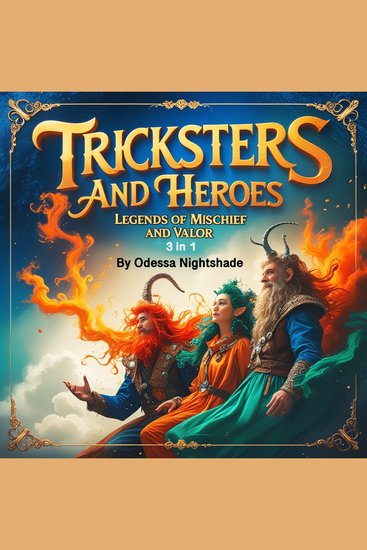
    This collection brings together three powerful narratives from diverse cultures, each telling stories of cleverness, bravery, and the battle between good and evil. 
    The first story takes you through the myths of The Trickster Gods, devious and mischievous deities who use wit and cunning to challenge the status quo. Often playing pranks on gods and humans alike, these figures represent chaos and creativity, teaching important lessons about the consequences of trickery and the unpredictable nature of life. From the Norse Loki to the African Anansi, these tricksters serve as both villains and saviors, weaving their own kind of order out of disorder. 
    Next, venture into The Heroes of Myth, timeless figures whose valor and determination have inspired generations. These legendary warriors—like Hercules, Achilles, and Perseus—embody the ideals of courage, honor, and the willingness to face great challenges for the greater good. Their stories, filled with monsters, gods, and impossible feats, have shaped the way we view heroism and sacrifice across cultures and time periods. 
    Finally, explore Native American Legends, a rich tapestry of stories passed down through generations of indigenous peoples. These legends highlight the deep connection between humans, nature, and the spiritual world. From powerful tricksters like Coyote to brave heroes who protect their communities, these myths are filled with wisdom, moral lessons, and reflections on the balance between the material and spiritual realms. 
    Tricksters and Heroes invites readers to embrace the complexity of human nature through the lens of mythology, where mischief, valor, and everything in between reveal truths about the world we live in.
    Show book
  • History of Ukraine - The Country’s Origin Conflicts Holodomor Soviet Era and More - cover

    History of Ukraine - The...

    Kelly Mass

    • 0
    • 0
    • 0
    The early history of the territory now known as Ukraine is marked by a series of ancient cultures and civilizations that shaped the region's development before and during the Dark Ages. The area was initially inhabited by the Dacians, a group known for their connections to the wider Thracian culture, alongside various nomadic tribes such as the Cimmerians, Scythians, and Sarmatians. These peoples made significant contributions to the cultural and political landscape of Eastern Europe during the Iron Age. 
    From around 750 BC to 250 BC, the Scythians established a powerful kingdom that extended its influence over much of the Eurasian steppes, including the territories of modern-day Ukraine. The Scythian kingdom is well-known for its unique art, horse-riding culture, and its role as a dominant force in the region. Meanwhile, Greek colonists founded several cities on the northern shores of the Black Sea during the 6th century BC, including Tyras, Olbia, and Hermonassa. These cities became important trading hubs and cultural centers, remaining under Roman and later Byzantine control until the 6th century AD.
    Show book