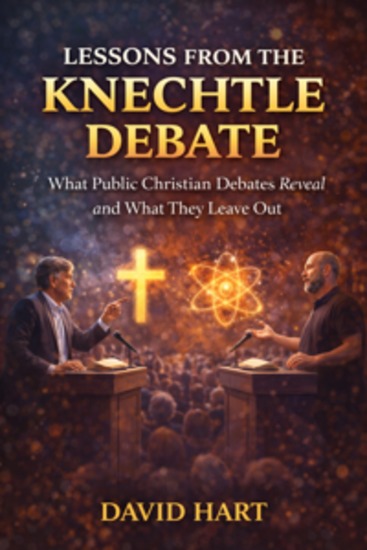
Lessons from the Knechtle Debate - What Public Christian Debates Reveal and What They Leave Out
David Hart
Publisher: David Hart
Summary
Christian debates today are loud, confident, and everywhere. From campus confrontations to viral online clips, arguments about Scripture, salvation, authority, and the Church are delivered in sharp sound bites that promise certainty and clarity. For many, these debates become the lens through which Christianity itself is understood. But what happens when complex faith is compressed into moments meant to win rather than to understand?Lessons from the Knechtle Debate steps back from the heat of modern Christian argument culture to examine the deeper questions beneath it. Rather than focusing on personalities or replaying exchanges, this book explores the theological foundations that repeatedly surface in contemporary debates. It asks why Scripture is treated the way it is, how authority is understood, what salvation truly means, and how the Church has historically lived and preserved the Christian faith.Through careful reflection on Scripture, early Christianity, church history, and theological development, the book reveals how many modern disagreements are not simply about doctrine, but about competing assumptions. Assumptions about certainty, simplicity, individual interpretation, and the role of history. It shows how debate culture shapes theology, often favoring confidence over depth and immediacy over continuity.Written in a clear, thoughtful, and engaging tone, this book is for readers who sense that something essential is missing from modern Christian arguments. It invites believers and seekers alike to slow down, look beyond slogans, and rediscover a faith that is not merely argued but lived. A faith rooted in history, shaped by community, and sustained by humility.This is not a call to abandon conviction, but to deepen it. Not a rejection of debate, but an invitation to move beyond it. Lessons from the Knechtle Debate offers a richer vision of Christianity, one that honors its past, wrestles honestly with its present, and points toward a more grounded and enduring future.
Available since: 12/23/2025.
Print length: 96 pages.