

Join us on a literary world trip!
Add this book to bookshelf
Grey
Write a new comment Default profile 50px
Grey
Subscribe to read the full book or read the first pages for free!
All characters reduced
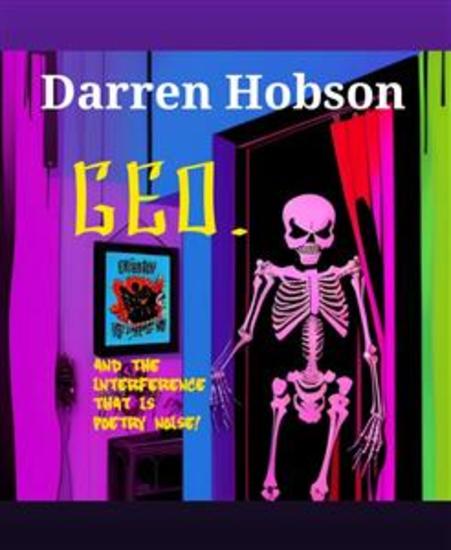
Geo - and the interference that is poetry noise - cover

Geo - and the interference that is poetry noise

Darren Hobson

Publisher: BookRix

  • 0
  • 0
  • 0

Summary

We live in complicated times all that we are and what we do is connected with everything that surrounds us, any action will cause a reaction and no matter how hard you try not to interfere in other people’s lives it is totally impossible to do so.This book is about consequences about a person who may or may not be fragile in the mind, how every action will push our subject to the extremes, opening deep wounds and manipulating his paranoid ways. It shows how a simple smile can push a person gently through the day without hindrance from the usual problems that we all face, yet on the other hand just a misplaced word could cast our subject into a whirlpool of despair that will make the next twenty hours hell.There is a chain reaction in every second that we breathe, a knock on effect that like a domino run will continue rippling into the future colliding with unsuspecting victims, this is the GEO in our lives as we are all anchored to this earth and we are all interacting lost souls.The poet continues to explore the dark regions of our lives bringing the cockroaches into the open but for all the bad news in-between the chaotic verses there will always be a little hidden silver lining waiting to be found.
Available since: 12/22/2023.
Print length: 35 pages.

Other books that might interest you

  • Tamerlane - cover

    Tamerlane

    Edgar Allan Poe

    • 0
    • 0
    • 0
    Tamerlane is part of Edgar Allan Poe's debut collection, showcasing his early poetic style, heavily influenced by Romantic poets like Lord Byron. The title poem, "Tamerlane," is a dramatic monologue by the historical conqueror, reflecting on his life of war and conquest.
    Show book
  • Harbinger - Poems - cover

    Harbinger - Poems

    Shelley Puhak

    • 0
    • 0
    • 0
     “The speaker in Shelley Puhak’s Harbinger is no closer to knowing herself than I am, than we are, which is why we trust her. Each similarly titled poem holds a triptych mirror up to the artist and, in so doing, up to us all, so we may better see ourselves as we are. In ever-changing form.” —Nicole Sealey  
    A stunning meditation on artistic creation and historical memory from the winner of the National Poetry Series, chosen by Nicole Sealey 
    From “Portrait of the artist, gaslit” to “Portrait of the artist’s ancestors” to “Portrait of the artist reading a newspaper,” the poems in Harbinger reflect the many facets of the artistic self as well as the myriad influences and experiences that contribute to that identity. 
    “Portrait of the artist as a young man” has long been the default position, but these poems carve out a different vantage point. Seen through the lens of motherhood, of working as a waitress, of watching election results come in, or of simply sitting in a waiting room, making art—and making an artist—is a process wherein historical events collide with lived experience, both deeply personal but also unfailingly political. When we make art, for what (and to whom) are we accountable? And what does art-making demand of us, especially as apocalypse looms? 
    With its surprising insights, Harbinger, the latest book from acclaimed poet Shelley Puhak, shows us the reality of the constantly evolving and unstable self, a portrait of the artist as fragmentary, impressionable, and always in flux. 
      
    Show book
  • The House Party - cover

    The House Party

    Laura Lomas

    • 0
    • 0
    • 0
    A wild party. A friendship. A cherished pet. And a night that changes everything.
    It's Julie's eighteenth birthday, and she's throwing a party in her father's extravagant townhouse. Her boyfriend has just dumped her and her long-suffering best friend Christine is trying to pick up the pieces. As the revellers pile into the booze, down in the kitchen Christine and her boyfriend Jon – son of Julie's cleaner – clear up and dare to dream of the future.
    But as the volume goes up and the shots go down, Julie concocts a twisted cocktail of privilege, desire and destruction.
    Laura Lomas's play The House Party spins Strindberg's classic play Miss Julie into intense, fizzing life for today's generation. It was first performed at the Minerva Theatre, Chichester, in 2024, co-produced with Headlong in association with Frantic Assembly, and directed by Holly Race Roughan.
    Show book
  • Poets on Poetry - The most artistic and creative form of writing we have a selection of poems from those artistic and creative minds about poetry itself - cover

    Poets on Poetry - The most...

    Matthew Arnold, Sarojini Naidu,...

    • 0
    • 0
    • 0
    Who has not tried to write a poem?  The poetic form of words seems to be rather easy.  In its basic form, which we learn as children, the rhyming couplet is, in a child’s written and spoken words, pure joy - success!  In the hands of a Shakespeare it is magnificent with a reach and understanding that the rest of us enjoy but are far from even attempting.    
     
    As we listen to various poetic forms, schools and movements we can only react with wonder at how these innocent words are assembled to create symphonies of ideas, wonder and revelation.  The emotions they seek to invoke can be anything from happiness to sadness, from love to revulsion. 
     
    Arnold, Stevens, Keats, Akhmatova, Browning, Herrick, Hood, Killigrew are but a few of the roll-call of wordsmiths who with mere words create ravenous beauty that reveals tender lines and sensitive verse on how and why they are who they are. 
     
    01 - Poets on Poetry - An Introduction 
    02 - When I Write Poems by Anna Akhmatova 
    03 - Of My Poems by Thomas MacDonagh 
    04 - An Apology For Her Poetry by Duchess of Newcastle, Margaret Cavendish 
    05 - Sonnet 76 - Why is My Verse So Barren of New Pride by William Shakespeare 
    06 - The Austerity of Poetry by Matthew Arnold 
    07 - Of Modern Poetry by Wallace Stevens 
    08 - Poetry by Claude McKay 
    09 - The Poetry of Keats by George Meredith 
    10 - Future Poetry by Alice Meynell 
    11 - Sonnet 17 - Who Will Believe My Verse in Time to Come by William Shakespeare 
    12 - Poetic Eggs by Ezra Pound 
    13 - Poem by William Carlos Williams 
    14 - On the Grasshopper and Cricket by John Keats 
    15 - Ode on the Poetical Character by William Collins 
    16 - Introduction and Conclusion of a Long Poem by Alan Seeger 
    17 - A True Account of the Birth and Conception of a Late Famous Poem by Charles Sackville, Earl Of Dorset 
    18 - The Poem That Took the Place of a Mountain by Wallace Stevens 
    19 - The Poet and the Poem by Elizabeth Stuart Phelps 
    20 - Of English Verse by Edmund Waller 
    21 - Love, The Soul of Poetry by Anne Killigrew 
    22 - Why, If All Poets Crown Their Love with Verse by Emily Hickey 
    23 - Verse Making Was the Least of My Virtues by Robert Browning 
    24 - The Poet's Love-Song by Sarojini Naidu 
    25 - A Letter to a Brother of the Pen in Tribulation by Aphra Behn 
    26 - Not Every Day Fit for Verse by Robert Herrick 
    27 - On the Poetic Muse by George Moses Horton 
    28 - Sonnet - Written in Keats by Thomas Hood 
    29 - Sonnet 86 -Was It the Proud Full Sail of His Great Verse by William Shakespeare 
    30 - Song in Imitation of Shakespeare by James Beattie 
    31 - The High-toned Old Christian Woman by Wallace Stevens 
    32 - Poetry is a Destructive Force by Wallace Stevens 
    33 - To My Most Dearly Loved Friend Henry Reynolds Esquire of Poets and Poesie by Michael Drayton 
    34 - His Poetry His Pillar by Robert Herrick 
    35 - To Live Merrily and to Trust to Good Verses by Robert Herrick 
    36 - Poem for the End by Ivor Gurney
    Show book
  • The Poetry of John Gould Fletcher - The first Southern poet to win the Pulitzer Prize - cover

    The Poetry of John Gould...

    John Gould Fletcher

    • 0
    • 0
    • 0
    John Gould Fletcher was born in Little Rock, Arkansas on the 3rd of January 1886 to a socially prominent family.  
     
    He was educated at Phillips Academy, Andover before advancing to Harvard University, which he attended from 1903 to 1907, before dropping out after his father's death. 
     
    As a young man Fletcher spent many years in England where he became part of the influential Imagist group of poets together with Amy Lowell and Ezra Pound.   
     
    His first marriage came from a resumed relationship with the now married Florence Emily ‘Daisy’ Arbuthnot.  Her adultery with Fletcher was the grounds for her divorce.  They married on 5th July 1916 but later divorced.  
     
    Fletcher first published in 1912, with ‘The Dominant City’ to much praise and admiration and followed this with other well-regarded volumes such as ‘Irradiations: Sand and Spray’, and ‘Goblins and Pagodas’. 
     
    In the late 1920s and 1930s Fletcher became increasingly active with a group of Southern writers and poets known as the Southern Agrarians. They published the classic ‘I'll Take My Stand: The South and the Agrarian Tradition’. 
     
    Although he was highly regarded as a poet, he was not very prolific.  However, such was the undoubted quality that in 1939 he received the Pulitzer Prize for his work ‘Selected Poems’.  He was the first poet from the south to receive such an accolade.  Fletcher’s other passion and pursuit was as an authority on modern painting, a subject on which he also published. 
     
    A second marriage followed in 1936 to the children’s author, Charlie May Simon.  They built ‘Johnswood’, a residence on the bluffs of the Arkansas River and travelled frequently to New York for shots of modern culture and intellectual stimulation as well as to the American West and South for the climate after Fletcher developed chronic arthritis. 
     
    In 1937 he wrote his autobiography, ‘Life is My Song’. 
     
    His developing passion for his roots and background resulted in the writing of a history of his State and published in 1947; ‘Arkansas’. 
     
    By now Fletcher was suffering from bouts of depression and on 10th May 1950, he committed suicide by drowning himself in a pond near his home in Little Rock, Arkansas.  He was 64.
    Show book
  • Never Craven Was the Raven - cover

    Never Craven Was the Raven

    Michael Anthony White

    • 0
    • 0
    • 0
    Amidst an otherwise routine blink, you have just caught glimpse of a curious and unfamiliar binding - one that promises only to lead you gradually off the wayside. Its destination: past the charming whims of poetic joviality into the snarky silhouette of an umbral fowl.
    Show book
