Join us on a literary world trip!
Add this book to bookshelf
Grey
Write a new comment Default profile 50px
Grey
Subscribe to read the full book or read the first pages for free!
All characters reduced
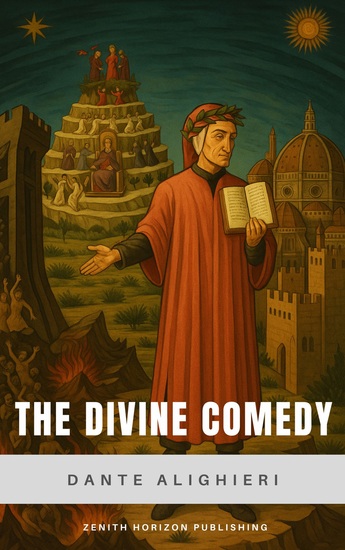
The Divine Comedy - Dante Alighieri's Epic Journey Through Hell Purgatory and Paradise - cover

The Divine Comedy - Dante Alighieri's Epic Journey Through Hell Purgatory and Paradise

Dante Alighieri, Zenith Horizon Publishing

Publisher: Zenith Horizon Publishing

  • 0
  • 0
  • 0

Summary

🔥 A visionary journey through the afterlife that shaped Western thought.
The Divine Comedy is Dante Alighieri's timeless literary epic—an allegorical voyage that begins in the darkness of Inferno, ascends through Purgatorio, and culminates in the radiance of Paradiso 🔥🌫️🌟.

Written in exquisite verse, this masterpiece explores justice, redemption, love, and divine order through unforgettable imagery and profound philosophical reflection. Whether you're a first-time reader or revisiting its pages, Dante's celestial vision remains one of the most profound literary achievements in human history.

Why readers across centuries revere this epic:
✔ "A cornerstone of Western literature, as relevant today as ever."
✔ "Striking imagery, unforgettable metaphors, and profound moral insight."
✔ Perfect for students, scholars, spiritual seekers, and lovers of poetic masterpieces 📚🧠💬

This edition includes:
🖼️ Classical illustrations for every canticle
📜 Commentary on Dante's life, vision, and cultural context
📱 Optimized for Kindle with intuitive navigation

📥 Download The Divine Comedy now and embark on the most profound journey ever written—through the depths of sin, the trials of purgation, and the beauty of paradise.
Available since: 06/05/2025.
Print length: 600 pages.

Other books that might interest you

  • The Poetry of Sarojini Naidu - One of the finest modern global poets - cover

    The Poetry of Sarojini Naidu -...

    Sarojini Naidu

    • 0
    • 0
    • 0
    Sarojini Chattopadhyay was born into a Bengali family in Hyderabad, India on 13th February 1879, the eldest of the eight siblings. The family was well-respected in Hyderabad and were established artists. 
     
    Naidu passed her matriculation examination at the University of Madras and took a four-year break from her studies.  
     
    In 1895, H.E.H. the Nizam's Charitable Trust founded by the 6th Nizam, Mahbub Ali Khan, gave her the chance to study in England, first at King's College, London and later at Girton College, Cambridge.  
     
    Even in these early times she was a social activist.  It was whilst in England that she worked as a suffragist and was first drawn to the Indian National Congress' Hindu movement for India's independence from British Colonial rule.  
     
    She began writing at the age of twelve. Her play, ‘Maher Muneer’, written in Persian, impressed the Nawab of Hyderabad. It was an auspicious start. 
     
    Sarojini met Paidipati Govindarajulu Naidu, a physician, and after finishing her studies at age 19 married him. The couple would have five children.  Interestingly their families approved their marriage even though they were from different castes and society was not as tolerant as it might be today.  Additionally, Sarojini was from Bengal and Naidu from Andhra Pradesh and marriages between those from the north and south were frowned upon.  Happily, they overcame these problems and both marriage and careers thrived. 
     
    In 1905, her first collection of poems, ‘The Golden Threshold’ was published. 
     
    Naidu became a part of the Indian nationalist movement and was a follower of Mahatma Gandhi and his idea of swaraj (this was an India without its colonial administration systems).  Despite her growing political career she still found time to write and published several further volumes of poetry. Such was her eloquence that she became known as the ‘Nightingale of India’. 
    Sarojini was appointed the President of the Indian National Congress in 1925 and was a major influence and figure in the Independence movement.  
     
    Along with several other Congress leaders including Gandhi and Jawaharlal Nehru she was arrested for taking part in the 1930 Salt March.  Indeed Sarojini faced frequent arrest by the British Authorities and spent, in total, many months in prison. 
     
    Following India's independence from British rule in 1947, Sarojini was appointed as the governor of the present-day Uttar Pradesh in so doing she became India's first female governor. 
     
    Returning from work in New Delhi on 15th February, 1949 she was advised to rest by her doctors, and her official engagements were cancelled.  Her health deteriorated rapidly and on 1st March bloodletting was performed after she complained of severe headache.  
     
    Sarojini Naidu died of a cardiac arrest on 2nd March 1949.  She was 70.
    Show book
  • A Rhyme A Dozen ― Spring - 12 Poets 12 Poems 1 Topic - cover

    A Rhyme A Dozen ― Spring - 12...

    Claude McKay, William Morris,...

    • 0
    • 0
    • 0
    ‘A dime a dozen’ as known in America, is perhaps equal to the English ‘cheap as chips’ but whatever the lingua franca of your choice in this series we hereby submit ‘A Rhyme a Dozen’ as 12 poems on many given subjects that are a well-rounded gathering, maybe even an essential guide, from the knowing pens of classic poets and their beautifully spoken verse to the comfort of your ears. 
    1 - A Rhyme A Dozen - 12 Poems, 12 Poets, 1 Topic - Spring - An Introduction 
    2 - Ode on the Spring by Thomas Gray 
    3 - Sonnet VIII - To Spring by Charlotte Smith 
    4 - Spring by Gerard Manley Hopkins 
    5 - I Have a Bird in Spring by Emily Dickinson 
    6 - Spring by Alfred Lord Tennyson 
    7 - Prairie Spring by Willa Cather 
    8 - In Springtime by Rudyard Kipling 
    9 - Spring in New Hampshire by Claude McKay 
    10 - Spring's Bedfellow by William Morris 
    11 - Spring Showers by James Thomson 
    12 - Spring Rain by Sara Teasdale 
    13 - These, I, Singing in Spring by Walt Whitman
    Show book
  • The Man with the Blue Guitar - From their pens to your ears genius in every story - cover

    The Man with the Blue Guitar -...

    Wallace Stevens

    • 0
    • 0
    • 0
    Wallace James Stevens was born on October 2nd, 1879 in Reading, Pennsylvania. 
    His father, a lawyer, sent Wallace to Harvard as a non-degree special student, after which he moved to New York City and worked briefly as a journalist. 
    From there he attended New York Law School and graduated in 1903. On a trip home to Reading in 1904 Stevens met Elsie Viola Kachel, a saleswoman, milliner, and stenographer. 
    After working for several New York law firms he was hired in January 1908, as a lawyer for the American Bonding Company. 
    After a 6 year courtship Wallace and Elsie married in 1909 over the objections of his parents.  For Wallace it was a seismic event; he never spoke to his father again.  
    By 1914 Wallace had become the vice-president of the New York office of the Equitable Surety Company of St. Louis, Missouri. In 1916, he joined Hartford Accident and Indemnity Company and they moved to Hartford.  His work was full-time and time for his poetry writing was in short supply. 
    From January 1922 made several business several visits to Key West, Florida.  "The place is a paradise," he wrote to Elsie, "midsummer weather, the sky brilliantly clear and intensely blue, the sea blue and green beyond what you have ever seen." 
    In 1923 ‘Harmonium’ was published.  At last, at age 38, he was an overnight success.  His career was not prodigious in quantity but its quality was exceptional. 
    In March 1955 Wallace underwent various medical tests and an operation which resulted in a diagnosis of stomach cancer. 
    He travelled in early June to receive honorary Doctorates at Hartford and Yale. 
    Wallace was readmitted on July 21st to St. Francis Hospital where his condition deteriorated. Wallace Stevens died on the 2nd August 1955 at the age of 75.  
    He won the Pulitzer Prize for Poetry for his Collected Poems in 1955.
    Show book
  • Pelléas and Mélisande - cover

    Pelléas and Mélisande

    Maurice Maeterlinck

    • 0
    • 0
    • 0
    Pelléas and Mélisande by Maurice Maeterlinck is a haunting and poetic masterpiece of Symbolist drama that explores love, fate, and the mysterious forces that shape human lives. First published in 1892, the play stands as one of the most influential works of European theatre, known for its dreamlike atmosphere, emotional subtlety, and profound exploration of hidden desires and destiny. 🌙📖
    
    The story begins when Prince Golaud discovers a mysterious young woman named Mélisande wandering alone in a forest. Enchanted by her beauty and quiet sadness, he marries her and brings her to the gloomy castle of Allemonde. Yet Mélisande's past remains unknown, and an aura of secrecy surrounds her presence. Within the castle walls, she forms a deep and tender bond with Pelléas, Golaud's younger half-brother.
    
    As their connection grows, an unspoken love emerges between Pelléas and Mélisande—one filled with innocence, longing, and emotional intensity. However, the oppressive atmosphere of the castle and Golaud's rising jealousy cast a shadow over their relationship. Suspicion, silence, and misunderstanding gradually lead the characters toward a tragic and inevitable fate.
    
    Maeterlinck's play is celebrated for its symbolic storytelling and lyrical dialogue. Rather than focusing on action, the drama emphasizes mood, suggestion, and the hidden emotions beneath everyday words. The mysterious setting, dimly lit castles, dark forests, and quiet fountains all contribute to a powerful sense of melancholy and destiny.
    
    Through its delicate and atmospheric narrative, Pelléas and Mélisande explores themes of forbidden love, innocence, jealousy, and the fragile nature of human happiness. The characters seem guided by forces beyond their control, reflecting the Symbolist belief that unseen powers and subconscious emotions shape human experience.
    
    The play's influence extended far beyond literature, inspiring artists, composers, and playwrights across Europe. Most notably, it served as the basis for Claude Debussy's famous opera of the same name, further cementing its place in cultural history.
    
    Today, Pelléas and Mélisande remains a timeless work of poetic drama, admired for its emotional depth, haunting beauty, and philosophical reflection on love and fate. 🌫️ Through its quiet intensity and symbolic richness, Maeterlinck's masterpiece continues to captivate readers and audiences around the world.
    Show book
  • Poets & Their Inner Demons – Dead Before 30 - Poems by poets all linked by suffering similar issues - cover

    Poets & Their Inner Demons –...

    John Keats, Percy Bysshe...

    • 0
    • 0
    • 0
    The stereotypical image of a poet is one of unknown talent starving in a garret and who’s faithfulness and legacy to the art is discovered only after their death. 
    In some cases this is undoubtedly true, but Poets being human and with the same building blocks of physical and mental health as the rest of us, also had the same afflictions and problems as the rest of us.   
    The long roll call of names and the truncated legacies that were left behind is filled with these lost talents. 
    In this volume we bring together those writers of verse and poetry who sadly died so young that their works may be small in number but glint with such brave, revealing and inventive verse that one can only imagine what heights poetry with their full lives could have been taken to.
    Show book
  • Hunting of the Snark The: An Agony in Eight Fits - cover

    Hunting of the Snark The: An...

    Lewis Carroll

    • 0
    • 0
    • 0
    First published in 1876, The Hunting of the Snark: An Agony in Eight Fits is one of Lewis Carroll’s most delightful and mysterious works of nonsense literature. 
    A peculiar crew of ten unlikely adventurers sets sail on a strange expedition to hunt the elusive Snark. Led by the confident Bellman and guided only by a completely blank map, their journey takes them through curious landscapes filled with odd creatures, baffling logic, and playful absurdity. Yet beneath the humor lies a quiet tension, for rumor has it that the Snark may actually be something far more dangerous—a Boojum. 
    Blending whimsy, satire, and imaginative wordplay, Carroll crafts a poetic adventure that has fascinated readers for generations. Both humorous and haunting, the poem invites listeners into a world where logic bends, language dances, and the unexpected waits just beyond the fog. 
    Beautifully narrated by Clare Staniforth, this classic work of Victorian nonsense comes vividly to life for modern listeners. 
    This audiobook is part of the Certified Human Voice™ catalog — performed entirely by a real human narrator, celebrating authentic storytelling and the enduring art of voice performance.
    Show book