Join us on a literary world trip!
Add this book to bookshelf
Grey
Write a new comment Default profile 50px
Grey
Subscribe to read the full book or read the first pages for free!
All characters reduced
Building Confidence in Learning - cover

Building Confidence in Learning

Daniel Taylor

Translator A AI

Publisher: Publifye

  • 0
  • 0
  • 0

Summary

Building Confidence in Learning explores the crucial link between self-esteem, motivation, and academic success for students with learning disabilities. It emphasizes that fostering self-confidence is not just supportive but essential, countering the learned helplessness that can arise from repeated academic struggles. The book demonstrates how targeted interventions and supportive environments can unlock a student's innate learning potential.

 
The book begins by introducing core psychological frameworks and then examines challenges faced by students with disabilities like dyslexia and ADHD. It dedicates sections to building self-esteem through cognitive restructuring and cultivating motivation via personalized learning, promoting a growth mindset.

 
The ultimate goal is to show how these strategies, supported by empirical research and case studies, can be integrated into classrooms and homes to create a positive feedback loop, improving both academic outcomes and self-efficacy.

 
This resource is designed for educators, parents, and counselors, providing them with evidence-based strategies and practical tools. By focusing on student agency and highlighting inherent strengths, Building Confidence in Learning offers a unique perspective, moving beyond deficit-based models and promoting a holistic understanding of students' needs.
Available since: 02/22/2025.
Print length: 109 pages.

Other books that might interest you

  • You're Stepping on My Cloak and Dagger - cover

    You're Stepping on My Cloak and...

    Roger Hall

    • 0
    • 0
    • 0
    With a sharp eye and wry wit, Roger Hall recounts his experiences as an American Army officer assigned to the Office of Strategic Services (OSS) during World War II. First published in 1957 to critical and popular acclaim, his book has become a cult favorite in intelligence circles. The story follows Hall's experiences from a junior officer fleeing a tedious training assignment in Louisiana to his quirky and rigorous OSS training rituals in the United States, England, and Scotland. Quick to pick up on the skills necessary for behind-the-lines intelligence work, he became an expert instructor. But he was only reluctantly given operational duties because of his reputation as an iconoclast. In his droll story-telling style, Hall describes his first parachute jump in support of the French resistance as a comedy of errors that terminated prematurely. His last assignment in the war zone came when William Colby appointed him section head of an operations group that made its way on foot through Sweden. Called one of the funniest and most perceptive works ever written about life in the OSS, the book includes a wealth of unforgettable personalities that Hall encountered over the years.
    Show book
  • Reenchantment of everyday life - cover

    Reenchantment of everyday life

    Thomas More

    • 0
    • 0
    • 0
    Starting from the premise that we can no longer afford to live in a disenchanted world, Moore shows that a profound, enchanted engagement with life is not a childish thing to be put away with adulthood, but a necessity for one's personal and collective survival. 
     With his lens focused on specific aspects of daily life such as clothing, food, furniture, architecture, ecology, language, and politics, Moore describes the renaissance these can undergo when there is a genuine engagement with beauty, craft, nature, and art in both private and public life.  
     Millions of readers who found comfort and substance in Moore's previous bestsellers will discover in this book ways to restore the heart and soul of work, home, and creative endeavors through a radical, fresh return to ancient ways of living the soulful life.
    Show book
  • Transform Your Brain Everyday - cover

    Transform Your Brain Everyday

    Jared Brenner

    • 0
    • 0
    • 0
    Transform Your Brain Everyday: Harness the Power of Your Brain for Optimal Health and PerformanceYour brain is the control center for your body, responsible for everything from processing sensory information to regulating emotions and facilitating movement. It's a complex organ made up of billions of nerve cells, or neurons, that communicate with each other through electrical and chemical signals.This audiobook is designed to help you gain a deeper understanding of your brain and provide practical tips for improving your brain health. Throughout the chapters, we'll explore topics such as brain nutrition, exercise, mindfulness, sleep, and cognitive behavioral therapy, among others. By the end of this audiobook, you'll have a greater appreciation for the incredible capabilities of your brain and the many ways you can optimize its functioning for everyday wellness and happiness.This audiobook will cover the following topics:- Brain Nutrition- Exercise and the Brain- Mindfulness Meditation- Sleep and Brain Health- Neuroplasticity- Building Resilience- Cognitive Behavioral Therapy- Music and the Brain- Social Connection - Managing Stress- Brain GamesTo learn more, scroll up and click “add to cart” now!
    Show book
  • Foreign Invaders of Ancient Egypt The: The History of the Hyksos Sea Peoples Nubians Babylonians and Assyrians - cover

    Foreign Invaders of Ancient...

    Editors Charles River

    • 0
    • 0
    • 0
    From approximately 3100 BCE until around 1075 BCE, ancient Egypt was ruled by 20 different dynasties. The length of the dynasties varied: some, such as those during the First and Second Intermediate periods could be quite short, while the Thirteenth and 18th Dynasties each contained more a one dozen kings and ruled over the Nile Valley for around 200 years each. Although the first 20 Egyptian dynasties varied in number of rulers and length, most shared one important attribute: they were all native Egyptian dynasties. The one important exception came during Egypt’s Second Intermediate Period, when a mysterious foreign group of people, known as the Hyksos, conquered Egypt and established the Fifteenth and Sixteenth Dynasties some time shortly after 1700 BCE. For centuries, the Hyksos rule over Egypt was an enigma shrouded in half-truths and myth. It was only in the mid-20th century that Egyptologists, using newly discovered and translated texts, shed fresh light on the Hyksos to reveal details about their origins and rule in Egypt. 
    The transition from the Bronze to the Iron Age during the late 13th and early 12th centuries BCE arguably changed the structure and course of world history more fundamentally than any period before or since. During this period, numerous wealthy and enduring kingdoms of the eastern Mediterranean Sea region collapsed, and new ones rose in their places. At the center of this period of turmoil was a group of people known today as the Sea Peoples, the English translation of the name given to them by the Egyptians. Despite their prominent role in history, however, the Sea Peoples remain as mysterious as they were influential; while the Egyptians documented their presence and the wars against them, it has never been clear exactly where the Sea Peoples originated from, or what compelled them to invade various parts of the region with massive numbers.
    Show book
  • 25+ The Big Book of Ancient Classics - The Odyssey by Homer Meditations by Marcus Aurelius The Republic by Plato Poetics by Aristotle and others - cover

    25+ The Big Book of Ancient...

    Aristotle, Aeschylus, Marcus...

    • 0
    • 0
    • 0
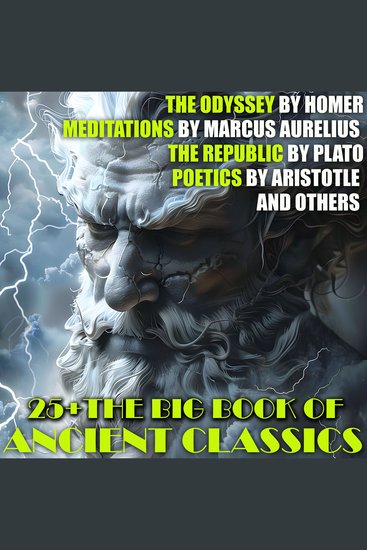
    We live in an era rife with cultural conflict. The 21st century is by no means free of wars, terrorism, riots, famine, nor epidemics. We may attempt to solve the challenges of our times by uniting the humanistic disciplines of philosophy, science, and technology. Our modern reality requires a fundamental understanding of the problems beleaguering our existence. Science and literature are key tools for gaining this insight. The wisdom accumulated throughout the centuries by scientists, philosophers, and writers is a solid foundation on which modern man can build the future. Our ability to learn from those who have come before is precisely what led Protagoras to declare that "Man is the measure of all things."
     
    Poetics by Aristotle
    The Athenian Constitution by Aristotle
    On Life and Death by Aristotle
    Agamemnon by Aeschylus
    The Eumenides by Aeschylus
    The Choephori by Aeschylus
    Meditations by Marcus Aurelius
    Medea by Euripides
    The Works and Days by Hesiod
    The Theogony by Hesiod
    The Shield of Heracles  by Hesiod
    The Odyssey by Homer
    The Apology of Socrates by Plato
    Charmides by Plato
    Crito by Plato
    Euthyphro  by Plato
    Ion by Plato
    Laches  by Plato
    Lysis by Plato
    Menexenus by Plato
    The Republic  by Plato
    The Allegory of the Cave by Plato
    Symposium by Plato
    Meno  by Plato
    Phaedo by Plato
    Critias  by Plato
    The Complete Poems by Sappho
    Antigone by Sophocles
    Show book
  • The Inevitable Revolution - cover

    The Inevitable Revolution

    Leo Tolstoy

    • 0
    • 0
    • 0
    "Men should believe in the law of love in the same way that they now believe in the inevitability of violence."
    
    The Inevitable Revolution (1909) is one of Tolstoy's last major works of non-fiction, focusing on themes of civil disobedience, pacifism, and anarchism. The author criticises prisons, parliaments, wars, conscription, capitalism, theft, revolutionary violence, and taxes, while praising the message of love found in Christianity and acknowledging similar teachings in other religions. He believes that adherence to the law of love offers practical solutions to the societal issues he critiques and essentially calls for a moral awakening among individuals to live non-violently and to not condone violence in any form.
    
    This essay serves as a profound reflection of Tolstoy's later philosophical views and its discussions on non-violence and ethical living continue to resonate today.
    Leo Tolstoy (1828–1910) was a Russian novelist, philosopher, and social reformer, widely regarded as one of the greatest writers of all time. He is best known for his epic novels War and Peace and Anna Karenina, both celebrated for their intricate character development and profound exploration of moral dilemmas and human nature. In his later years, Tolstoy experienced a spiritual awakening which led him to reject materialism and embrace a life of simplicity, seeking to align his life with his beliefs about non-violence and compassion. Tolstoy's legacy endures not only through his literary masterpieces but also through his profound impact on literature and philosophy.
    Show book