Join us on a literary world trip!
Add this book to bookshelf
Grey
Write a new comment Default profile 50px
Grey
Subscribe to read the full book or read the first pages for free!
All characters reduced
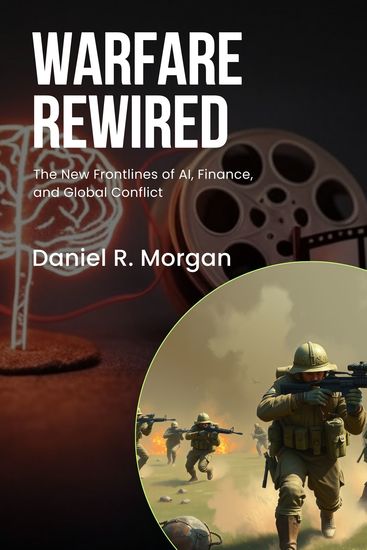
Warfare Rewired - The New Frontlines of AI Finance and Global Conflict - cover

Warfare Rewired - The New Frontlines of AI Finance and Global Conflict

Daniel R. Morgan

Publisher: Velvet Ink Press

  • 0
  • 0
  • 0

Summary

From cybernetic dominance to battlefield documentaries and financial brinkmanship, Warfare Rewired explores the most urgent frontlines shaping modern conflict. This trio of investigative works dives deep into the shifting terrain of warfare—where code, currency, and culture converge in unpredictable ways.
 
In AGI Wars, readers are immersed in the accelerating race for artificial general intelligence. The stakes? Not just supremacy in innovation, but control over future battlefields where decisions are automated and power is algorithmic. This is not science fiction—it’s the blueprint of tomorrow's warfare.
 
Flirting with Financial Oblivion reveals the hidden landmines beneath global markets. When governments gamble with risk and volatility becomes a political weapon, economic collapse becomes a new form of conflict—one waged not with tanks, but through inflation, debt, and collapse.
 
Finally, Cinematic Chronicles of the Iraq War transports us to a different kind of theater: the screen. These cinematic stories reveal the personal, political, and strategic layers of war, as interpreted through film. This is where narrative shapes memory—and memory influences policy.
 
Together, these books redefine what it means to be “at war” in the 21st century. Whether you’re drawn to AI ethics, geopolitical instability, or the hidden mechanics of financial collapse, this collection offers a high-stakes tour through the invisible battlefields of our time.
Available since: 08/14/2025.
Print length: 710 pages.
Other books that might interest you

  • Liberalism - Individual Liberty and the Modern State - cover

    Liberalism - Individual Liberty...

    Hector Davidson

    • 0
    • 0
    • 0
    Liberalism is a political and philosophical ideology rooted in the principles of individual liberty, equality, and limited government. At its core, liberalism emphasizes the autonomy of the individual, arguing that each person has the right to pursue their own life and happiness, free from unnecessary interference by the state or society. Emerging in the Enlightenment period, liberalism challenged the traditional structures of monarchies and feudal systems, advocating for the rights of the individual and the importance of reason, tolerance, and democratic participation. 
    The roots of liberal thought can be traced back to the works of early modern philosophers such as John Locke, whose ideas on natural rights and government by consent laid the foundation for liberal political theory. Locke’s assertion that individuals possess inherent rights to life, liberty, and property formed the basis for much of liberal thought, influencing the development of constitutionalism and democratic governance. Over time, thinkers like Montesquieu, Rousseau, and later John Stuart Mill contributed to the evolution of liberalism, expanding its focus to issues of civil liberties, political freedoms, and social equality. 
    A defining characteristic of liberalism is its emphasis on individual freedom. This includes both personal liberty—the freedom to make choices about one’s own life—and political liberty—the right to participate in the democratic process and have a say in the laws and policies that govern society. Classical liberals advocated for minimal government interference in the economy and individual affairs, emphasizing free markets, private property, and limited state power. The role of the state, in this view, is to protect the rights of individuals and maintain social order, but not to intervene in the private lives or economic transactions of citizens.
    Show book
  • Reagan-Carter Debate - cover

    Reagan-Carter Debate

    Ronald Reagan, Jimmy Carter

    • 0
    • 0
    • 0
    The only debate between Ronald Reagan and Jimmy Carter was held in Cleveland, Ohio on October 28, 1980, just days before the election on November 4, 1980. The debate, broadcast live on radio and television, was one of the most-watched presidential debates. 
    Questions by four journalists focused on the following topics: U.S. armed forces, the nation’s economy, urban policies, international terrorism, strategic arms limitation, energy, social security, each candidate’ s assessment of his opponent, and closing statements. 
    Search online for “Ronald Reagan major speeches” to see both a text version and a video version of this debate. 
    Audio recording courtesy of the Ronald Reagan Presidential Library. 
    AspenLeafMedia.com
    Show book
  • The Coming Storm - Power Conflict and Warnings from History - cover

    The Coming Storm - Power...

    Odd Arne Westad

    • 0
    • 0
    • 0
    From a renowned Yale historian comes a chilling look at the looming threat of the next Great Power war and the urgent interventions necessary to avoid it in the twenty-first century. The vast majority of people alive today have come of age in a world of remarkable stability, presided over by either one or two Superpowers. This is not to say the world has been peaceful; but it has, to a great extent, been predictable. As an increasing number of Great Powers jostle for regional supremacy, as well as competitive advantage in nuclear technology, artificial intelligence, space exploration, and trade, our world has become more fragile, unpredictable—and combustible. The outbreak of global war among today’s Great Powers seems increasingly likely. Such war, as Odd Arne Westad powerfully argues in this urgent book, would be of a magnitude and devastation never before seen. To understand the threats that face us in this complex new terrain, we must look to the lessons of the past, and especially the late nineteenth and early twentieth century—a time when Great Powers clashed and sought regional dominance, nationalism and populism were on the rise, and many felt that globalization had failed them; a time when tariffs increased, immigration and terrorism were among the biggest issues of the day, and a growing number of people blamed the citizens of other countries for their problems. A time, in other words, that carries eerie parallels with our own.
    Show book
  • Being Cosmopolitan - A Political Approach - cover

    Being Cosmopolitan - A Political...

    Luke Ulas

    • 0
    • 0
    • 0
    What does it mean to be cosmopolitan? Typically, cosmopolitanism is understood as a broad moral orientation, involving some kind of commitment to global moral equality. On this understanding, to be cosmopolitan is simply to evidence that moral orientation oneself. By contrast, Being Cosmopolitan takes up a thoroughly political approach. The focus is on what it might mean, and what it is like, to be political in a distinctly cosmopolitan form. What it means to be cosmopolitan in this thoroughly political sense cannot involve appeal to any particular moral orientation, because politics is about, inter alia, the contestation of such orientations and commitments. Instead, this book offers an account that is based upon the internalization of particular kind of global "social imaginary," involving the imagination of a global public to which certain issues—or global public affairs—are understood to pertain. 


    Within which kind of global order is it possible, or comfortable, for a cosmopolitical agent to live? In answer to this question, the book argues against the viability of both a world of self-determining peoples, and of "pluralist" global visions—both of which are popular with moral cosmopolitan theorists.
    Show book
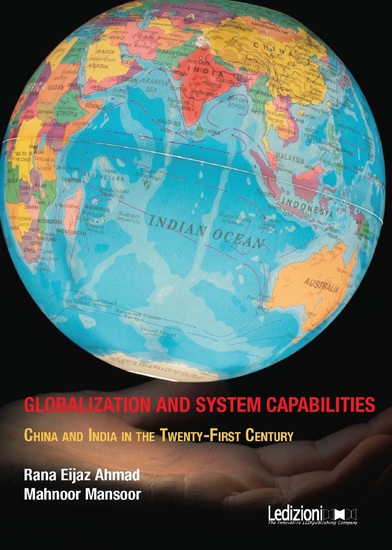
  • Globalization and System Capabilities - China and India in the Twenty-First Century - cover

    Globalization and System...

    Rana Eijaz Ahmad, Mahnoor Mansoor

    • 0
    • 0
    • 0
    Welcome to the world of artificial intelligence, where digitalization has transformed the globe worldwide. This book investigates the 'system capabilities' and its utilization through the lens of leadership as per its idiosyncrasy. The thesis of this book emphasizes that it is not the form of government but the efficient utilization of the system capabilities by the leadership that make the difference in the socio-political and economic development of any country in the world. It provides a dynamic landscape of globalization, discovering how two economic dynamos—China and India—navigate and shape the complicated web of global relations in the contemporary era.
    As the world becomes increasingly interconnected, understanding the roles of major players in shaping global systems is crucial. China and India, with their rich histories, diverse cultures, and rapidly evolving economies, stand as pivotal actors in the unfolding narrative of our shared global future.
    Show book
  • Hamburg Climate Futures Outlook 2024 - Conditions for Sustainable Climate Change Adaptation - cover

    Hamburg Climate Futures Outlook...

    Anita Engels, Jochem Marotzke,...

    • 0
    • 0
    • 0
    Many countries, communities, and social actors around the world are struggling to cope with the impacts of climate change. Adapting to climate change in a sustainable manner involves a huge collective effort and is barely happening. How can sustainable climate change adaptation become plausible? The Hamburg Climate Futures Outlook 2024 provides a unique systematic and global assessment of the context conditions for sustainable climate change adaptation, evaluating the social dynamics of deep decarbonization and the physical dynamics in regional climate variability and extremes. Through nine case studies across the globe, the assessment provides insights into key barriers and opportunities for sustainable climate change adaptation.
    Show book