Join us on a literary world trip!
Add this book to bookshelf
Grey
Write a new comment Default profile 50px
Grey
Subscribe to read the full book or read the first pages for free!
All characters reduced
WHY TRUMP’S TARIFFS WILL WORK - A comprehensive study on the most important presidential economic measure in recent years - cover

WHY TRUMP’S TARIFFS WILL WORK - A comprehensive study on the most important presidential economic measure in recent years

DANCE J.D.

Publisher: Publisher s13109

  • 0
  • 0
  • 0

Summary

A comprehensive study on the most important presidential economic measure in recent years
Available since: 04/06/2025.

Other books that might interest you

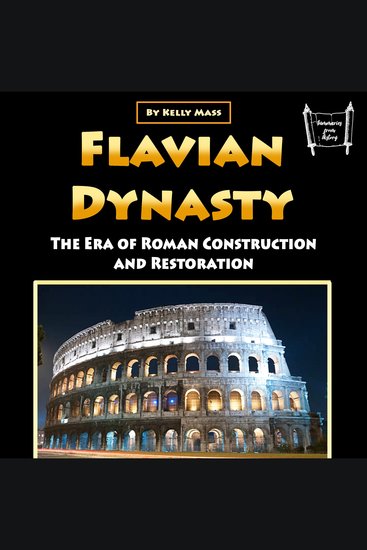
  • Flavian Dynasty - The Era of Roman Construction and Restoration - cover

    Flavian Dynasty - The Era of...

    Kelly Mass

    • 0
    • 0
    • 0
    The Flavian dynasty, which ruled the Roman Empire from AD 69 to 96, is remembered as a period of remarkable transformation, spanning the reigns of Emperor Vespasian and his two sons, Titus and Domitian. This dynasty emerged during a time of political instability, marked by the tumultuous civil war of 69, often referred to as the Year of the Four Emperors. The Roman Empire was in turmoil after the deaths of emperors Galba and Otho, and the brief rule of Vitellius, who assumed the throne in mid-69. However, Vitellius' reign was soon contested by legions in the Eastern provinces, who declared Vespasian their emperor. This marked the beginning of the Flavian rise to power. The Second Battle of Bedriacum was a pivotal moment, securing the Flavian cause and leading to their eventual triumph. On December 20, 69, Vespasian entered Rome and, the following day, was officially declared Emperor by the Senate, establishing the Flavian dynasty. 
    Despite its relatively brief reign, the Flavian dynasty witnessed several notable events that shaped Roman history. One of the most significant challenges of Titus' rule was the eruption of Mount Vesuvius in 79, which buried the cities of Pompeii, Herculaneum, and others under layers of ash and lava. This catastrophic event, along with the subsequent fires and pestilence that ravaged Rome in 80, deeply affected the empire. On the military front, Titus' most enduring legacy was the brutal siege of Jerusalem in 70, following the Jewish revolt that began in 66. The city was destroyed, and its temple, a symbol of Jewish religious and cultural identity, was looted and razed. The military campaigns of the Flavians also extended beyond the Mediterranean; Gnaeus Julius Agricola, during his command in Britain (77–83), achieved remarkable victories that expanded Roman influence in the British Isles.
    Show book

  • Emotional Sugar - cover

    Emotional Sugar

    Brittany Forrester

    • 0
    • 0
    • 0
    From cupcakes to pies to iced coffee drinks, sugar is found in many foods and is almost impossible to avoid. Emotional or psychological dependence on sugary foods and beverages, also known as sugar addiction, is a fundamental cause of concern for health officials in America. Processed foods and refined grains create additional sugar in the body once the body metabolizes the food. Sugar in moderation is not harmful; however, many overdo it. A recent study suggests Americans eat far too much sugar. Specifically, approximately 75% of Americans eat excessive amounts of sugar, many of whom could be classified as having a sugar addiction.Sugar consumption can create a short-term high and a spark of energy in the body. Some studies have suggested sugar is as addictive as cocaine. People often enjoy the dopamine release sugar brings. However, due to the addictive nature of sugar, long-term health effects like obesity and diabetes are a risk of sugar overindulgence. Like other compulsions or behavioral addictions, sugar addiction is a risk for people with low moods, anxiety, and stress.This book explored sugar use, as an additive process, through the lens of emotional regulation, addressing the research question: What is the lived experience of emotional regulation through sugar addiction? This book aimed to a greater understanding of the interdependent nature of sugar and emotions. What might a sugar-addicted population express that facilitates recovery and emotional regulation? The lived experience revealed that envy, deprivation, fear of sugar control, and lack of support from authority figures contributed to an inability to get enough comfort foods or stop overconsumption and to feelings of guilt, shame, and loss.
    Show book
  • Airplane Mode - An Irreverent History of Travel - cover

    Airplane Mode - An Irreverent...

    Shahnaz Habib

    • 0
    • 0
    • 0
    Longlisted for the Andrew Carnegie Medals of Excellence 


    The conditions of travel have long been dictated by the color of passports and the color of skin. 


    The color of one's skin and passport have long dictated the conditions of travel.  For Shahnaz Habib, travel and travel writing have always been complicated pleasures. Habib threads the history of travel with her personal story as a child on family vacations in India, an adult curious about the world, and an immigrant for whom roundtrips are an annual fact of life. Tracing the power dynamics that underlie tourism, this insightful debut parses who gets to travel, and who gets to write about the experience. 


    Threaded through the book are inviting and playful analyses of obvious and not-so-obvious travel artifacts: passports, carousels, bougainvilleas, guidebooks, trains, the idea of wanderlust itself. Together, they tell a subversive history of travel as a Euro-American mode of consumerism—but as any traveler knows, travel is more than that. As an immigrant whose loved ones live across continents, Habib takes a deeply curious and joyful look at a troubled and beloved activity.
    Show book
  • A Rare Recording of The Civil War's Confederate Rebel Yell - cover

    A Rare Recording of The Civil...

    Various Various

    • 0
    • 0
    • 0
    The Rebel Yell was a battle cry used by Confederate soldiers during the Civil War. The yell was hollered when soldiers were charging into battle, as a way to intimidate the enemy and to boost their own morale. There is some debate about how the Rebel Yell began. Confederate soldiers may have learned the yell from Native Americans, or simply imitated them. It is known that some Texas Confederate units combined Comanche war whoops into their version of the yell. Another claim is that it came from the screams traditionally made by Irish and Scottish Highlanders when they made a Highland charge during battle. According to Encyclopedia Virginia: "Distinctive noises made by soldiers were identified from the very beginning of the war, but the yell’s first appearance in combat may have come at the Battle of Manassas, on July 21, 1861, and it is strongly associated with the Confederate general Stonewall Jackson." Colonel Keller Anderson of Kentucky's Orphan Brigade said: "Then arose that do-or-die expression, that maniacal maelstrom of sound; that penetrating, rasping, shrieking, blood-curdling noise that could be heard for miles and whose volume reached the heavens--such an expression as never yet came from the throats of sane men, but from men whom the seething blast of an imaginary hell would not check while the sound lasted."
    Show book
  • Neurokarma - A Consciousness-Based Model for Transforming Trauma Patterns - cover

    Neurokarma - A...

    Fritz H. Hemmerich

    • 0
    • 0
    • 0
    This audiobook is narrated by an AI Voice.  rauma is karma. Karma is trauma. 
     
    This equation changes everything. 
     
    What you call character flaws are conditioned survival patterns. 
    The rage that erupts when coffee spills. 
    The freeze when your boss criticizes. 
    The helplessness you feel when you "cannot act otherwise." 
     
    These are not fate. These are not punishment. These are neural pathways, carved deep, firing in milliseconds. 
     
    Between impulse and action lies a window. Inside that span, freedom lives. 
     
    In this groundbreaking work, physician and philosopher Fritz H. Hemmerich reveals how trauma and karma are two languages for the same deep conditioning, and demonstrates why our deepest patterns can be interrupted using cutting-edge neuroscience and ancient wisdom. Discover the power of laminar breathing that calms your system in seconds, learn why trauma heals more effectively when we keep the benefit for others in view (Karma Burning), and understand how epigenetic changes can dissolve generations of conditioning. Through trainable practices such as vital-belt awareness and praeemption, you will learn to interrupt automatic patterns — anger, withdrawal, collapse, people-pleasing — and replace them with grounded presence. This isn't another self-help book. It's a roadmap to neurological liberation, with practical 2-minute exercises, moving case studies, and scientific precision that guides you from automatic reacting to conscious responding — from surviving to thriving.
    Show book
  • Theory of Moral Sentiments The: Book Summary & Analysis - cover

    Theory of Moral Sentiments The:...

    Briefly Summaries

    • 0
    • 0
    • 0
    This is a concise summary and analysis of The Theory of Moral Sentiments, by Adam Smith.
     
    It is not the original book and is not affiliated with or endorsed by Adam Smith.
     
    Ideal those seeking a quick and insightful overview.
     
    The Theory of Moral Sentiments explores the foundations of human morality, empathy, and social behavior. This groundbreaking work examines how individuals form ethical judgments, emphasizing the role of sympathy in understanding the emotions and actions of others. By analyzing the interplay between self-interest and societal norms, it provides profound insights into human psychology and the principles that govern harmonious living. A timeless exploration of ethics and philosophy, this book remains a cornerstone in understanding moral philosophy and its implications for human connection and society.
    Show book