Join us on a literary world trip!
Add this book to bookshelf
Grey
Write a new comment Default profile 50px
Grey
Subscribe to read the full book or read the first pages for free!
All characters reduced
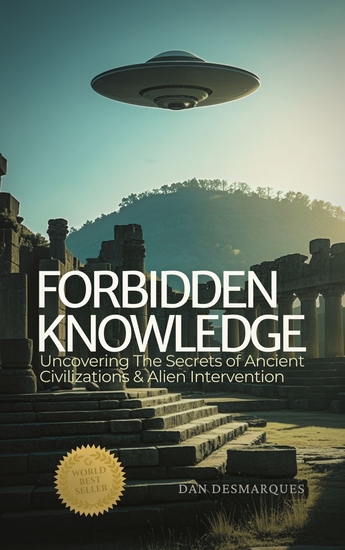
Forbidden Knowledge - Uncovering the Secrets of Ancient Civilizations and Alien Intervention - cover

Forbidden Knowledge - Uncovering the Secrets of Ancient Civilizations and Alien Intervention

Dan Desmarques

Publisher: 22 Lions

  • 0
  • 0
  • 0

Summary

Have you ever felt that our history is far richer and more complex than what is presented in classrooms and textbooks? Have you ever wondered why certain truths seem to be deliberately obscured, leaving the official narrative feeling incomplete or even fabricated? If so, you are not alone. The hidden truths of our past are waiting to be uncovered, and it's time to reveal the secrets that have been hidden from humanity for millennia.
 
In Forbidden Knowledge, we embark on an eye-opening journey through the mysterious history of our world. This book delves into the secrets of ancient civilizations, the intriguing role of extraterrestrials in our evolution, and the systematic suppression of knowledge by the powerful. This is not just a collection of theories; it is a clarion call for those who yearn to understand the true nature of our existence and reclaim our spiritual sovereignty.
 
Through rigorous research and compelling evidence, we explore the legacies of advanced ancient civilizations such as Atlantis and Lemuria, revealing their profound influence on our modern world. We examine the involvement of extraterrestrial beings, from the genetic engineering of the Anunnaki to the divine wisdom attributed to the Egyptian gods. We also expose the tactics used by the powers that be to suppress this knowledge, including the manipulation of education and the media, and the pervasive use of disinformation.
 
But Forbidden Knowledge is not only about exposing the deceptions of the past; it is also about embracing the truths of the present and envisioning a future that honors our divine potential. By rediscovering the true messages of enlightened figures, we can free ourselves from the constraints of religious dogma and raise our consciousness. This journey encourages us to recognize the interconnectedness of all beings and the vital importance of compassion, empathy, and unity.
 
If you are ready to question the narratives that have been imposed upon us and seek the profound truths that lie beyond the veil of deception, then this book is for you. The path to spiritual liberation is paved with knowledge, understanding, and the courage to defy the status quo. It is a journey that invites us to face the shadows of our past and step into the light of our true potential. If you are ready to discover the truth, you can begin this extraordinary journey today.
Available since: 11/24/2024.
Print length: 160 pages.

Other books that might interest you

  • Punic Wars - Events and Background of the Wars between Ancient Rome and Carthage - cover

    Punic Wars - Events and...

    Kelly Mass

    • 0
    • 0
    • 0
    The Punic Wars were a series of three major conflicts fought between the Roman Republic and the ancient city-state of Carthage from 264 BC to 146 BC. These wars were pivotal in shaping the balance of power in the ancient Mediterranean, ultimately resulting in the complete destruction of Carthage and the rise of Rome as the dominant power in the region. 
    The first war, known as the First Punic War, began in 264 BC, centered around the strategic island of Sicily. According to the Greek historian Polybius, it was “the longest and most bitterly waged battle in history.” The conflict ignited when Rome’s growing imperial ambitions clashed with Carthage’s established control over the island. Carthage, a formidable maritime power with a vast network of colonies across the western Mediterranean, saw Sicily as vital to its prosperity. Rome, a land-based power with a strong army but a comparatively weak navy, sought to challenge Carthage’s dominance at sea. Over the course of the war, naval engagements dominated, and the conflict resulted in significant losses for both sides. Despite initial setbacks, Rome ultimately prevailed after 23 years of intense fighting, inflicting severe losses on the Carthaginian fleet and forcing Carthage to pay massive reparations. The island of Sicily became Rome’s first province, marking a significant step in the Republic’s expansion. The end of the First Punic War also saw the outbreak of the Mercenary War within Carthage’s borders, a revolt by Carthaginian soldiers who had not been paid, further weakening the empire.
    Show book
  • The Chaldean Oracles - Mystical Wisdom of the Cosmos and Divine Realms - cover

    The Chaldean Oracles - Mystical...

    Julian the Theurgist, Ancient...

    • 0
    • 0
    • 0
    What if you could access ancient wisdom that bridges the gap between the human and the divine, unlocking the secrets of the cosmos and the soul’s journey? 
    The Chaldean Oracles is a modern translation of one of the most revered esoteric texts of late antiquity. Attributed to the Chaldean magi and Julian the Theurgist, this work unveils the sacred teachings of divine hierarchies, cosmic order, and the spiritual practices of theurgy—a method of connecting with the divine through rituals and inner transformation. 
    Far more than an ancient text, The Chaldean Oracles provides a spiritual roadmap for navigating life’s mysteries, harmonizing with the cosmos, and awakening to the soul’s highest potential. 
    What You’ll Discover in This Modern Translation: 
    - The Divine Hierarchy – Explore the structure of the cosmos, the divine realms, and the intermediaries between the human and divine. 
    - Theurgy and Spiritual Practices – Learn how sacred rituals and inner discipline lead to divine connection and spiritual ascent. 
    - Timeless Wisdom for the Soul’s Journey – Discover the path of purification, illumination, and unification with the divine. 
    - The Interplay of Fire and Light – Understand the mystical elements of the universe and their role in transformation and enlightenment. 
    Imagine understanding the sacred mysteries of existence, discovering the divine potential within, and aligning with the eternal truths of the cosmos. For centuries, The Chaldean Oracles has inspired spiritual seekers—now it’s your turn. 
    Embark on your journey of spiritual awakening and cosmic wisdom today. Get your copy now and uncover the timeless teachings of The Chaldean Oracles.
    Show book
  • Grilling Dahmer - The Interrogation Of "The Milwaukee Cannibal" - cover

    Grilling Dahmer - The...

    Patrick Kennedy, Robyn Maharaj

    • 0
    • 10
    • 0
    The Milwaukee detective who interrogated the notorious serial killer shares a vivid chronicle of what was revealed during the weeks-long encounter. In the late hours of July 22, 1991, Detective Patrick “Pat” Kennedy of the Milwaukee Police Department was asked to respond to a possible homicide. Little did he know that he would soon be delving into the dark mind of one of America's most notorious serial killers, the “Milwaukee Cannibal” Jeffrey Dahmer. As the media clamored for details, Kennedy spent the next six weeks, sixteen hours a day, locked in an interrogation room with Dahmer. There the thirty-one-year-old killer described in lurid detail how he lured several young men to his apartment where he strangled, sexually assaulted, dismembered, and in some cases, cannibalized his victims. In Grilling Dahmer,Kennedy takes readers inside the mind of evil as he patiently, meticulously, listens to unspeakable horrors.
    Show book
  • Spreading Hate - The Global Rise of White Supremacist Terrorism - cover

    Spreading Hate - The Global Rise...

    Daniel Byman

    • 0
    • 0
    • 0
    The modern white power movement is now a global, transnational phenomenon. 
     
    In this sweeping, authoritative account, Daniel Byman traces the key moments in the white power movement’s evolution in the United States and around the world and then details its many facets today. Using a wide range of sources, Byman explodes several myths about  
    white power terrorism and identifies dangerous gaps in current policies. 
     
    For almost two decades since 9/11, white supremacist terrorism has been relegated to a secondary concern in the US and Europe despite shocking episodes of violence from New Zealand to Norway to South Carolina. Because white power terrorists’ grievances echo  
    mainstream debates and their violence often exacerbates polarization, their political impact can be inordinately high even if the body count is low. As Byman stresses, they are not a hidebound movement seeking to turn back the clock, but are dynamic, drawing on  
    ideas from around the world and exploiting the most cutting-edge technologies, especially social media. 
     
    White power terrorists, however, have many weaknesses. They are divided, with poor leadership, and often attract the incompetent and the criminal as well as the dangerous and deluded. If governments act decisively and treat white power terrorism with the same  
    urgency they use to manage jihadist violence, then the threat can be reduced. This will require aggressive law enforcement, international intelligence cooperation, crackdowns by technology companies, and other forceful steps. Spreading Hate will be essential reading  
    for anyone worried about this increasingly networked movement that threatens to grow more dangerous in the years to come.
    Show book
  • The Ancient World’s Most Influential Philosophers - cover

    The Ancient World’s Most...

    Editors Charles River

    • 0
    • 0
    • 0
    Although he is still one of history’s most famous philosophers, Confucius was in many respects an unremarkable man, and even his physical features were said to be unattractive. There is little evidence that he thought of himself as a harbinger of any kind, but shortly after his death, writings, sayings, and theories based on his life and ideas spread throughout China and even took hold of the imperial court of one of the most powerful and important dynasties, the Han (206 BCE-220 CE). It was during the Han Dynasty that Confucianism became closely tied to state affairs, and it would remain so until the fall of the last dynasty in 1912.  
    	None of Socrates’ works survived antiquity, so most of what is known about him came from the writings of his followers, most notably Plato. What is known about Socrates is that he seemed to make a career out of philosophy, and Plato was intent on following in his footsteps. Yet for all of the influence of Socrates’ life on his followers, it was Socrates’ death around 399 B.C. that truly shaped them. Plato was so embittered by Socrates’ trial in Athens that he completely soured on Athenian democracy, and Aristotle would later criticize politicians who relied on rhetoric; when Aristotle’s own life was threatened, he fled Greece and allegedly remarked, “I will not allow the Athenians to sin twice against philosophy." 
    	Alongside Pericles, Cicero was one of antiquity’s greatest politicians, and he has remained one of the most influential statesmen in history, relied upon by the Romans of his day, political philosophers like John Locke, Enlightenment thinkers like Rousseau, and America’s Founding Fathers. Thomas Jefferson credited Cicero as an inspiration for the Declaration of Independence, and John Adams asserted, "As all the ages of the world have not produced a greater statesman and philosopher united than Cicero, his authority should have great weight.”
    Show book
  • Ottoman Empire’s Greatest Sultans The: The Lives and Legacies of Osman I Mehmed II and Suleiman the Magnificent - cover

    Ottoman Empire’s Greatest...

    Editors Charles River

    • 0
    • 0
    • 0
    In terms of geopolitics, perhaps the most seminal event of the Middle Ages was the successful Ottoman siege of Constantinople in 1453. The city had been an imperial capital as far back as the 4th century, when Constantine the Great shifted the power center of the Roman Empire there, effectively establishing two almost equally powerful halves of antiquity’s greatest empire. Constantinople would continue to serve as the capital of the Byzantine Empire even after the Western half of the Roman Empire collapsed in the late 5th century. Naturally, the Ottoman Empire would also use Constantinople as the capital of its empire after their conquest effectively ended the Byzantine Empire, and thanks to its strategic location, it has been a trading center for years and remains one today under the Turkish name of Istanbul.  
    The Ottoman conquest of Constantinople also played a decisive role in fostering the Renaissance in Western Europe. The Byzantine Empire’s influence had helped ensure that it was the custodian of various ancient texts, most notably from the ancient Greeks, and when Constantinople fell, Byzantine refugees flocked west to seek refuge in Europe. Those refugees brought books that helped spark an interest in antiquity that fueled the Italian Renaissance and essentially put an end to the Middle Ages altogether. 
    In the wake of taking Constantinople, the Ottoman Empire would spend the next few centuries expanding its size, power, and influence, bumping up against Eastern Europe and becoming one of the world’s most important geopolitical players. It was a rise that would not truly start to wane until the 19th century, and the Ottomans would maintain their empire until the end of World War I. 
    Show book