Join us on a literary world trip!
Add this book to bookshelf
Grey
Write a new comment Default profile 50px
Grey
Subscribe to read the full book or read the first pages for free!
All characters reduced
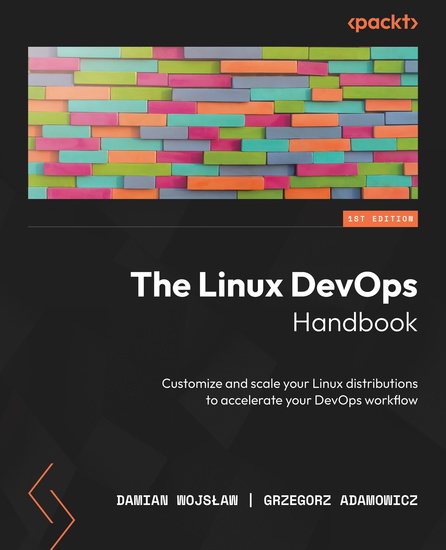
The Linux DevOps Handbook - Customize and scale your Linux distributions to accelerate your DevOps workflow - cover

The Linux DevOps Handbook - Customize and scale your Linux distributions to accelerate your DevOps workflow

Damian Wojsław, Grzegorz Adamowicz

Publisher: Packt Publishing

  • 0
  • 0
  • 0

Summary

The Linux DevOps Handbook is a comprehensive resource that caters to both novice and experienced professionals, ensuring a strong foundation in Linux. This book will help you understand how Linux serves as a cornerstone of DevOps, offering the flexibility, stability, and scalability essential for modern software development and operations.You’ll begin by covering Linux distributions, intermediate Linux concepts, and shell scripting to get to grips with automating tasks and streamlining workflows. You’ll then progress to mastering essential day-to-day tools for DevOps tasks. As you learn networking in Linux, you’ll be equipped with connection establishment and troubleshooting skills. You’ll also learn how to use Git for collaboration and efficient code management.The book guides you through Docker concepts for optimizing your DevOps workflows and moves on to advanced DevOps practices, such as monitoring, tracing, and distributed logging. You’ll work with Terraform and GitHub to implement continuous integration (CI)/continuous deployment (CD) pipelines and employ Atlantis for automated software delivery. Additionally, you’ll identify common DevOps pitfalls and strategies to avoid them.By the end of this book, you’ll have built a solid foundation in Linux fundamentals, practical tools, and advanced practices, all contributing to your enhanced Linux skills and successful DevOps implementation.
Available since: 11/17/2023.
Print length: 428 pages.


Other books that might interest you

  • The Digital Mindset - What It Really Takes to Thrive in the Age of Data Algorithms and AI - cover

    The Digital Mindset - What It...

    Paul Leonardi, Tsedal Neeley

    • 0
    • 0
    • 0
    The pressure to "be digital" has never been greater. 


    The digital revolution is here. It's changing how work gets done, how industries are structured, and how people from all walks of life work, behave and relate to each other. To thrive in a world driven by data and powered by algorithms, we must learn to see, think, and act in new ways. We need to develop a digital mindset. 


    But what does that mean? Some fear it means that in the near future we will all need to become technologists who master the intricacies of coding, algorithms, AI, machine learning, robotics, and who knows what's next. 


    This book introduces three approaches—Collaboration, Computation, Change—that you need for a digital mindset, and the perspectives and actions within each approach that will enable you to develop digital skills you need. With the digital mindset, you can ask the right questions, make smart decisions and appreciate new possibilities for a digital future. Leaders who adopt these approaches will be able to develop their organization's talent to prepare their company for successful and continued digital transformation. 


    The surprising and welcome secret is that developing a digital mindset isn't as hard as we think. Most people can become digitally savvy if they follow the "30% rule," or the minimum threshold that gives us just enough digital literacy to understand and take advantage of the digital fabric woven into our world.
    Show book
  • Touchpad Plus Ver 40 Class 2 - cover

    Touchpad Plus Ver 40 Class 2

    Nidhi Gupta

    • 0
    • 0
    • 0
    Computer Science Textbook with New Pedagogical Approaches 
    
    KEY FEATURES 
    - National Education Policy 2020 
    - Tech Funda: This section provides a practical information or tip to the students. 
    - Clickipedia: This section provides interesting computer facts. 
    - Lab Session: This is a lab activity to develop practical skills. (Subject Enrichment) 
    - Explore More: This section contains supplement topics for add-on knowledge. 
    - QR Code: Scan the QR Code given on the first page of each chapter to start chapter animation. 
    - Mind Boggler: This section has puzzle or fun based activity to help understand the concepts better. 
    
    DESCRIPTION 
    Computer technology has become essential and an integral part of life at work, in recreation, social networking and education too. With the constant development of new technology, it has become more significant in helping and preparing students for jobs. Computers have revolutionised the way education is imparted to children. 
    
    Touchpad Plus Version 4.0 is a complete computer science curriculum solution for grades 1-8. It is based on Windows 10 and MS Office 2019, with new and future-ready content. Fun is the most important element of learning. Keeping in mind the concept of Joyful Learning, varied activities have been designed based on multiple intelligences and 21st century skills for holistic development. 
    
    The books have a conversational style introduction of each chapter to make learning fun and engaging. The topics and their approaches are integrated in different themes as per ICT learning. Grade I and II books have four-line writing space to enhance writing skills in children. Each book is accompanied by digital learning resources that offer interesting animation and interactive tests for the student to supplement classroom learning with independent learning. 
    
    The books are curated in a way that they make students and teachers equal partners in the learning process and take learning beyond classroom. We welcome and look forward to all meaningful and valuable suggestions for improving the book 
    
    WHAT WILL YOU LEARN 
    You will learn about: 
    - Digital World 
    - Cyber World 
    - Coding World 
    - Computational Thinking 
    - Artificial Intelligence 
    
    WHO THIS BOOK IS FOR 
    Grade 2 
    
    TABLE OF CONTENTS 
    1. More About a Computer 
    2. Working of a Computer 
    3. IPO Devices 
    4. The Keyboard and the Mouse 
    5. Introduction to Word 2019 
    6. Let’s Learn Paint 
    7. Reasoning and Analysis 
    8. More on ScratchJr 
    9. Artificial Intelligence Around Us 
    ADD-ONS 
    ASSESSMENTS
    Show book
  • A Year's Turning - cover

    A Year's Turning

    Michael Viney

    • 0
    • 0
    • 0
    Michael Viney and his wife Ethna lived in the city, had successful jobs in the media and had just turned forty when they made a life-changing decision: to give up everything for a self-reliant existence on a remote cottage farm in County Mayo, on the West Coast of Ireland. This enchanting chronicle of life on the land follows the highs and lows of one year in the Irish countryside. Since then, for sixty years, Michael Viney's weekly columns in The Irish Times have established his reputation as a uniquely compassionate and informed commentator on the natural world, and undoubtedly one of Ireland's greatest nature writers.
    Show book
  • Ecofarmer's Discovery An - How The Soil Really Works - cover

    Ecofarmer's Discovery An - How...

    Ewan Campbell

    • 0
    • 0
    • 0
    As more farmers move to a regenerative approach to their farming practices, many turn to Ewan who has been farming this way for decades, providing practical answers for practical farmers through growing the greatest soil on earth. 
    Ewan, faced with a failing farm and 'empty pockets', realised that doing things the way they had always been done was what had gotten him to the point of 'farming off the cliff slowly'. Asking the question 'What is soil?' he embarked on a journey of research and trials resulting in a deep understanding of the delicate interaction of the soil, biology, nutrient, plant and ultimately health of the animal and ourselves. 
    Through observation of phenomena, study of concepts and testing Ewan finds solutions to problems that are facing farmers today - always a beneficial outcome. 'Study books and observe nature; if they do not agree, throw away the books' (Albrecht). 
    This book chronicles the pursuit of knowledge and excellence in farming - everything is connected to the soil. If the soil is failing then so is the produce and profitability. In this world of clean and green, Ewan is able to bring back the natural nitrogen cycle in the plant (nitrogen doesn't need to be from a bag) whilst growing and measuring deep carbon levels, beneficial to the water cycle as well. Nature will repair itself and this book will explain how. 
    With the patent for 'Probitas' - a product that amplifies the natural electrical potential of the earth and with his extensive knowledge of soil silicas and free aluminium, Ewan is a force that Big Ag tried to eliminate. 
    Farmers are increasingly looking to heal their land, maintain healthy and productive animals and revitalise and regenerate their farming life and enthusiasm. 
    Ewan puts complex concepts through the 'simplifier' to allow anyone to understand, linking soil-plant-animal-human health. He is often told that nobody else has their feet in the farm like he does.
    Show book
  • Reaching the Moon: The History of the NASA Programs that Led to the Successful Apollo Missions - cover

    Reaching the Moon: The History...

    Editors Charles River

    • 0
    • 0
    • 0
    The Apollo Program is the most famous and celebrated in American history, but the first successful landing of men on the Moon during Apollo 11 had complicated roots dating back over a decade, and it also involved one of NASA’s most infamous tragedies. From 1959-1963, the United States worked toward putting satellites and humans into orbit via the Mercury program, but Eisenhower’s administration was already designing plans for the Apollo program by 1960, a year before the first Russian orbited the Earth and two years before John Glenn became the first American to orbit the Earth. 
    At the same time, America would begin missions to the Moon as early as 1958. On March 27, 1958, Secretary of Defense Neil McElroy announced a lunar project for the International Geophysical Year, consisting of three Air Force launches followed by two Army launches of a JPL-designed lunar probe. ARPA directed the Air Force to launch its probes "as soon as possible consistent with the requirement that a minimal amount of useful data concerning the Moon be obtained." 
    Throughout the 1960s, NASA would spend tens of billions on missions to the Moon, the most expensive peacetime program in American history to that point, and Apollo was only made possible by the tests conducted through earlier missions, including the historic Ranger Program. Conceived as an early part of the attempt to land a man on the Moon, Ranger was designed to photograph the lunar surface in preparation for future landings. Until Ranger, images of the Moon were only available through Earth-based telescopes, which lacked the detail necessary to determine safe sites for landing a spacecraft. Ranger aimed to fill in that gap of knowledge, and like many of NASA’s missions during the 1960s, the program exemplified both the successes and the failures of the agency’s early years.
    Show book
  • Machine learning - Demystifying the wold of Machine Learning and intelligent systems - cover

    Machine learning - Demystifying...

    Et Tu Code

    • 0
    • 0
    • 0
    Dive into the fascinating realm of artificial intelligence with 'Machine Learning: Demystifying the World of Intelligent Systems'. This comprehensive guide offers a clear and concise journey through the intricate landscape of machine learning. From its historical roots in the 1950s to cutting-edge advancements, the book covers everything from fundamental concepts to advanced techniques. 
    Explore the core pillars of machine learning, including supervised and unsupervised learning, deep learning, and reinforcement learning. Understand how machines learn from labeled and unlabeled data, model complex relationships, and make decisions to maximize rewards. 
    Discover the critical role of feature engineering and evaluation metrics in crafting high-performing models. Learn about the ethical considerations surrounding AI technologies and their real-world applications across diverse industries, from healthcare to finance. 
    Whether you're a novice eager to grasp the basics or a seasoned practitioner seeking to stay abreast of recent advances, this book equips you with the knowledge and tools essential to navigate the ever-evolving landscape of machine learning. With insights into popular algorithms, tools, and libraries, as well as discussions on recent trends like transfer learning and generative models, 'Machine Learning' is your indispensable companion in unraveling the mysteries of intelligent systems.
    Show book