Join us on a literary world trip!
Add this book to bookshelf
Grey
Write a new comment Default profile 50px
Grey
Subscribe to read the full book or read the first pages for free!
All characters reduced
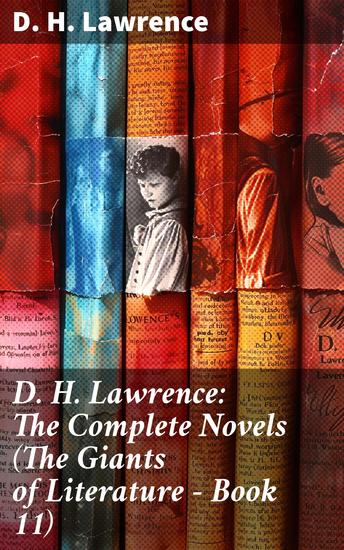
D H Lawrence: The Complete Novels (The Giants of Literature - Book 11) - Exploring Human Relationships in Lawrence's Psychological Realism - cover

D H Lawrence: The Complete Novels (The Giants of Literature - Book 11) - Exploring Human Relationships in Lawrence's Psychological Realism

D. H. Lawrence

Publisher: Good Press

  • 0
  • 0
  • 0

Summary

In 'D. H. Lawrence: The Complete Novels,' readers are presented with a comprehensive collection that encapsulates the breadth and depth of Lawrence'Äôs narrative artistry. This anthology showcases the author's diverse literary style, characterized by lush, vivid descriptions and an intense exploration of human emotion. Set against the backdrop of early 20th-century sociocultural shifts, the novels grapple with themes of sexuality, personal freedom, and the connection between humanity and the natural world, exposing the complexities of relationships and the human psyche. D. H. Lawrence, an emblematic figure in modernist literature, was born into a working-class family in England, experiencing the constraints of societal norms firsthand. His tumultuous upbringing, combined with a deep interest in psychology and philosophy, fueled his desire to challenge conventional moralities through literature. The socio-political turbulence of his time further inspired his characters'Äô struggles for authenticity and self-actualization, making his works resonate with urgency and relevance. This collection is a must-read for those interested in the interplay between art and life, as Lawrence's novels invite readers to confront their own understandings of existence. Ideal for both seasoned scholars and newcomers, this compilation serves as a gateway into the profound and often controversial insights of one of the 20th century's greatest literary figures.
Available since: 12/25/2023.
Print length: 4362 pages.

Other books that might interest you

  • Oh Whistle and I'll Come to You My Lad - cover

    Oh Whistle and I'll Come to You...

    M. R. James

    • 0
    • 0
    • 0
    Title: Oh, Whistle, and I’ll Come to You, My Lad 
    Author: M. R. James 
    Narrator: Jonathan Dunne 
    Original Publication: 1904 
    Public Domain: Yes 
    Series Placement: Timeless Terrors No. 60 
    Description: 
    Oh, Whistle, and I’ll Come to You, My Lad is among M. R. James’s most chilling and influential ghost stories — a masterpiece of creeping dread where the rational mind meets forces far beyond its understanding. 
    Professor Parkins, a staunch skeptic, takes a seaside holiday expecting rest and quiet. Instead, he unearths a mysterious bronze whistle at the remains of an ancient Templar site — an artifact inscribed with warnings that curiosity ignores at its peril. One careless blow of the whistle calls forth a presence woven from nightmares: a silent, predatory shape that haunts the spare bed and hunts the unbeliever who summoned it. 
    James conjures terror not through spectacle but through atmosphere — empty beaches, salt-stung winds, and a room where bedclothes stir with malevolent intent. This is horror born of scholarship, superstition, and the unseen prowling just beyond the candle’s reach. 
    Narrated by Amazon-bestselling horror author Jonathan Dunne, this performance restores the full tension and terror of one of the greatest ghost stories ever written. While the text is fully in the public domain, this narration and production are copyright © 2025 Jonathan Dunne. 
    Part of Timeless Terrors, a series dedicated to resurrecting the legends of classic horror, Oh, Whistle, and I’ll Come to You, My Lad reminds us that some relics were buried for a reason — and some calls should never be answered. 🕯️
    Show book
  • A Little Woman - A man tries to appease a woman frustrated with him in true Kafkaesque fashion - cover

    A Little Woman - A man tries to...

    Franz Kafka

    • 0
    • 0
    • 0
    Franz Kafka was born on 3rd July 1883 in Prague, then in Bohemia, the eldest of 6, into a middle-class Jewish family. 
     
    Life for the young Kafka and his passion for literature was often made an ordeal by his over-bearing and domineering entrepreneur of a father.   
     
    In 1889 Kafka was sent to the Deutsche Knabenschule, an elementary school in Prague. His father would only allow him to be educated in German-speaking schools and even went so far as to limit visits to the synagogue to four a year. 
     
    In 1901 he graduated from the classics-oriented Altstädter Gymnasium. Kafka did well there and across a large range of subjects.  He now enrolled at the Charles Ferdinand University, to study chemistry, but quickly switched to law for which he obtained his degree in June 1906 and then performed the mandatory year of unpaid service as clerk at the civil and criminal courts. 
     
    A job at an Italian insurance company left him little time to write and after a year he took another job with the Worker's Accident Insurance Institute for the Kingdom of Bohemia where he stayed until ill health led to his resignation in 1922. 
     
    Although he saw work as a means to pay the bills and to allow him time to write, he received several promotions and was noted as a good employee. 
     
    By 1917 Kafka was suffering from tuberculosis, which required frequent periods of convalescence. Interspersed with this, were several intense affairs before he settled in Berlin with Dora Diamant, a 25-year-old kindergarten teacher who herself having left the ghetto now influenced Kafka's interest in the book of Jewish law, the Talmud. 
     
    Kafka’s on-going health was littered with problems. Apart from TB there were several other ailments, including migraines, insomnia, boils, depression, all usually brought on by excessive stresses and strains. He attempted to counteract all of this by naturopathic treatments, a vegetarian diet and consuming large quantities of unpasteurized milk. 
     
    His tuberculosis still worsened. He returned to Prague, where he died on 3rd June 1924. He was 40. 
     
    His literary works are few in number but towering in influence.  His masterpieces include ‘The Trial’, ‘The Metamorphosis’ as well as a number of short stories which reveal facets of humankind that truthfully could only be born from Kafka’s brain and pen.
    Show book
  • Apple Blossom in Brittany - From their pens to your ears genius in every story - cover

    Apple Blossom in Brittany - From...

    Ernest Dowson

    • 0
    • 0
    • 0
    The bookshelves of British literature are incredible collections that have gathered together centuries of very talented authors.  From these Isles their fame spread and whilst among their number many are now forgotten or neglected their talents endure.  Among them is Ernest Dowson.
    Show book
  • The Dunwich Horror — Part 6 of 10 - cover

    The Dunwich Horror — Part 6 of 10

    H.P. Lovecraft

    • 0
    • 0
    • 0
    Welcome to Timeless Terrors No. 62, continuing H. P. Lovecraft’s escalating tale of cosmic terror: The Dunwich Horror. 
    Dunwich teeters on the edge of catastrophe. Wilbur Whateley’s rapid transformation and unholy knowledge have pushed him toward a desperate quest for the Necronomicon’s deepest secrets. As he ventures beyond Dunwich to obtain what he lacks, the true danger may no longer lie with Wilbur himself—but with what he and his grandfather have kept hidden in the sealed upper rooms of the Whateley farmhouse. 
    The invisible presence upstairs grows louder, larger, and more impossible to contain. Rumblings shake the hills at night. Strange footprints appear near the barns. Doors rattle without wind. The villagers feel the dread in their bones: something is waking… and nothing can stop it. 
    Narrated by Amazon-bestselling horror author Jonathan Dunne, this installment brings Lovecraft’s mounting dread to life, revealing the widening cracks between our world and ancient, indifferent powers lurking beyond it. 
    This is Part 6 of a 10-part complete audiobook. Stay tuned — the nightmare is about to break open.
    Show book
  • The Wild Duck - cover

    The Wild Duck

    Henrik Ibsen

    • 0
    • 0
    • 0
    "The Wild Duck" is a play written by Henrik Ibsen, a renowned Norwegian playwright. First published in 1884, it is considered one of Ibsen's most complex and psychologically intense works. "The Wild Duck" delves into themes of truth, illusion, and the consequences of deception, exploring the effects of hidden truths on individuals and their relationships. 
     
    The play revolves around the Ekdal family and their complex dynamics. Gregers Werle, a well-intentioned but idealistic outsider, enters their lives and sets in motion a chain of events that unravel long-held secrets. Central to the story is the metaphor of the wild duck, which represents the ideal of truth and the consequences of disrupting the illusions that people construct to protect themselves. 
     
    Through the characters' interactions and revelations, Ibsen explores the destructive nature of hidden truths and the self-deception that individuals engage in to maintain a fragile sense of happiness. The play raises questions about the value of truth, the masks people wear to navigate their lives, and the consequences of confronting or avoiding painful realities. 
     
    Ibsen's skillful character development and intricate plot twists make "The Wild Duck" a powerful exploration of human nature and the complexities of interpersonal relationships. The play challenges societal norms and exposes the destructive effects of maintaining illusions. It serves as a critique of social hypocrisy and the consequences of clinging to idealistic notions of truth. 
     
    "The Wild Duck" continues to be regarded as a significant work in the canon of modern drama. Its exploration of truth, illusion, and the consequences of deception resonates with audiences, prompting contemplation of the human capacity for self-deception and the inherent complexities of navigating relationships and society. 
    .
    Show book
  • The First Men in The Moon - The Lost Manuscript - cover

    The First Men in The Moon - The...

    H. G. Wells

    • 0
    • 0
    • 0
    Britain won the Moon Race! Decades before Neal Armstrong took his "giant leap for mankind" two intrepid adventurers from Lympne, England, journeyed there using not a rocket, but an antigravity coating. Mr. Bedford, who narrates the tale, tells of how he fell in with eccentric inventor Mr. Cavor, grew to believe in his research, helped him build a sphere for traveling in space, and then partnered with him in an expedition to the Moon. What they found was fantastic! There was not only air and water but the Moon was honeycombed with caverns and tunnels in which lived an advanced civilization of insect-like beings. While Bedford is frightened by them and bolts home, Cavor stays and is treated with great respect. So why didn't Armstrong and later astronauts find the evidence of all this? Well, according to broadcasts by Cavor over the newly-discovered radio technology, he told the Selenites too much about mankind, and apparently, they removed the welcome mat!  
     
    Herbert George Wells was an English writer. Prolific in many genres, he wrote more than fifty novels and dozens of short stories. His non-fiction output included works of social commentary, politics, history, popular science, satire, biography, and autobiography.
    Show book