Join us on a literary world trip!
Add this book to bookshelf
Grey
Write a new comment Default profile 50px
Grey
Subscribe to read the full book or read the first pages for free!
All characters reduced
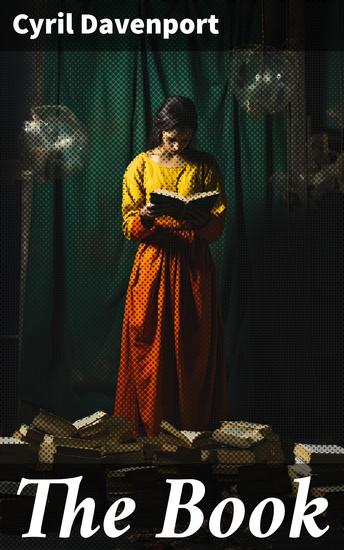
The Book - Its History and Development - cover

The Book - Its History and Development

Cyril Davenport

Publisher: Good Press

  • 0
  • 0
  • 0

Summary

In "The Book," Cyril Davenport intricately weaves a tapestry of literary exploration that transcends traditional narrative forms. Set in a world where the boundaries of reality and fiction blur, the text employs a postmodern style that reflects the complexity of contemporary existence. Davenport's use of metafictional elements invites readers to question the nature of storytelling itself, engaging with themes of identity, memory, and the fluidity of time. His stylistic choices, marked by fragmented prose and rich symbolism, create a layered reading experience that challenges and rewards the attentive reader. Cyril Davenport is a notable figure in contemporary literature, having emerged from an academic background steeped in philosophy and literary theory. Influenced by existentialism and post-structuralism, Davenport's writing often reflects his fascination with the intersection of life and literature. His previous works have garnered critical acclaim for their depth and innovation, and "The Book" represents a culmination of his ongoing dialogue with the art of narrative. For readers seeking an intellectually stimulating experience that prompts contemplation of the written word's role in shaping reality, "The Book" is a compelling choice. Its rich metafictional layers and thought-provoking themes ensure that it will resonate with both literary scholars and casual readers alike.
Available since: 10/29/2023.
Print length: 227 pages.

Other books that might interest you

  • How to Control Your Emotions - 10 Tips to Help You Conquer Your Emotions - cover

    How to Control Your Emotions -...

    Alex Wolf

    • 0
    • 0
    • 0
    You’re having a bad day, all your emotions are overwhelming you, and you have no idea what to do! All you feel like doing is laying in bed, crying, and eating some grossly saturated food. Going through emotional phases can be really difficult, as it feels like you’ve lost complete control over yourself. What if you were told you could take back control over yourself now? 
    Emotions can feel so strong and influential because they are! They can influence the decisions you make, how you live your life, and how you interact with others. It’s time to leave the negativity, stress, and depression behind, so you pursue life with positivity and freedom. 
    You have the power within you to conquer your emotions once and for all, through these 10 powerful tips. Read this book to learn how you can take back control over your emotions.
    Show book
  • Reparations - A Christian Call for Repentance and Repair - cover

    Reparations - A Christian Call...

    Gregory Thompson, Duke L. Kwon

    • 0
    • 0
    • 0
    Christians are awakening to the legacy of racism in America like never before. While public conversations regarding the realities of racial division and inequalities have surged in recent years, so has the public outcry to work toward the long-awaited healing of these wounds. But American Christianity, with its tendency to view the ministry of reconciliation as its sole response to racial injustice, and its isolation from those who labor most diligently to address these things, is underequipped to offer solutions. Because of this, the church needs a new perspective on its responsibility for the deep racial brokenness at the heart of American culture and on what it can do to repair that brokenness. 


    This book makes a compelling historical and theological case for the church's obligation to provide reparations for the oppression of African Americans. Duke Kwon and Gregory Thompson articulate the church's responsibility for its promotion and preservation of white supremacy throughout history, investigate the Bible's call to repent and make restitution, and offer concrete examples of the work of reparation at the local level. They lead listeners toward a moral imagination that views reparations as a long-overdue and necessary step in our collective journey toward healing and wholeness.
    Show book
  • Flowers Guns and Money - Joel Roberts Poinsett and the Paradoxes of American Patriotism - cover

    Flowers Guns and Money - Joel...

    Lindsay Schakenbach Regele

    • 0
    • 0
    • 0
    A fascinating historical account of a largely forgotten statesman, who pioneered a form of patriotism that left an indelible mark on the early United States. 
     
    Joel Roberts Poinsett’s (1779–1851) brand of self-interested patriotism illuminates the paradoxes of the antebellum United States. He was a South Carolina investor and enslaver, a confidant of Andrew Jackson, and a secret agent in South America who fought surreptitiously in Chile’s War for Independence. He was an ambitious Congressman and Secretary of War who oversaw the ignominy of the Trail of Tears and orchestrated America’s longest and costliest war against Native Americans, yet also helped found the Smithsonian. In addition, he was a naturalist, after whom the poinsettia—which he appropriated while he was serving as the first US ambassador to Mexico—is now named. 
      
    As Lindsay Schakenbach Regele shows in Flowers, Guns, and Money, Poinsett personified a type of patriotism that emerged following the American Revolution, one in which statesmen served the nation by serving themselves, securing economic prosperity and military security while often prioritizing their own ambitions and financial interests. Whether waging war, opposing states’ rights yet supporting slavery, or pushing for agricultural and infrastructural improvements in his native South Carolina, Poinsett consistently acted in his own self-interest. By examining the man and his actions, Schakenbach Regele reveals an America defined by opportunity and violence, freedom and slavery, and nationalism and self-interest.
    Show book
  • Ships from History - A Brief Historic Overview of the Mayflower and the Titanic - cover

    Ships from History - A Brief...

    Kelly Mass

    • 0
    • 0
    • 0
    This combo consists of 2 books: 
    1 - Mayflower: In 1620, a group of English families, known now as the Pilgrims, were carried from England to the New World on the Mayflower. When the Mayflower finally showed up in America on November twenty-first, 1620, it had 102 guests and a team of around 30 on board and was anchored off Cape Cod. 
    The Pilgrims, as opposed to their Puritan coworkers, chose to break away from the Church of England because of its Roman Catholic heritage and the church's hesitation to reform, requiring them to pray in personal instead of in the church. In 1608, a group of English families left England for the Netherlands, where they could practice their faith without fear of persecution. As early as 1620, the Plymouth Group population had determined to cross the Atlantic to the New World, which they viewed as a "new Promised Land." 
    2 - Titanic: At the time of her first journey from Southampton to N.Y. City, RMS Titanic hit an iceberg and died in the North Atlantic Ocean on April fifteenth, 1912. An overall of 2,224 guests and team were reported to have been on board when the ship sank, making it one of the absolute worst single ship catastrophes and the absolute worst peacetime superliner or cruise liner sinking to date. As a result of the general public's interest in the after-effects, the mishap has acted as a structure for the category of catastrophe movies. 
    The RMS Titanic was the second of 3 Olympic-class ocean liners run by the White Star Line when she began service in the year 1912. Harland & Wolff shipyard in Belfast produced her. That mishap said the life of the shipyard's Chief Naval Designer, Thomas Andrews.
    Show book
  • Pepper - A History of the World's Most Influential Spice - cover

    Pepper - A History of the...

    Marjorie Shaffer

    • 0
    • 0
    • 0
    “This is more than the story of a spice . . . Get ready for a sweeping ride through history.” ―David Oshinsky, Pulitzer Prize–winning authorThe perfect companion to Mark Kurlansky's Salt: A World History, Pepper illuminates the rich history of pepper for a popular audience. Vivid and entertaining, it describes the part pepper played in bringing the Europeans, and later the Americans, to Asia and details the fascinating encounters they had there. As Mark Pendergrast, author of Uncommon Grounds, said, “After reading Marjorie Shaffer's Pepper, you'll reconsider the significance of that grinder or shaker on your dining room table. The pursuit of this wizened berry with the bite changed history in ways you've never dreamed, involving extraordinary voyages, international trade, exotic locales, exploitation, brutality, disease, extinctions, and rebellions, and featuring a set of remarkable characters.”From the abundance of wildlife on the islands of the Indian Ocean, which the Europeans used as stepping stones to India and the East Indies, to colorful accounts of the sultan of Banda Aceh entertaining his European visitors with great banquets and elephant fights, this fascinating book reveals the often surprising story behind one of mankind's most common spices.“Using first-person accounts from journals and ships' logs, Shaffer crafts a textured story of exploration, danger, wealth and greed. Readers will find adventures on the high seas, pirates, ambitious Jesuits, sultans living in opulence and the plunder of what was once considered a ‘Garden of Eden’ . . . A vividly told story of a common spice’s uncommon history.” —Kirkus Reviews“A delightful history of the Indian Ocean and the South Seas.” ―Robert D. Kaplan, New York Times–bestselling author
    Show book
  • On This Day in Politics - Britain's Political History in 365 Days - cover

    On This Day in Politics -...

    Iain Dale

    • 0
    • 0
    • 0
    Who became Britain's first Prime Minister on 3 April 1721? 
    When was Karl Marx born? 
    Where and when was the first battle of the Wars of the Roses? 
    When did Big Ben first bong? 
    When did the first British woman cast her vote? (Clue: It wasn't 1918.) 
     
    Find the answers to these questions and many more in this landmark political history. 
     
    From the first meeting of an elected English parliament on 20 January 1265 to the tabling of the Bill of Rights on 13 February 1689; from the Peterloo massacre of 16 August 1819 to Britain voting to leave the EU on 23 June 2016, there is a growing thirst for knowledge about the history of our constitutional settlement, our party system and how our parliamentary democracy has developed. 
     
    Writing as an observer of political history, but also as someone with an opinion, acclaimed political broadcaster Iain Dale charts the main events of the last few hundred years, with one event per page, per day. 
     
    'The indefatigable Iain Dale always cuts to the nub of politics.' Adam Boulton
    Show book