Join us on a literary world trip!
Add this book to bookshelf
Grey
Write a new comment Default profile 50px
Grey
Subscribe to read the full book or read the first pages for free!
All characters reduced
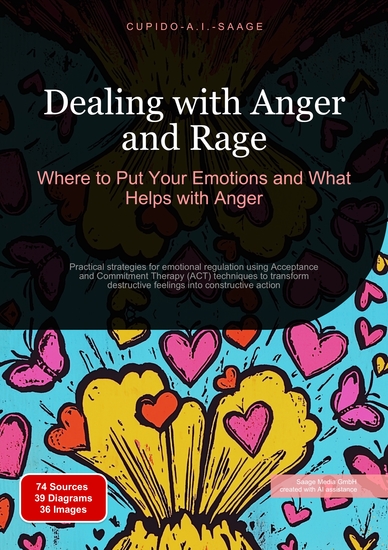
Dealing with Anger and Rage - Where to Put Your Emotions and What Helps with Anger - cover

Dealing with Anger and Rage - Where to Put Your Emotions and What Helps with Anger

Cupido A.I. Saage

Translator Cupido A.I. Saage

Publisher: Saage Media GmbH

  • 0
  • 0
  • 0

Summary

Are you struggling with overwhelming anger that disrupts your relationships, work, and inner peace? 'Dealing with Anger and Rage' offers a comprehensive approach to understanding and managing these powerful emotions through evidence-based Acceptance and Commitment Therapy (ACT) techniques.
This practical guide helps you transform your relationship with anger by first understanding its physiological and psychological foundations. You'll learn to recognize your personal anger patterns and identify specific triggers that set off your emotional responses. Rather than viewing anger as an enemy to be suppressed, this book teaches you to see it as valuable information about your needs and boundaries.
The book provides both immediate strategies for de-escalation during intense moments and long-term approaches for sustainable change:
• Discover where to put your anger through creative channeling and constructive communication
• Learn what helps with anger through specific ACT techniques that create space between you and your emotions
• Develop mindfulness practices that allow you to observe anger without being consumed by it
• Explore value-based responses that transform destructive impulses into meaningful action
Unlike approaches that focus solely on anger management, Acceptance and Commitment Therapy offers a unique perspective: accepting emotions while committing to behaviors aligned with your core values. This balance helps you respond to challenging situations with flexibility rather than reactivity.
Whether you're dealing with occasional irritation or struggling with rage that feels beyond control, this book provides practical tools to:
• Regulate your emotional responses in the moment
• Communicate effectively even when emotions run high
• Develop self-compassion around difficult feelings
• Build healthier relationships through improved emotional awareness
Transform your relationship with anger and reclaim your emotional well-being with this accessible guide to applying Acceptance and Commitment Therapy in your daily life.
For this book, we relied on innovative technologies, including Artificial Intelligence and tailor-made software solutions. These supported us in numerous process steps: brainstorming and research, writing and editing, quality assurance, as well as the creation of decorative illustrations.
We aim to provide you with a reading experience that is particularly harmonious and contemporary.
Available since: 05/21/2025.
Print length: 213 pages.

Other books that might interest you

  • The Menace of Prosperity - New York City and the Struggle for Economic Development 1865–1981 - cover

    The Menace of Prosperity - New...

    Daniel Wortel-London

    • 0
    • 0
    • 0
    Many local policymakers make decisions based on a deep-seated belief: what’s good for the rich is good for cities. Convinced that local finances depend on attracting wealthy firms and residents, municipal governments lavish public subsidies on their behalf. Whatever form this strategy takes—tax-exempt apartments, corporate incentives, debt-financed mega projects—its rationale remains consistent and assumed to be true. But this wasn’t always the case. Between the 1870s and the 1970s, a wide range of activists, citizens, and intellectuals in New York City connected local fiscal crises to the greed and waste of the rich. These figures saw other routes to development, possibilities rooted in alternate ideas about what was fiscally viable. 
      
    In The Menace of Prosperity, Daniel Wortel-London argues that urban economics and politics are shaped by what he terms the “fiscal imagination” of policymakers, activists, advocates, and other figures. His survey of New York City during a period of explosive growth shows how residents went beyond the limits of redistributive liberalism to imagine how their communities could become economically viable without the largesse of the wealthy. Their strategies—which included cooperatives, public housing, land-value taxation, public utilities, and more—centered the needs and capabilities of ordinary residents as the basis for local economies that were both prosperous and just. 
      
    Overturning stale axioms about economic policy, The Menace of Prosperity shows that not all growth is productive for cities. Wortel-London’s ambitious history demonstrates the range of options we’ve abandoned and hints at the economic frameworks we could still realize—and the more democratic cities that might result.
    Show book
  • Persecution of Jews in Medieval Spain The: The History of the Discrimination and Expulsion of Spanish Jews during the Reconquista and Inquisition - cover

    Persecution of Jews in Medieval...

    Editors Charles River

    • 0
    • 0
    • 0
    The term “Reconquista” is a Spanish word transferred to the English language to represent the nearly 800 years in which the Moors and Christians struggled against one another for control of the Iberian Peninsula. Although the phrase typically refers to the time when the numerous Christian kingdoms mobilized to overthrow the Islamic Caliphates set up in the peninsula, the term can additionally be used to refer to the entire situation starting in the 8th century, when Islamic civilization slowly moved out of North Africa, across the Mediterranean Sea, and into southern Iberia.  
    	Not surprisingly, three religions attempting to coexist during medieval times resulted in nearly incessant conflicts, marked by high taxation, disparate societies, rigid cultural controls, and systemic violence. Despite the odds, these three religions managed to live in a state of quasi-acceptance and peace in most of the major cities like Cordoba and Toledo, with sporadic warfare occurring on the borders between Al-Andalus and the Christian kingdoms near the Pyrenees Mountains. Muslims, Christians, and Jews would attempt to reorganize their societies several times over the centuries through warfare, always with Jews on the lower rungs and Christians and Muslims fighting it out above them.   
    	By the end of the 14th century, the distrust and prejudice against Jewish communities quickly spread to Spain. In 1391, James II of Aragon boarded the bandwagon; backed into a corner by the Roman Catholic Church, he established a law that banned Jews from Spain altogether. Jews were shunned in droves, and the remaining were given an ultimatum to either convert/revert to Catholicism or face immediate death. Yet another wave of gory pogroms ensued across the country, especially in Barcelona.
    Show book
  • Leadership Is Influence - A Three-Pronged Approach To Becoming A Leader of Influence - cover

    Leadership Is Influence - A...

    Paul Lawrence Vann

    • 0
    • 0
    • 0
    Why do some people become good leaders, yet never become leaders of influence? Furthermore, do good leaders know their primary function is to influence members of their staff, including their managers, and employees? 
    "The most important leadership lessons I have learned in over thirty years of leadership, says Vann, is to influence and develop others around you." 
    In order for a good leader to become a leader of influence, they must develop all members of their staff to become leaders. By developing other leaders, the organization as a whole maximizes its human potential, develops a competitive advantage in its industry, and improves its bottom line. 
    The fact of the matter is this, no matter whether you are an employee or manager without the title of the leader of a company or organization, you are still a leader in your role. You do not have to have the title of a leader to be one. Leadership Is Influence can help you to become a leader and over time, you can become a leader of influence, you have to do the work to make it happen.
    Show book
  • Ancient Egyptian Gods - From Ra to Anubis - cover

    Ancient Egyptian Gods - From Ra...

    Odessa Nightshade

    • 0
    • 0
    • 0
    Ancient Egyptian civilization was deeply intertwined with religion, and at the heart of their belief system was a vast pantheon of gods and goddesses. These deities were more than just figures of worship; they shaped every aspect of daily life, from the rising of the sun to the passage into the afterlife. Unlike many modern religions, Egyptian theology was fluid, allowing gods to merge, evolve, or take on different roles depending on the time and region. This dynamic belief system gave rise to a rich mythology that endured for thousands of years.   
    The gods of Egypt were not distant, abstract beings but rather personal and deeply involved in the world. They governed nature, oversaw justice, protected the people, and maintained cosmic balance, known as *ma’at*. The concept of *ma’at* was central to Egyptian religion, representing order, harmony, and truth. It was the gods' duty to uphold *ma’at* against chaos, often personified by Set, the god of disorder and storms. This cosmic struggle played out in myths, particularly in the tales of Osiris, Isis, and Horus, which symbolized the eternal battle between good and evil, life and death.  
    Temples were the primary centers of worship, serving as both religious and political institutions. Each major city had its patron deity, and grand temples were built to honor and house these gods. Priests conducted daily rituals, offering food, incense, and prayers to ensure divine favor. Unlike in many other religions, common Egyptians were not allowed direct access to the inner sanctums of temples, where the gods' statues resided. Instead, they worshipped through prayers, festivals, and personal altars in their homes. 
    Show book
  • The Simple Guide to ADHD Regulation - The Secret to Finding Balance Getting Things Done and Enjoying Your Life - cover

    The Simple Guide to ADHD...

    CCC Jenna Free

    • 0
    • 0
    • 0
    One minute you’re on a roll, churning out work like a machine. Then, the next day even putting on socks feels overwhelming. Sound familiar? This frantic crash cycle isn’t just a personality quirk or laziness. As therapist Jenna Free (@adhdwithjennafree) explains, the real culprit to your ADHD highs and lows is dysregulation. 
    If you have ADHD (or simply suspect you do) and you’ve found yourself frustrated with all of the hacks—half-completed planners, too many screenshots to count, timers going off every 30 minutes, and sticky notes covering your desk and walls— you’re not alone. If all these “solutions” have fallen flat and you’re struggling to keep your head above water—this book is for you. 
    The Simple Guide to ADHD Regulation can help you reset your nervous system, gain control of your life, and even begin to enjoy it. 
    What you’ll discover inside:Reasons why ADHD often feels like chaotic highs and crashing lowsExplanations of how fight, flight, freeze, and fawn responses shape your daily strugglesPractical steps to reset your nervous system, thoughts, and actionsTools to help you stop avoiding tasksPrompts to help you zoom out to what really matters mostEngaging sidebars and fun graphics to bring the teachings to life 
    What you won’t find inside?Quick fixes and band aidsHard assignments and homeworkShame and shoulds 
      
    Plus, this book is full of fun graphics and illustrations, so if the thought of a long, boring book is overwhelming you—no fear! As someone who has ADHD herself, Jenna made this book specifically designed with your brain in mind! If you're ready to rethink how you approach ADHD, take back control, and finally live a life that doesn’t feel so hard, we’ve got you. 
      
    (P.S. You'll even figure out why putting on socks feels impossible some days. . . and how to overcome it!)
    Show book
  • Urban Policy and Governance - Challenges and Solutions - cover

    Urban Policy and Governance -...

    Lyric Vale

    • 0
    • 0
    • 0
    Urban policy and governance are central to shaping the future of cities worldwide. As urban areas continue to expand, the challenges faced by city leaders, policymakers, and residents grow ever more complex. Urban policy refers to the strategies, frameworks, and regulations that guide the development and management of cities. It encompasses everything from housing and infrastructure to social equity, environmental sustainability, and economic growth. Governance, on the other hand, focuses on the decision-making processes, institutions, and actors responsible for implementing these policies. Effective urban governance ensures that cities function smoothly and equitably while addressing the diverse needs of their populations. 
    The rapid pace of urbanization has been a defining feature of the 21st century, with over half of the world's population now living in cities. This urban shift presents numerous challenges, including overcrowding, resource scarcity, environmental degradation, and social inequality. However, it also creates opportunities for innovation and progress. A well-crafted urban policy can harness the potential of urbanization to improve quality of life, create economic opportunities, and foster sustainability. 
    Urban governance is shaped by various factors, including political, economic, and social dynamics. At its core, it involves coordinating efforts among multiple stakeholders, such as local governments, private sector entities, civil society groups, and international organizations. The collaboration between these actors is crucial to addressing the complex and interconnected issues that cities face. Effective governance must be inclusive, transparent, and accountable to ensure that all voices, particularly those of marginalized communities, are heard and considered in decision-making processes.
    Show book