¡Acompáñanos a viajar por el mundo de los libros!
Añadir este libro a la estantería
Grey
Escribe un nuevo comentario Default profile 50px
Grey
Suscríbete para leer el libro completo o lee las primeras páginas gratis.
All characters reduced
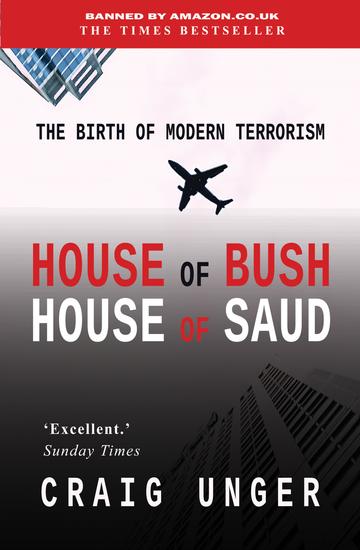
House of Bush House of Saud - The Birth of Modern Terrorism - cover

House of Bush House of Saud - The Birth of Modern Terrorism

Craig Unger

Editorial: Gibson Square

  • 0
  • 0
  • 0

Sinopsis

In 2001, the 9/11 attacks awoke the world to the military-style threat of Islamism. Due to the White House, the nationality of fifteen Saudis among the nineteen suicide bombers remained cast in shadows. In this exceptional tour-de-force, Craig Unger meticulously pieces together the US role in the birth of modern terrorism by relying on research and interviews with those who would prefer to deny the truth.The acclaimed account of the link between modern terrorism and Saudi and corporate greed whose first UK publisher cancelled for fear of libel, and which several online retailers dared not stock.'Excellent.'—Sunday Times'A notably intelligent piece of investigative reporting which lights the blue touch-paper.'—Observer'A forensic examination.'—Daily Telegraph'Very powerful.'—Guardian, book of the week'Hard-hitting.'—Independent on Sunday'An explosive book.'—Scotland on Sunday'None can match this.'—Irish Times'Well-sourced... cool, calm and collected.'—Times Higher Education Supplement'As chilling as it is gripping.'—Belfast Telegraph'Craig Unger has done America and the world a huge favor.'—Michael Moore, Director of Fahrenheit 9/11, the movie inspired by House of Bush House of Saud'Unger's meticulously researched book raises troubling questions about the ties between the Bush family and the Saudi royal family, especially in the aftermath of 9/11. It's a provocative read that challenges conventional narratives.'—The Washington Post'Craig Unger's House of Bush, House of Saud is a compelling and disturbing account of the intertwining interests of two powerful families. While some may dismiss it as conspiracy theory, the depth of research demands attention.'—The Washington Post'Unger's book is a gripping and unsettling exploration of the Bush-Saudi nexus. It's a damning indictment of how personal and financial interests can overshadow national security.'—The Guardian'Craig Unger's House of Bush, House of Saud is a meticulously documented account of the symbiotic relationship between two of the world's most powerful families. It's a chilling read that raises more questions than it answers.'—The Independent'Unger's book is a riveting and deeply researched exposé that sheds light on the shadowy connections between the Bush family and the Saudi elite. It's a sobering reminder of the complexities of global power dynamics.'—The Sydney Morning Herald'Craig Unger's House of Bush, House of Saud is a provocative and eye-opening investigation into the ties that bind American politics and Saudi wealth. It's a must-read for anyone interested in the hidden forces behind global events.'—Le Monde'Unger's book is a meticulously researched and deeply unsettling account of the Bush-Saudi relationship. It's a powerful critique of the intersection of politics, oil, and terrorism.'—Der Spiegel'Craig Unger's House of Bush, House of Saud is a provocative and deeply researched account of the intricate ties between the Bush family and the Saudi royal family. While some of its claims are controversial, the book provides valuable insights into the intersection of oil, politics, and terrorism.'—Foreign Affairs'Unger's book is a bold and controversial examination of the ties between the Bush family and the Saudi royal family. While some may question its conclusions, the depth of research and the questions it raises make it a valuable contribution to the field.'—International Affairs
Disponible desde: 14/02/2025.
Longitud de impresión: 356 páginas.

Otros libros que te pueden interesar

  • The Politics of Digital Pharmacology - Exploring the Craft of Collective Care - cover

    The Politics of Digital...

    Felix Heidenreich, Florian...

    • 0
    • 1
    • 0
    Digitization is transforming our world economically, culturally, and psychologically. The influx of new forms of communication, networking, and business opportunities, as well as new types of distraction, self-observation, and control into our societies represents an epochal challenge. Following Bernard Stiegler's concept of pharmacology, Felix Heidenreich and Florian Weber-Stein propose to view these new forms as digital pharmaka. Properly dosed, they can enable new self-relationships and forms of sociality; in the case of overdose, however, there is a risk of intoxication.
    In this essay, Felix Heidenreich, Florian Weber-Stein, and, in a detailed interview, Bernard Stiegler analyze this complex change in our world and develop new skills to use digital pharmaka.
    Ver libro
  • Moscow Rules - What Drives Russia to Confront the West - cover

    Moscow Rules - What Drives...

    Keir Giles

    • 0
    • 0
    • 0
    From Moscow, the world looks different. It is through understanding how Russia sees the world—and its place in it—that the West can best meet the Russian challenge. 


    Russia and the West are like neighbors who never seem able to understand each other. A major reason, this book argues, is that Western leaders tend to think that Russia should act as a "rational" Western nation—even though Russian leaders for centuries have thought and acted based on their country's different history and traditions. Russia, through Western eyes, is unpredictable and irrational, when in fact its leaders almost always act in their own predictable and rational ways. For Western leaders to try to engage with Russia without attempting to understand how Russians look at the world is a recipe for repeated disappointment and crises. 


    Keir Giles, a senior expert on Russia at Britain's prestigious Chatham House, describes how Russian leaders have used consistent doctrinal and strategic approaches to the rest of the world. These approaches may seem alien in the West, but understanding them is essential for successful engagement with Moscow. Giles argues that understanding how Moscow's leaders think—not just Putin but his predecessors and eventual successors—will help counterparts in the West develop a less crisis-prone and more productive relationship with Russia.
    Ver libro
  • Why Vote - How to make your voice heard in a world of broken politics - cover

    Why Vote - How to make your...

    Joe Phillips, David Seymour

    • 0
    • 0
    • 0
    Swamped beneath the tide of fake news, wars on woke and social media storms lies democracy. Jo Phillips and David Seymour guide the reader through the workings of government and Parliament and make a passionate case for the power of democracy. Their argument is that young people should take back control of the future, hold politicians to account and get involved.
    In the last decade we've had a Brexit referendum, the Covid pandemic, war in Ukraine and Gaza, increasing fears over the climate emergency, a new monarch and since 2010, six Prime Ministers.
    Britain's influence in the world has been diminished, freedom to protest peacefully has been curtailed, the cost of further education is a concern, the health service is in crisis and the likelihood of owning your own home or even finding somewhere to rent is becoming less and less.
    If younger people turned out to vote in the same numbers that older people do, this country would be a very different place. Apathy is the enemy, not the answer.
    Ver libro
  • A Greater Britain - Rethinking the UK's Global Strategy - cover

    A Greater Britain - Rethinking...

    Azeem Ibrahim

    • 0
    • 0
    • 0
    Britain is no longer the great power it once was. Caught between an unmoored America and a fractured Europe, it confronts rising authoritarian challenges from China and Russia, while its domestic debates drift into abstract moralising. Lacking a coherent vision for the future, the country risks sliding further into managed decline, its global relevance steadily eroding.
    Yet such a trajectory is not inevitable. In this clear-eyed assessment of Britain's economic, ideological and strategic vulnerabilities, Azeem Ibrahim identifies the essential building blocks of renewal. He outlines a programme of reforms that will allow a genuinely independent Britain to capitalise on its core strengths. After all, as a lean and specialised nuclear power with one of the world's most sophisticated intelligence networks, as well as world-class universities and a cultural reach second only to the US, the UK can still shape global affairs.
    A Greater Britain argues that a clear strategic anchor and bold leadership are needed if the UK is to convert its advantages into real influence. By formulating a pioneering Knowledge Power Doctrine, the book offers a global strategy for a once powerful nation, providing nothing short of a roadmap back to British greatness.
    Ver libro
  • Socialized Medicine - cover

    Socialized Medicine

    Ronald Reagan

    • 0
    • 0
    • 0
    In 1961 Reagan spoke out against socialized medicine. Since 1965 when Medicare and Medicaid were enacted, the federal government controls payment for most U.S. healthcare: hospitals, drugs, doctors, nurses, and so on. Has this been a blessing or a curse? 
    Milton Friedman, the small, talkative, smiling genius, perhaps the best economist ever, argued that governments should give the deserving needy money to buy education, housing, and healthcare, but should never give goods or services such as govenment schools, government housing, or medical services. 
    Would this small change make a big difference? Prior to 1965, U.S. health insurance was medically underwritten. When a person applied for insurance, they were weighed and tested to see how healthy they were. If they were unhealthy, premiums were high, and coverage limited. 
    The result was that people had powerful financial incentives to adopt a healthy diet and lifestyle. Under Medicare, Medicaid, and Obamacare, medical underwriting is illegal and the financial incentive for a healthy diet is eliminated. Epidemics of obesity, type 2 diabetes, and chronic disease since 1965 are the result. And the cost of medical services without market competition has exploded. 
    If the elderly and needy were paid in cash rather than medical services, and purchased medical services in competitive, risk-based markets, people would have strong incentive to adopt fiber-based diets of vegetables, fruit, nuts, seeds, and whole grains, and avoid animal foods and low-fiber processed foods that promote chronic disease. 
    The left blames the food industry for our poor diet, but the federal government’s control of medical services and abolition of medical underwriting are the true causes of the obesity and diabetes crisis that afflicts America, and the reason healthcare is so amazingly expensive. Competitive markets would benefit the elderly, the needy, and the country. 
    AspenLeafMedia.com
    Ver libro
  • An Enemy of the Crown - The British Secret Service Campaign against Charles Haughey - cover

    An Enemy of the Crown - The...

    David Burke

    • 0
    • 0
    • 0
    In the early 1970s, Sir Maurice Oldfield of the British Secret Service, MI6, embarked upon a decade-long campaign to derail the political career of Charles Haughey. The English spymaster believed Haughey was a Provisional IRA godfather, therefore, a threat to Britain. Oldfield was assisted by unscrupulous British agents and by a shadowy group of conspirators inside the Irish state's security apparatus, all sharing his distrust of Haughey. Escaping scrutiny for their actions until now, Enemy of the Crown examines more than a dozen instances of their activities.
    Oldfield was conspiratorial by nature and lacked a moral compass. Involved in regime change plots and torture in the Middle East, in the Republic of Ireland he engaged with convicted criminals as agent provocateurs as well as the exploitation of pedophile rings in Northern Ireland. He and his spies engaged in dirty tricks as they ran vicious smear campaigns in Ireland, Britain and the US. MI6 and IRD intrigues were deployed to impede Haughey's bid to secure a position on Fianna Fáil's front bench and any return to respectability.
    London's hateful drive against Haughey saw no let-up after Fianna Fáil's triumphal return to power in 1977 which saw them win a large majority of seats in the Dáil. When Haughey sought a place at Cabinet, Oldfield and his spies devised more dirty tricks to impede him. While Haughey was suspicious of MI6 interference, he had no inkling of the full extent of London's clandestine efforts to destroy him. By circulating lurid stories about him, they played a major part in trying to prevent him succeed Jack Lynch as Taoiseach in 1979. This book attempts to shed light on some of the anti-Haughey conspiracies which took place during the period of the late 1960s right through to the early 1980s.
    Ver libro