Join us on a literary world trip!
Add this book to bookshelf
Grey
Write a new comment Default profile 50px
Grey
Subscribe to read the full book or read the first pages for free!
All characters reduced
The History of the Russian Campaign - Undertaken by the Emperor Napoleon in the Year 1812 - cover

The History of the Russian Campaign - Undertaken by the Emperor Napoleon in the Year 1812

Count Philip de Segur

Publisher: Good Press

  • 0
  • 0
  • 0

Summary

In "The History of the Russian Campaign," Count Philip de Segur delivers a meticulous account of the catastrophic 1812 invasion of Russia by Napoleon's Grande Arm√©e. Written with a sharp narrative style, the book intertwines rigorous military analysis with vivid personal reflections, creating a compelling chronicle that transcends mere historical record. De Segur captures the psychological complexities of war, the unforgiving Russian landscape, and the fate of a colossal army caught in the turmoil of an ill-fated campaign, all while articulating broader themes of ambition, hubris, and the unpredictable nature of fate in military endeavors. As a French diplomat and officer who witnessed the events firsthand, de Segur's insights stem from a deeply personal and professional engagement with the Napoleonic Wars. His aristocratic background and extensive military experience afford him a nuanced understanding of both the high command's decisions and the soldiers' plight. De Segur'Äôs reflections often reveal a poignant awareness of the human cost of war, underscoring the author'Äôs belief in the moral consequences of conflict and ambition. This book is recommended for anyone interested in military history, Napoleonic studies, or the broader implications of war on society. De Segur's eloquent prose and astute observations not only enrich our understanding of the Russian campaign but also invite readers to reflect on the enduring lessons of history.
Available since: 12/21/2023.
Print length: 578 pages.

Other books that might interest you

  • Polyvagal Practices - Anchoring the Self in Safety - cover

    Polyvagal Practices - Anchoring...

    LCSW Deb Dana

    • 0
    • 0
    • 0
    Bringing the benefits of polyvagal theory to listeners through easy-to-implement exercises. 


    Here, for the first time, is a layperson's explanation of polyvagal theory, an approach to mental health and well-being that has taken the clinical world by storm. A polyvagal approach to life is based on the knowledge that the autonomic nervous system is shaped by early experience and reshaped with ongoing experience. This short book will offer an overview for nonspecialists and provide a series of exercises and meditations (practices) that will allow listeners to tune into their nervous systems, providing calming prompts to build and strengthen ventral vagal connections. 


    This book includes a comprehensive chapter on polyvagal theory, preceded by exercises that focus on mapping, reflecting, listening, deepening, creating, and connecting. Listeners who want to change a pattern and find new rhythm for their nervous systems can use this material to work toward those goals.
    Show book
  • Start of World War II in the Pacific Theater The: The History of the Attack on Pearl Harbor the Doolittle Raid and the Philippines Campaign of 1941-42 - cover

    Start of World War II in the...

    Editors Charles River

    • 0
    • 0
    • 0
    All Americans are familiar with the “day that will live in infamy.” At 9:30 a.m. on Sunday, December 7, 1941, Pearl Harbor, the advanced base of the United States Navy’s Pacific Fleet, was ablaze. It had been smashed by aircraft launched by the carriers of the Imperial Japanese Navy. All eight battleships had been sunk or badly damaged, 350 aircraft had been knocked out, and over 2,000 Americans lay dead. Indelible images of the USS Arizona exploding and the USS Oklahoma capsizing and floating upside down have been ingrained in the American conscience ever since. In less than an hour and a half the Japanese had almost wiped out America’s entire naval presence in the Pacific.  
    	Those who had decoded and seen the Japanese communications in early December 1941 would not be surprised when they heard about an attack on December 7, 1941. They would, however, be astonished when they heard where that attack took place. Posted on the other side of the world, it was early on the morning of December 8 in the Philippines when American general Douglas MacArthur received news of the Japanese attack on Pearl Harbor hours earlier. With that, it could only be a matter of time before the Japanese attacked the Philippines. 
    	The Americans would turn the war in the Pacific around in the middle of 1942, but in the wake of Pearl Harbor and the Japanese invasion of the Philippines, the country was in desperate need of a morale boost, and it would come in the form of the Doolittle Raid. In part to show that the Japanese were not invincible, and in part to reassure the American public that the nation would not lose the war, the Doolittle Raid included both Army and Navy units that launched 16 land-based medium bombers from an aircraft carrier, a feat that was the first of its kind but also one involving a great deal of risk.
    Show book
  • Profit over Privacy - How Surveillance Advertising Conquered the Internet - cover

    Profit over Privacy - How...

    Matthew Crain

    • 0
    • 0
    • 0
    In Profit over Privacy, Matthew Crain gives internet surveillance a much-needed origin story by chronicling the development of its most important historical catalyst: web advertising. 


    Profit over Privacy uses the 1990s as its backdrop to show how the massive data-collection infrastructure that undergirds the internet today is the result of twenty-five years of technical and political economic engineering. Crain considers the social causes and consequences of the internet's rapid embrace of consumer monitoring, detailing how advertisers and marketers adapted to the existential threat of the internet and marshaled venture capital to develop the now-ubiquitous business model called "surveillance advertising." He draws on a range of primary resources from government, industry, and the press and highlights the political roots of internet advertising to underscore the necessity of political solutions to reign in unaccountable commercial surveillance. 


    Surveillance advertising is the result of political choices—not the inevitable march of technology. Unlike many other countries, the United States has no internet privacy law. A fascinating prehistory of internet advertising giants like Google and Facebook, Profit over Privacy argues that the internet did not have to turn out this way and that it can be remade into something better.
    Show book
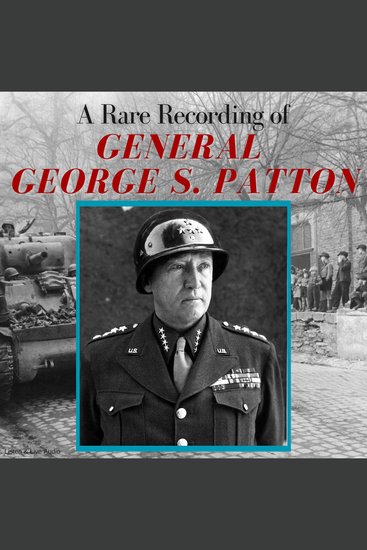
  • A Rare Recording of General George S Patton - cover

    A Rare Recording of General...

    General George S. Patton

    • 0
    • 0
    • 0
    George Smith Patton Jr. (November 11, 1885 - December 21, 1945) was a charismatic, hard-driving and highly-regarded general in the United States Army who commanded the Seventh United States Army in the Mediterranean Theater of World War II, and the Third United States Army in France and Germany after the Allied invasion of Normandy in June 1944. The following is from a speech Patton gave in Los Angeles during World War II.
    Show book
  • Winning on My Terms: How I Changed the Rules - Unlock success with "Winning on My Terms"—audio lessons that redefine your test preparation journey! - cover

    Winning on My Terms: How I...

    Blake Thorne

    • 0
    • 0
    • 0
    Winning on My Terms: How I Changed the Rules 
    Are you aiming to advance in your career and strengthen your knowledge by embracing "Challenge the Norms and Own Your Path"? 
    Looking for a thorough guide that offers all the necessary elements to own your journey? 
    Your search ends here! 
    This guide acts as your ultimate companion for enhancing understanding, applying skills, and engaging in hands-on exercises, preparing you for success. 
    Key features of this enriched guide: 
    - Profound insights about embracing and redefining success 
    - Detailed explanation of how to challenge conventional paths 
    - Effective strategies for preparation and overcoming obstacles  
    Our guide stands out with comprehensive coverage, essential for victory. Concepts aren't just glossed over; they are explored in depth. 
    Please note that this guide is not affiliated with any official entity and is purely an independent resource for your benefit. 
    Designed with a clear structure and straightforward language, our guide ensures smooth transitions between topics. Say goodbye to dense jargon and welcome clear and precise content. 
    So, why wait? Click the BUY NOW button, secure your guide, and start your journey to success on your terms!
    Show book
  • The Hitler Bloodline - Uncovering the Fuhrer’s Secret Family - cover

    The Hitler Bloodline -...

    David Gardner

    • 0
    • 0
    • 0
    The astounding story of the quest to find the living descendants of the most monstrous tyrant in history - Adolf HitlerAdolf Hitler was one of six children born to his mother, and one of eight born to his father from two of his three marriages. Alois Hitler, né Schicklgruber, was an official of the Austrian customs service, and the combination of an imperial uniform and a severe drinking habit seems to have ensured that Hitler's father was a drunken bully given to beating his children if they were not instantly obedient.Alois had two children, Alois junior and Angela, by his second wife, and six by his third, Hitler's mother Clara, of whom four, all boys, died at birth or in infancy. Young Adolf was therefore left with a half-brother, Alois, and half-sister, Angela, and a full sister, Paula, who died in 1960. When Hitler killed himself in April 1945, all his siblings were still living and some had children of their own. So, what happened to them?The answer is that no one was really certain until David Gardner published this book in 2001, having patiently and steadfastly tracked down Hitler's living relations to the USA, and made contact with some of them. Now revised and updated, this is a fascinating study of a little-known side of Hitler's history, as well as a riveting account of how the author traced and contacted the survivors of a bloodline that most of the world probably hoped had become extinct.
    Show book