

Join us on a literary world trip!
Add this book to bookshelf
Grey
Write a new comment Default profile 50px
Grey
Subscribe to read the full book or read the first pages for free!
All characters reduced
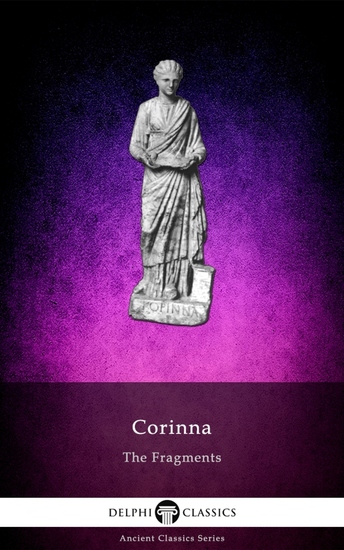
The Fragments of Corinna (Illustrated) - cover

The Fragments of Corinna (Illustrated)

Corinna of Tanagra

Publisher: Delphi Publishing Ltd

  • 0
  • 0
  • 0

Summary

One of the few female poets from ancient Greece whose work survives, Corinna was a lyric poet from Boeotia, who is traditionally described as a rival of Pindar. The fragments of her poetry reveal a concise and generally undecorated use of language, favouring simple metrical schemes. Her poetry focuses more on the narrative mythological mode, like Stesichorus, than on an intricate use of language. Unlike Pindar, her ironic and humorous approach is surprisingly modern. Her poems were highly regarded by Ovid and Propertius. Delphi’s Ancient Classics series provides eReaders with the wisdom of the Classical world, offering both English translations and the original Greek texts. This eBook presents Corinna’s fragments, with illustrations, an informative introduction and the usual Delphi bonus material. (Version 1)
 
* Beautifully illustrated with images relating to Corinna’s life and works* Features the extant works of Corinna, in both English translation and the original Greek* Concise introduction to the poetry* J. M. Edmonds’ translations of the fragments, previously appearing in the Loeb Classical Library* Images of artworks that have been inspired by Corinna* Excellent formatting of the texts* Easily locate the fragments you want to read with individual contents tables* A brief biography
 
CONTENTS:
 
The TranslationsThe Fragments of Corinna
 
The Greek TextsList of Greek Texts
 
The BiographyCorinna (1870) by Charles Peter Mason
Available since: 04/29/2025.
Print length: 154 pages.
Other books that might interest you

  • Birds Knit My Ribs Together - cover

    Birds Knit My Ribs Together

    Phil Barnett

    • 0
    • 0
    • 0
    what if / I actually – am – a bird / my cupped hands / opening to release me... Phil Barnett's relationship with birds is so close that his poetry blurs the distinctions between himself and the birds - a kind of ornimorphology where rather than giving the birds human characteristics, the reverse happens, and he imagines himself as a bird. Phil Barnett is a photographer, writer, musician, artist and naturalist, who has a passion for the birds that kept him company through a long hard illness. His photography and poetry have quite a following on social media, which is where we found him, on The Daily Haiku. His skill as a photographer leads to an acute visual sensibility, and his slow recovery moves from a tick sheet his mother had to fill in for him, to extraordinary poetry - full of wit and wonder and spectacular language.
    Show book
  • Journey to the Morning Light - Poems - cover

    Journey to the Morning Light -...

    Catherine de Vinck

    • 0
    • 0
    • 0
    A posthumous collection of poems on the beauty of the seasons, creation, life and death, from beloved poet Catherine de Vinck.
    
    In the words of the Foreword by Mary Evelyn Tucker, the poetry of Catherine de Vinck, "calls us to ever greater awareness of who we are and where we dwell. She offers us glimpses of truth, not answers to our questions. She lights the path, sometimes with the brilliance of a single image. More often she surrounds us with the atmosphere of dusk—the twilight arising in our consciousness where mood and memory mingle."


    Show book
  • Riders to the Sea & Shadow of the Glen - cover

    Riders to the Sea & Shadow of...

    J. M. Synge

    • 0
    • 0
    • 0
    Riders to the Sea & Shadow of the Glen are both one act plays by J.M. Synge, an Irish playwright in the early 20th Century who made it his life's mission to accurately depict the people of the Irish Countryside. 
    Riders to the Sea is a Tragedy in One Act about a mother and her daughters dealing with a familial curse that seems to cause all of the men in the family to die. Anxieties come to a peak when the last, remaining son is getting ready to ride out to sea in order to try and provide for his family. 
    Shadow of the Glen is a contemplative Drama in One Act about how a women's integrity can be unjustly scrutinized through hearsay and speculation, and how forcing those opinions out into the open can have disastrous consequences for everyone involved.
    Show book
  • Concerto - cover

    Concerto

    Robert S. Field

    • 0
    • 0
    • 0
    On Charlie Tyndale’s family tree Are branches bearing, he discovers, Ancestors of the landed gentryIncluding incestuous lovers;An intrepid adventurer too,With an eye for a collectible,And there’s a murdered musician whoIn life was all too corruptible.Was his killer a spurned lover, orA rival claimant to the estate, Or treasure-seekers settling a score,Or all, in a brutal syndicate?    And through all a Concerto’s movements endure;   To Charlie’s ancestral tale, the overture.
    Show book
  • A Love Story Called My Hell - cover

    A Love Story Called My Hell

    A. Wayne Heusel

    • 0
    • 0
    • 0
    A love story called My Hell was inspired by my Muse, and many of the poets I have studied. It was originally written to be a narrated stage play. In this Narrative epic Love Story there are hidden messages that only your subconscious will perceive. I wrote this epic story with the intent to show the moral of the story, "Love Conquers All." The story is about a  journey through Hell and many personal confrontations with Satan himself. This is one Journey through Hell you will never forget. Welcome to My Hell.
    Show book
  • The Poetry of Robert Herrick - 17th Century lyrical poet that was also a cleric - cover

    The Poetry of Robert Herrick -...

    Robert Herrick

    • 0
    • 0
    • 0
    The Clergyman and poet, Robert Herrick was born in Cheapside, in London in 1591. An exact date is not known though he was baptized on August 24th, the seventh child of Nicholas Herrick, a wealthy goldsmith.  
    Some controversy surrounds several chapters in his early years.  The first are allusions that his father, in November 1592, two days after making a will, killed himself by jumping from the fourth-floor window of his house. However, the Queen's Almoner did not confiscate the Herrick estate for the crown as was the usual procedure with suicides, so an alternate narrative emerged that he fell accidentally which seems to have more credence. 
    There is no record of Herrick attending school. Some claim a poem alludes to Westminster School, others merely that he meant Westminster, the area. Another school of thought claims he was educated at Merchant Taylor’s School.  What is known is that in 1607 he was apprenticed to his uncle Sir William Herrick as a goldsmith.   
    Herrick certainly seems to have been a keen and avid poet. The earliest work known to be written by him dates from 1610; 'A Country Life', and deals with the move from London to farm life in Leicestershire.  
    After six years as an apprentice, when Herrick was 22 he matriculated at St John’s College, Cambridge before moving to Trinity College and graduating with his Bachelor of Arts in 1617, Master of Arts in 1620, and in 1623 he was ordained priest.  
    By 1625 he was well known as a poet, mixing in literary circles in London such as that around Ben Jonson. An avowed admirer of Jonson he was also one of a group whom became known as ‘The Sons of Ben’ writing both in his style and about him. 
    In 1629 he was presented by Charles I to the parishioners of Dean Prior, a remote parish of Devonshire. The best of his work was written in the peace and seclusion of country life; 'To Blossoms' and 'To Daffodils' are classical depictions of a devoted appreciation of nature.  
    However, after he refused to subscribe to The Solemn League and Covenant, he was ejected from Devonshire in 1647 and moved to London where he published his religious poems Noble Numbers (1647), and Hesperides (1648). 
    Herrick was distinguished as a lyric poet, and some of his love songs, for example, 'To Anthea' and 'Gather Ye Rose-buds' are considered exceptional.  
    By 1660 he was reinstated at Dean Prior where he lived for the remainder of his life. He wrote no more poems after 1648 but over his life it is thought he wrote in the region of 2,500 poems in total, only a small portion of which were ever published. 
    He died in October 1674, at the age of 83 in circumstances unknown.  He was buried on October 15th, 1674 in an unmarked grave in the churchyard at Dean Prior. 
     This volume comes to you from Portable Poetry, a specialized imprint from Deadtree Publishing.  Our range is large and growing and covers single poets, themes, and many compilations.
    Show book
