¡Acompáñanos a viajar por el mundo de los libros!
Añadir este libro a la estantería
Grey
Escribe un nuevo comentario Default profile 50px
Grey
Suscríbete para leer el libro completo o lee las primeras páginas gratis.
All characters reduced
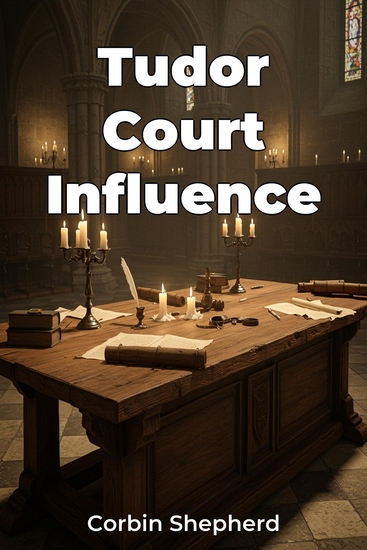
Tudor Court Influence - cover

Tudor Court Influence

Corbin Shepherd

Traductor A AI

Editorial: Publifye

  • 0
  • 0
  • 0

Sinopsis

Tudor Court Influence examines how the Tudor dynasty transformed England through calculated administrative reform, establishing the foundations for a centralized government. Beyond the spectacle of court life, the book reveals the court as a powerful instrument used by monarchs like Henry VIII and Elizabeth I to consolidate authority. The dissolution of the monasteries under Henry VIII, for example, led to the creation of new administrative bodies, fundamentally altering the structure of English governance. The Tudor's strategic use of the Privy Council further professionalized the civil service ultimately reshaping England’s political landscape.

 
The book meticulously progresses from the historical context predating the Tudors to the administrative innovations and reforms enacted during their reign. By exploring the roles of key figures and analyzing primary sources like state papers and court records, the book provides a comprehensive understanding of the Tudor court's lasting impact. This approach offers readers a fresh perspective, emphasizing the court’s role as an engine of administrative reform rather than merely a stage for royal display.
Disponible desde: 05/05/2025.
Longitud de impresión: 58 páginas.

Otros libros que te pueden interesar

  • The Missionary of Knowledge - Hastings Rashdall’s Life and Thought - cover

    The Missionary of Knowledge -...

    Christopher Cunliffe

    • 0
    • 1
    • 0
    Hastings Rashdall (1858–1924) was not only one of the leading churchmen of his time, whose opinion on a range of issues carried weight and influence; he also made substantial and lasting contributions to three fields of knowledge –history, philosophy, and theology. Yet he is not much remembered in today’s Church, although the concerns he addressed and the solutions he proposed still have relevance to the challenges of articulating an intellectually convincing and spiritually satisfying Christian faith in the modern world.
    
     
    This book, written to mark the centenary of Rashdall’s death, provides a brief and clear introduction to his thought, set in the historical context of his life and time. The opening chapters provide a biographical framework, drawing extensively on archival research. They are followed by separate accounts of his historical, philosophical, and theological work, concentrating on his many publications.
    
     
    Theory and practice come together in an exploration of Rashdall’s engagement with public life, and the book concludes with an assessment of what he might have to offer to today’s Church.
    Ver libro
  • America’s Greatest Engineering Projects: The Construction History of the Transcontinental Railroad the Panama Canal and the Hoover Dam - cover

    America’s Greatest Engineering...

    Editors Charles River

    • 0
    • 0
    • 0
    The Transcontinental Railroad, laid across the United States during the 1860s, remains the very epitome of contradiction. On the one hand, it was a triumph of engineering skills over thousands of miles of rough terrain, but on the other hand, it drained the natural resources in those places nearly dry. It “civilized” the American West by making it easier for women and children to travel there, but it dispossessed Native American civilizations that had lived there for generations. It made the careers of many men and destroyed the lives from many others. It was bold and careless, ingenious and cruel, gentle and violent, and it enriched some and bankrupted others. In short, it was the best and worst of 19th century America in action. 
    Traveling around the tip of South America was fraught with danger, and European explorers and settlers had proposed building a canal in Panama or Nicaragua several centuries before the Panama Canal was actually built. Taking about 10 years to build, workers had to excavate millions of cubic yards of earth and fight off hordes of insects to make Roosevelt’s vision a reality. Roosevelt also had to tie up the U.S. Navy in a revolt in Colombia to ensure Panama could become independent and thus ensure America had control of the canal. 
    During the 1930s, at the height of the Great Depression, thousands of workers began work on the Hoover Dam, built in the Black Canyon, which had been cut by the powerful Colorado River. The Colorado River was responsible for the Grand Canyon, and by the 20th century, the idea of damming the river and creating an artificial lake was being explored for all of its potential, including hydroelectric power and irrigation. By the time the project was proposed in the 1920s, the contractors vowing to build it were facing the challenge of building the largest dam the world had ever known. As if that wasn’t enough, the landscape was completely unforgiving.
    Ver libro
  • The Murder Squad - cover

    The Murder Squad

    Michael Adams

    • 0
    • 0
    • 0
    SHORTLISTED FOR THE NED KELLEY AWARD FOR BEST TRUE CRIME 
     
    How the New South Wales Police Force's finest solved murders in one of the most tumultuous periods in Australian history.  
     
    As Australia sank into the darkest days of the Great Depression, a succession of bloody mysteries grabbed headlines and gripped the country. The Hammer Horror, The Bungendore Bones, The Park Demon, The Human Glove and The Pyjama Girl – these were just some of the grisly cases that had to be solved by the Sydney detectives of The Murder Squad.  
     
    With the people, press and politicians screaming for justice and vengeance, homicide chief Tom McRae and his colleagues used bold new investigative tools in the massive manhunts for these maniacal killers. Working under intense pressure, hard-nosed and hard-charging cops solved some cases brilliantly – yet others were 'closed' with dodgy convictions while several shadowy figures were to get away with murder.  
     
    Set against the backdrop of our greatest economic crisis, as the federal and state governments headed for a showdown and fascist and communist thugs threatened civil war, The Murder Squad reopens the files on Australia's most chilling forgotten crimes to ask who was guilty, who was innocent, and whether some cops were as dangerous as the monsters they were hunting.
    Ver libro
  • Stop Doing Sh*t You Don't Want to Do - A Straightforward Guide to Letting Go of Unresolved Trauma - cover

    Stop Doing Sh*t You Don't Want...

    PhD Bob Beare

    • 0
    • 0
    • 0
    Do you want to let go of what’s not working - and claim your authentic life? 
    “Dr. Bob’s book offers the practical tools to gain awareness of the ways we unconsciously remain trapped in cycles of trauma and dependency.” — Dr. Nicole LePera, #1 NY Times Best-selling author of How to Do the Work and How to Meet Yourself 
    Trauma is running the show and most of us don’t think we have it. We label it “stuck”, “stress”, “depression”, and “anxiety.” The solutions are simple but not easy. Stop Doing Sh*t You Don’t Want to Do unpacks:The many forms of trauma - mild and severe,The many ways we medicate our pain.The importance of finding support.How to do the deep inner work.How to live with purpose.How to live with passion. 
    Dr. Bob Beare’s book is a framework and a guide to emotional freedom. It provides powerful insights on how to go beyond therapy and create a meaningful and purposeful life — a reminder that, with support, we can transcend the patterns that keep us stuck!
    Ver libro
  • Nazca Civilization - The Enigmatic Lines and the Desert Kingdom of Peru - cover

    Nazca Civilization - The...

    Rolf Hedger

    • 0
    • 0
    • 0
    The Nazca civilization emerged along the southern coast of present-day Peru, a harsh and arid region that required ingenuity and adaptation for survival. Flourishing between approximately 100 BCE and 800 CE, the Nazca people built upon the cultural and technological advancements of their predecessors, most notably the Paracas culture. The transition from the Paracas to the Nazca was marked by shifts in artistic expression, religious practices, and innovations in agriculture that allowed the new civilization to thrive in the desert landscape. 
    One of the defining characteristics of the Nazca civilization was its ability to adapt to the unforgiving environment. The region’s climate was dry, with little rainfall, yet the Nazca found ways to harness the limited water supply to sustain their agricultural economy. They engineered underground aqueducts known as puquios, a sophisticated irrigation system that transported water from underground sources to the surface, ensuring a steady supply for crops. This ingenuity allowed them to cultivate maize, beans, squash, and cotton, which became essential to their diet and economy. 
    The Nazca culture was also shaped by its geography. The valleys of the Rio Grande de Nazca provided fertile land where the civilization’s settlements and ceremonial centers flourished. Unlike the grand urban centers of the Andean highlands, the Nazca people lived in smaller, dispersed communities that relied on a combination of agriculture and trade. These communities were connected by a shared cultural and religious framework that revolved around the worship of powerful deities linked to nature, fertility, and water.
    Ver libro
  • How Premonitions Really Work - Learn About and Change Your Future - cover

    How Premonitions Really Work -...

    Martin K. Ettington

    • 0
    • 0
    • 0
    I’ve already written a couple of books on prophecy and premonitions including my own experiences. 
    But as an engineer I felt that I really had not fully communicated what I’ve learned about these abilities and how we can apply this knowledge to our lives. 
    Thus the purpose of this book is to be as detailed as I can be about what premonitions are and how you can use them to improve your life and change your probable futures. 
    As an engineer and experiencer of many modes of premonitions and prophecies I feel I have a lot to offer here and want you the reader to benefit from what I’ve learned. 
    Historical prophecies are also covered as are the real source of premonitional abilities, techniques to see your own futures, how far ahead people can see the future, how to use these techniques with a group of people, and much more on the importance of prophecy in our world. 
    The ability to change the direction of your fate is also discussed.
    Ver libro