Join us on a literary world trip!
Add this book to bookshelf
Grey
Write a new comment Default profile 50px
Grey
Subscribe to read the full book or read the first pages for free!
All characters reduced
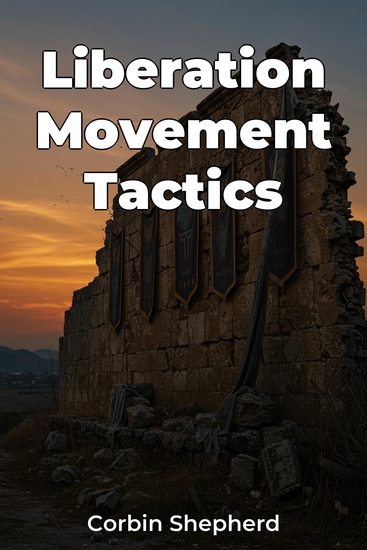
Liberation Movement Tactics - cover

Liberation Movement Tactics

Corbin Shepherd

Translator A AI

Publisher: Publifye

  • 0
  • 0
  • 0

Summary

Liberation Movement Tactics explores the multifaceted nature of resistance against oppression, providing insights into why some liberation movements succeed while others fail. It examines organizational tactics and leadership styles, emphasizing how these factors, combined with strategic planning, influence outcomes. The book analyzes how different organizational models, from decentralized networks to structured hierarchies, impact a movement’s resilience and ability to mobilize. Furthermore, it highlights how effective leadership—be it charismatic or collective—can inspire trust and guide strategic decision-making.

 
The book progresses by first defining core concepts like oppression and resistance, then delves into case studies of successful movements, such as the anti-apartheid struggle in South Africa and the Indian independence movement. These case studies illustrate the diverse approaches to challenging oppressive regimes.

 
Finally, the book synthesizes lessons learned, offering a framework for assessing the potential success of future social movements, providing practical guidelines for activists and scholars alike. By combining historical analysis with actionable insights, Liberation Movement Tactics offers a valuable resource for understanding and supporting movements for social change.
Available since: 05/02/2025.
Print length: 62 pages.


Other books that might interest you

  • A Classic Interview with Music Icon Miles Davis - cover

    A Classic Interview with Music...

    Miles Davis

    • 0
    • 0
    • 0
    Miles Dewey Davis III (May 26, 1926 - September 28, 1991) was an American jazz trumpeter, bandleader, and composer. Born into an upper-middle-class family in Alton, Illinois, and raised in East St. Louis, Davis is among the most influential and acclaimed figures in the history of jazz and 20th-century music. Davis adopted a variety of musical directions in a roughly five-decade career that kept him at the forefront of many major stylistic developments in jazz. The following audio recordings are from a 1953 radio interview in East St. Louis and a 1984 television interview in Norway.
    Show book
  • Inca Mythology - Sacred Legends of the Inca Empire - cover

    Inca Mythology - Sacred Legends...

    Matthew Fillard

    • 0
    • 0
    • 0
    The Inca Empire, at its zenith, spanned much of South America, including present-day Peru, Ecuador, Bolivia, and parts of Chile and Argentina. Known for its advanced architecture, agricultural systems, and administrative organization, the Inca civilization also possessed a deeply spiritual culture. Central to their worldview was a rich tapestry of mythology that explained the creation of the world, the origins of humankind, and the roles of the gods in the natural and spiritual realms. These sacred legends were not just stories; they were the very foundation upon which the Inca society was built, shaping everything from daily rituals to the governance of the empire.  
    Inca mythology was intricately connected to the natural world, with gods and deities representing various elements of the environment, such as the sun, the moon, the earth, and water. The Inca people believed that these deities were not distant, abstract beings but rather active forces that influenced their lives. The most important gods were thought to have a direct relationship with the ruler, often considered to be divine or descended from these gods. As such, the Inca king, or Sapa Inca, was revered as the son of the sun god, Inti, and his authority was considered sacred.  
    The role of mythology extended beyond the divine and into the social and political spheres. It was through myth that the Inca legitimized their rule, connected their empire to the divine order, and reinforced the unity of their vast territories. Legends of the first rulers, such as Manco Capac and Mama Ocllo, were tied to creation myths that depicted them as divine figures sent to bring civilization to the world. These stories were used to justify Inca conquests and to explain the hierarchical structure of society. 
    Show book
  • Spiritual Wisdom - The Divine Insight - cover

    Spiritual Wisdom - The Divine...

    Esther Jameson

    • 0
    • 0
    • 0
    Spirituality is the essence of human existence, a journey beyond the physical world into the depths of the soul. It is not confined to religious doctrines but is instead a personal experience that connects an individual to a higher reality. At its core, spirituality is about seeking truth, understanding the purpose of life, and attaining inner peace. Some find this connection through meditation and prayer, while others experience it in nature, art, or acts of kindness. Regardless of the path taken, spirituality fosters a sense of belonging to something greater than oneself. 
    The relationship between the mind and spirit is fundamental to spiritual growth. Thoughts shape perception, and perception influences reality. A mind cluttered with negativity and distractions struggles to grasp deeper truths, while a mind that is calm and focused becomes a gateway to higher awareness. This is why many spiritual traditions emphasize practices such as mindfulness, meditation, and contemplation. These practices clear the noise of daily life and create space for divine insight. In this state of clarity, individuals often experience a profound sense of connection with the universe, realizing that they are not separate from it but an integral part of its vast and mysterious existence. 
    Awakening to higher consciousness is a transformative process. It often begins with an inner calling—an unshakable feeling that there is more to life than material success and worldly pleasures. This realization can emerge through deep reflection, personal struggles, or even spontaneous moments of enlightenment. As one embarks on the path of self-discovery, old beliefs and conditioned patterns begin to dissolve, making way for a more expansive understanding of life. True spiritual awakening is not about accumulating knowledge but about experiencing a shift in perception—one that transcends fear, attachment, and limitation.
    Show book
  • Rescue Yourself - How to complete a PhD without a supervisor - cover

    Rescue Yourself - How to...

    Tara Brabazon

    • 0
    • 0
    • 0
    You enrol in a PhD, believing in the project and committed to its completion. But something goes wrong. A supervisor leaves the institution, becomes sick, or discards you from their research team or lab.  What happens next?  Who can rescue you?  This book - Rescue Yourself:  How to complete a PhD without a supervisor - helps students organize their habits, strategies, behaviour and emotions to finish a PhD.  Let's start our work from the fear, confusion and worry, and scaffold a thesis to success.
    Show book
  • Pieces of Mee - cover

    Pieces of Mee

    Anexis Matos

    • 0
    • 0
    • 0
    Unleash your inner teen, fangirl, and your best and worse parts in this debut poetry collection. 
    The cringe of being a teenage girl. Blindness in all its glory and challenge. The fantastic parts of fandom. The power of stories. From reflections to a tragic love story of Death and their priestess, a poem is waiting to become your favorite.
    Show book
  • Nineveh - History of the Ancient Assyrian City - cover

    Nineveh - History of the Ancient...

    Kelly Mass

    • 0
    • 0
    • 0
    Nineveh was an age-old Assyrian city in Upper Mesopotamia, near Mosul in modern-day northern Iraq. It was the capital and biggest city of the Neo-Assyrian Empire, and the world's biggest city for some decades, and is on the eastern bank of the Tigris River. It's now a prevalent name for the portion of Mosul that's on the Tigris' eastern bank, and it is also the name of the nation's Nineveh Governorate. 
    It was the world's largest city for about fifty years till it was sacked by a union of its previous subject tribes, including but not limited to the Babylonians, Medes, Persians, Scythians, and Cimmerians, in the year 612 BC, following a severe period of civil dispute in Assyria. The city was never ever a political or administrative center again, though it was the seat of a Christian bishop by Late Antiquity. Throughout the Middle Ages, it weakened in contrast to Mosul and was mainly deserted by the 13th century AD. 
    In the Bible, it has been mentioned several times, and it is the center of attention in the story of Jonah, who was swallowed up by a whale or fish and spat out on the beach, only to hear from God that he still needed to go to Nineveh and give the people a chance to repent. 
    There is much more to this mysterious city of the ancient. Learn more by reading or listening to this book!
    Show book