
Join us on a literary world trip!
Add this book to bookshelf
Grey
Write a new comment Default profile 50px
Grey
Subscribe to read the full book or read the first pages for free!
All characters reduced
Hidden Details - cover

Hidden Details

Corbin Shepherd

Translator A AI

Publisher: Publifye

  • 0
  • 0
  • 0

Summary

Hidden Details argues that history's pivotal moments often hinge on overlooked details, not just grand strategies. It challenges conventional narratives by examining logistical constraints, individual actions, and unintended consequences, revealing how these factors drastically altered outcomes. Consider, for example, how weather patterns impacted military campaigns or how unsung heroes influenced crucial historical junctures. This book asserts that a comprehensive understanding requires meticulous examination of these seemingly insignificant elements, empowering readers to critically assess established historical accounts.

 
The book progresses by first introducing core concepts through examples. Subsequent sections then offer in-depth analyses of specific historical events, examining both military and political turning points impacted by logistical and environmental factors, as well as instances where individual actions and unintended consequences changed the course of events.

 
By focusing on micro-level factors, Hidden Details distinguishes itself by moving away from deterministic explanations and emphasizing contingency and human agency, providing a framework for identifying and analyzing these hidden influences on policy decisions and strategic decision-making.
Available since: 05/06/2025.
Print length: 67 pages.

Other books that might interest you

  • Top 101 Inventions Of All Time! - Intriguing Facts & Trivia About History’s Greatest Inventions! - cover

    Top 101 Inventions Of All Time!...

    Scott Matthews

    • 0
    • 0
    • 0
    Imagine a world where distances felt infinite, ideas couldn't be replicated en masse, darkness consumed nights, and a fever could spell the end. It's a world nearly unrecognizable to us today, thanks to inventions that have crafted the very fabric of our modern existence. 
    Where would we be without the wheel's revolution, or the profound ripple of the printing press? Would the stars still feel out of reach if not for telescopes and rockets, or our world feel vast without cars, planes, and the internet to bridge it? 
    Fuel your curiosity and gain a deeper understanding of the inventive spirit that revolutionized our world. Discover the ingenious minds and fascinating anecdotes behind each invention, and find inspiration in their revolutionary impact. 
    Discover the Pioneers: Explore the brilliant inventors who transformed ideas into reality, inspiring generations to come. 
    Engage in Trivia: Delight in intriguing trivia and fun facts, impressing friends and family with your newfound knowledge. 
    Insights Into Progress: Gain valuable insights into the progress of human history, seeing how innovations shaped societies and cultures. 
    Technological Evolution: Follow the evolution of inventions from ancient times to the cutting-edge technologies of today. 
    Inspiration for Tomorrow: Be inspired by the boundless creativity of inventors and envision the potential for future breakthroughs. 
    From the invention of the wheel to the marvel of electricity, from the groundbreaking medical discoveries to the wonders of the digital age, Top 101 Inventions Of All Time! celebrates the brilliance of human creativity and ingenuity. Whether you're a history enthusiast or simply curious about the marvels that surround us, this book promises an enlightening and exhilarating journey through the realm of invention. 
    Are you ready to unlock the secrets of history's most influential inventions? 
    Come inside and embark on an enlightening journey across these inventions!
    Show book
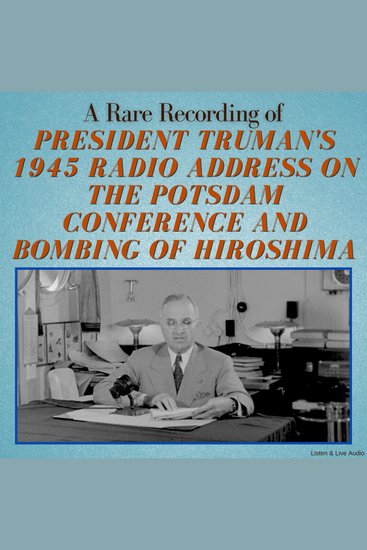
  • A Rare Recording of President Truman's 1945 Radio Address On The Potsdam Conference and Bombing of Hiroshima - cover

    A Rare Recording of President...

    President Harry S. Truman

    • 0
    • 0
    • 0
    Harry S. Truman (May 8, 1884 - December 26, 1972) was the 33rd president of the United States, serving from 1945 to 1953. A member of the Democratic Party, he previously served as vice president from January to April 1945 under FDR and as a US senator from Missouri from 1935 to January 1945. Assuming the presidency after FDR's death, Truman implemented the Marshall Plan to rebuild the economy of Western Europe and established both the Truman Doctrine and NATO to contain the expansion of Soviet communism. The following recording is an August 9th 1945 radio address President Harry S. Truman gave on the results of the Potsdam Conference and the dropping of the atomic bomb on Hiroshima, Japan.
    Show book
  • How You Can Talk With God - A Series of Lectures - cover

    How You Can Talk With God - A...

    Paramahansa Yogananda

    • 0
    • 0
    • 0
    Have you ever enjoyed your own personal conversations with God? In this series of short lectures, the celebrated author of Autobiography of a Yogi shares his personal insights and testimonies regarding the nature of God, and how each and every one of us can initiate talks with Him. 
    "Our love is the one thing God does not possess, unless we choose to bestow it. So, you see, even the Lord has something to attain: our love. And we shall never be happy until we give it." - Paramahansa Yogananda 
    "Yogananda dispels the notion held by most people that direct contact with God is beyond their reach...Millions of readers who were introduced to the spiritual wisdom of the East through "Autobiography of a Yogi" will find the same deep inspiration and wisdom in the pages of "How You Can Talk with God." - Arkansas State Press Review
    Show book
  • To the Lighthouse - cover

    To the Lighthouse

    Virginia Woolf

    • 0
    • 0
    • 0
    Unlock the Profound Beauty of Human Connection and the Unstoppable March of Time.
    
    Experience the height of stream of consciousness storytelling with Virginia Woolf's most autobiographical and evocative work, To the Lighthouse. Set on the Isle of Skye, the novel centers on the Ramsay family and their visits to the Scottish coast, framed by the anticipation of a simple trip to a nearby lighthouse—a trip that will take ten years and a lifetime of emotional change to complete.
    
    Through the shifting perspectives of the nurturing Mrs. Ramsay, the intellectually demanding Mr. Ramsay, and the struggling artist Lily Briscoe, Woolf explores the intricate tensions of family life and the fleeting nature of experience. The famous middle section, "Time Passes," stands as one of the most haunting passages in literature, depicting the decay of the family home while world events and personal tragedies unfold in the background.
    
    A landmark of Modernist literature, To the Lighthouse is more than a story; it is a meditation on how we perceive reality and the struggle to create something permanent in a world of constant flux.
    
    Journey into the heart of the Ramsay family. Buy "To the Lighthouse" today and experience one of the greatest novels of the 20th century.
    Show book
  • Ten Things Your Student with Autism Wishes You Knew 2nd Edition - cover

    Ten Things Your Student with...

    Ellen Notbohm

    • 0
    • 0
    • 0
    The essential autism spectrum guidebook for teachers everywhere! 
     
    In this exciting companion to Ellen Notbohm’s beloved classic Ten Things Every Child with Autism Wishes You Knew, the unique perspective of an autistic child’s voice returns to describe for teachers, in the classroom and in the larger  
    community, how to understand thinking and processing patterns common in autism, how to shape an environment conducive to their learning style, and how to communicate with autistic learners of all ages in functional, meaningful ways.  
     
    It’s the guidebook every educator and family member, worldwide, needs to create effective and inclusive settings wherein child and adult are both teachers and learners. 
     
    This vibrantly updated and expanded edition includes an imaginative, all-new guide adaptable for group discussion, self-reflection, or self-expression, added perspective from autistic adults about their experiences in education, and an  
    afterword by Bryce Notbohm. Perennially popular since 2006 and translated into multiple languages, Ten Things Your Student with Autism Wishes You Knew now brings fresh perspective to a new generation of educators and autistic learners.
    Show book
  • Utilitarianism - cover

    Utilitarianism

    John Stuart Mill

    • 0
    • 0
    • 0
    Utilitarianism is a moral theory that was developed by British philosopher John Stuart Mill in the 19th century. According to Mill, the ethical basis for decision-making should be the greatest happiness or pleasure for the greatest number of people. This principle is also known as the "greatest happiness principle." 
    Mill believed that human happiness was the ultimate goal of morality and that actions should be judged according to their ability to promote happiness. He argued that actions that bring about the greatest amount of happiness for the greatest number of people are morally right, while actions that lead to pain or suffering are morally wrong. 
    Mill believed that happiness should be measured by the amount of pleasure that people experience, and he distinguished between two types of pleasure: higher pleasures and lower pleasures. Higher pleasures are those that are associated with the intellect, such as the pursuit of knowledge or the appreciation of art, while lower pleasures are those that are associated with the body, such as the satisfaction of hunger or the gratification of sexual desire. According to Mill, higher pleasures are more desirable than lower pleasures because they are more intellectual and have a more lasting impact on a person's happiness. 
    Mill's utilitarianism has been influential in many areas of philosophy, including ethics, political philosophy, and social theory. His emphasis on the importance of promoting the happiness of the greatest number of people has been used to justify a wide range of policies and practices, including democracy, public health measures, and the redistribution of wealth. However, Mill's theory has also been criticized for its focus on pleasure and its potential to justify actions that are harmful to minorities or individuals.
    Show book