Join us on a literary world trip!
Add this book to bookshelf
Grey
Write a new comment Default profile 50px
Grey
Subscribe to read the full book or read the first pages for free!
All characters reduced
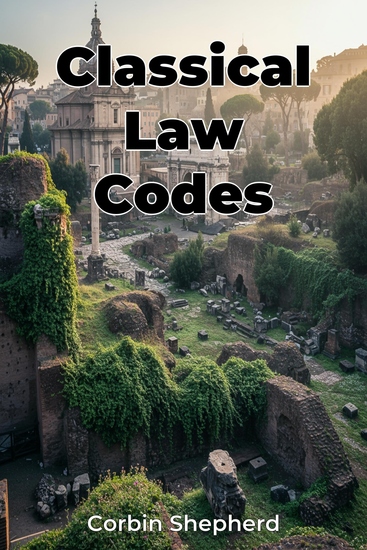
Classical Law Codes - cover

Classical Law Codes

Corbin Shepherd

Translator A AI

Publisher: Publifye

  • 0
  • 0
  • 0

Summary

Classical Law Codes explores how ancient Greek and Roman legal systems shaped Western concepts of justice and governance. It offers a comparative analysis, highlighting differences in codification, civil rights, and property regulation. One intriguing insight is how Roman law, with its emphasis on codification, had a more direct impact than the more philosophical Greek legal practices. The book demonstrates how these systems, though ancient, still resonate in contemporary legal discourse.

 
The book unfolds in three parts, beginning with the historical and social context of Greek law, particularly in Athenian democracy. It then examines Roman law, from the Twelve Tables to Justinian's Corpus Juris Civilis, tracing the evolution of legal thought and institutions.

 
Finally, it directly compares the two systems, focusing on property rights, contracts, and criminal justice, revealing how each system addressed social inequality and individual liberties. Through primary sources and scholarly analysis, this book provides a nuanced understanding of classical legal systems and their lasting legacy.
Available since: 05/05/2025.
Print length: 61 pages.

Other books that might interest you

  • Political Theology - Four Chapters on the Concept of Sovereignty - cover

    Political Theology - Four...

    Carl Schmitt

    • 0
    • 0
    • 0
    Written in the intense political and intellectual tumult of the early years of the Weimar Republic, Political Theology develops the distinctive theory of sovereignty that made Carl Schmitt one of the most significant and controversial political theorists of the twentieth century. 
     
    Focusing on the relationships among political leadership, the norms of the legal order, and the state of political emergency, Schmitt argues in Political Theology that legal order ultimately rests upon the decisions of the sovereign. According to Schmitt, only the sovereign can meet the needs of an "exceptional" time and transcend legal order so that order can then be reestablished. Convinced that the state is governed by the ever-present possibility of conflict, Schmitt theorizes that the state exists only to maintain its integrity in order to ensure order and stability. Suggesting that all concepts of modern political thought are secularized theological concepts, Schmitt concludes Political Theology with a critique of liberalism and its attempt to depoliticize political thought by avoiding fundamental political decisions. 
     
    This audiobook is expertly read by Andy Ingalls, with audio engineering by Allie McSwain. It was produced and published by Echo Point Books & Media, an independent bookseller in Brattleboro, Vermont.
    Show book
  • When the United States Invaded Russia - Woodrow Wilson's Siberian Disaster - cover

    When the United States Invaded...

    Carl J Richard

    • 0
    • 0
    • 0
     “An intriguing and carefully argued entry into a small and often overlooked discussion of American political maneuvering at the end of World War I.” —Library Journal   In a little-known episode at the height of World War I, President Woodrow Wilson dispatched thousands of American soldiers to Siberia. Carl J. Richard convincingly shows that Wilson’s original intent was to enable Czechs and anti-Bolshevik Russians to rebuild the Eastern Front against the Central Powers. But Wilson continued the intervention for a year and a half after the armistice in order to overthrow the Bolsheviks and to prevent the Japanese from absorbing eastern Siberia. As Wilson and the Allies failed to formulate a successful Russian policy at the Paris Peace Conference, American doughboys suffered great hardships on the bleak plains of Siberia.   Richard argues that Wilson’s Siberian intervention ironically strengthened the Bolshevik regime it was intended to topple. Its tragic legacy can be found in the seeds of World War II—which began with an alliance between Germany and the Soviet Union, the two nations most aggrieved by Allied treatment after World War I—and in the Cold War, a forty-five year period in which the world held its collective breath over the possibility of nuclear annihilation.   One of the earliest U.S. counterinsurgency campaigns outside the Western Hemisphere, the Siberian intervention was a harbinger of policies to come. Richard notes that it teaches invaluable lessons about the extreme difficulties inherent in interventions and about the absolute need to secure widespread support on the ground if such campaigns are to achieve success, knowledge that U.S. policymakers tragically ignored in Vietnam and have later struggled to implement in Iraq and Afghanistan.
    Show book
  • Bombing Hitler's Hometown - The Untold Story of the Last Mass Bomber Raid of World War II in Europe - cover

    Bombing Hitler's Hometown - The...

    Mike Croissant

    • 0
    • 0
    • 0
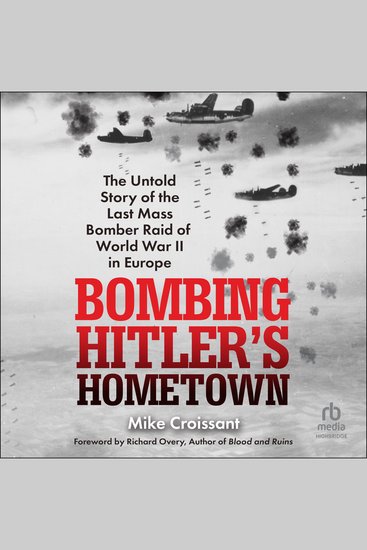
    In April 1945, Linz was one of Nazi Germany's most vital assets. It was a crucial transportation hub and communications center, with railyards brimming with war materiel destined for the front lines. Linz was also the town Hitler claimed as home and had long intended to remake as the cultural capital of Europe, filling its planned Fuehrermuseum with world-famous art stolen from his conquered territories. 


    Inevitably, Linz was also one of the most heavily defended targets remaining in Europe. The airmen of the Fifteenth Air Force were a mix of seasoned veterans and newcomers. As their mission was unveiled in the predawn hours of April 25th, audible groans and muffled expletives passed many lips. The reality of that mission would prove more brutal than any imagined. 


    Drawing on interviews with dozens of America's last surviving World War II veterans, as well as previously unpublished sources, Mike Croissant compellingly relates one of the war's last truly untold stories—a gripping chronicle of warfare, the death of Nazi Germany, and the beginning of the Cold War. It is also a timeless tale of courage and terror, loss and redemption, humanity and savagery.
    Show book
  • Beyond Difficult - cover

    Beyond Difficult

    Jessie Stern, Rachel Samson

    • 0
    • 0
    • 0
    An attachment-based guide to dealing with challenging people 
     
    Do you sometimes dread work because you don't want to face more drama with your co-worker? Have you spent significant time and money on therapy trying to work on painful romantic relationships that ultimately became messy break-ups? Do you ever walk away from an unpleasant conversation wishing you had known how to handle it better in the moment? This book is for you. 
     
    Australian clinical psychologist Rachel Samson and American attachment researcher Dr Jessie Stern have come together to bring you the ultimate guide to understanding the 'difficult' people in your life. Learn how to navigate your interactions with them with more confidence and compassion – and a lot less stress! 
     
    Using the science of attachment and temperament, Beyond Difficult offers a new, relationship-focused approach to mastering the art of dealing with difficult people.
    Show book
  • Belgian Fairy Tales - Tales from Flanders and the Ardennes - cover

    Belgian Fairy Tales - Tales from...

    William Elliot Griffis

    • 0
    • 0
    • 0
    Flemish and Walloon tales - Lyderic the orphan, the Long Wappers and their tricks, the Blue-Beard of Flanders - retold for English readers by a man who had done the same for Japan and Korea. Griffis wrote the book in the wake of the First World War, when the country was in every newspaper.
    Show book
  • The Eyes of the Skin - Architecture and the Senses - cover

    The Eyes of the Skin -...

    Juhani Pallasmaa

    • 0
    • 0
    • 0
    Explore the relationship between architecture and the sensory experience with the fourth edition of this groundbreaking work. 
     
    First published in 1996, The Eyes of the Skin is a classic of architectural theory. It asks the far-reaching question why, when there are five senses, is one single sense―sight―so predominant in architectural culture and design? With the ascendancy of the digital and the all-pervasive use of the image electronically, the subject is all the more pressing and topical since the first edition’s publication. Juhani Pallasmaa argues that the suppression of the other four sensory realms has led to the overall impoverishment of our built environment, often diminishing the emphasis on the spatial experience of a building and architecture’s ability to inspire, engage and be wholly life enhancing. 
     
    For a student reading this text for the first time, The Eyes of the Skin is a revelation. It provides a fresh, compelling insight into architectural culture which continues to inspire more than a quarter-century after its initial publication. 
     
    The fourth edition of The Eyes of the Skin also features:The author’s latest views on the emphasis of place, unfocused perception and existential experienceUpdates and clarifications throughout, to reinforce how our sense of self in the world remains our most important sense with the greatest architectural impactAn updated Foreword that touches on the current understanding of the seminal importance of the existential sense 
     
    The Eyes of the Skin is a must-read for all architecture students, who will find its insights transformative. 
     
    This augmented spoken-word version was originally developed for neurodivergent audiences who may be challenged by the written word. However, as the project developed, it became clear that audiences such as those for whom English is a second language, those with visual challenges and others for whom the spoken word is preferred to the written word would also appreciate such a translation. 
     
    This audio version is narrated by significant architects and creative practitioners and those narrations are augmented by an evocative soundscape designed to amplify particular elements of the narrative through reimagining the Sami people’s tradition of ‘yoiking’, simultaneously providing a cultural reference to the author’s biography. 
     
    (Hearing) The Eyes of the Skin shifts the paradigm of architectural education and communication, acknowledging that we need diverse means of communication as we enter into what might be termed ‘a new age of orality’. 
     
    (Hearing) The Eyes of the Skin is now a must-listen for all architecture students, who will find its insights transformative.
    Show book