Join us on a literary world trip!
Add this book to bookshelf
Grey
Write a new comment Default profile 50px
Grey
Subscribe to read the full book or read the first pages for free!
All characters reduced
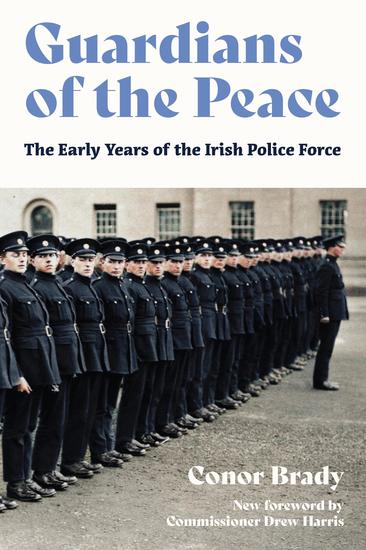
Guardians of the Peace - cover

Guardians of the Peace

Conor Brady

Publisher: New Island

  • 0
  • 0
  • 0

Summary

Guardians of the Peace is a political history of the Irish police force, An Garda Síochana, from its foundation at the birth of the Irish State, through the Irish Civil War, the threat of the fascist 'Blueshirts', the continuing campaign of the IRA, de Valera's entry into the Dáil in 1932 and the creation, effectively of his own police force – 'The Broy Harriers' – through World War 2.
As the author outlines in his insightful introduction, the story told in this book is part of a longer and wider narrative. But it is a story which still has relevance as Ireland moves, hopefully, to a new era of peace and stability. It is above all a chronicle of the idealism and the imperfections of ordinary men presented by history with the discharging of a rather extraordinary task.
As the force approaches one hundred years since its founding, it is hoped that this history will evoke the ideals and the founding principles adopted in 1922 and perhaps help to re-interpret and re-apply them in a 21st Century context.
Available since: 04/22/2022.
Print length: 260 pages.

Other books that might interest you

  • United States Presidents - Martin van Buren Abraham Lincoln George Washington and Ulysses Grant - cover

    United States Presidents -...

    Kelly Mass

    • 0
    • 0
    • 0
    This is a combo book with biographies about the following United States presidents: 
    1 - Martin Van Buren was an American attorney and statesman who acted as the United States' 8th president between 1837 to 1841. He was the ninth ruler of New York, the tenth US Secretary of State, and the 8th Vice President of the United States. He was a creator of the Democratic Party. With the support of well-known leaving President Andrew Jackson and the Democratic Party's organizational strength, he won the 1836 governmental election. 
    2 - From 1861 till his assassination in 1865, Abraham Lincoln was an American legal representative and statesman who functioned as the 16th president of the United States. Lincoln led the nation through the American Civil War, preserving the Union, eliminating slavery, enhancing the federal government, and helping the economy of the United States. 
    3 - George Washington was an American soldier, statesman, and Founding Father who worked as the nation's first president from 1789 to 1797. Washington was called leader of the Continental Army by the Continental Congress, and he led the Patriot forces to triumph in the American Revolutionary War. 
    4 - Ulysses S. Grant was an American army officer and political leader who acted as the United States' 18th president from 1869 to 1877. Grant was an achieved civil liberties executive at the time of his presidency, developing the Justice Department and teaming up with the Radical Republicans to secure African Americans at the time of Restoration. He led the Union Army to success in the American Civil War as Commanding General in the year 1865, and after that briefly functioned as Secretary of War.
    Show book
  • Plundered - The Tangled Roots of Racial and Environmental Injustice - cover

    Plundered - The Tangled Roots of...

    David W. Swanson

    • 0
    • 0
    • 0
    Two of the world's greatest crises, systemic racism and environmental destruction, share the same origin story. The two are rooted in economic forces that exploit and oppress both people and land. 


    Pastor David Swanson shows how we have failed our God-given duty as caretakers of creation and how that failure has resulted in the exploitation of people and the extraction of natural resources. Racial and ecological injustice share the same root cause—greed—that turns people and the natural world into commodities that are only valued for their utility. Yet Christians have the capacity to live in a way that nurtures racial and environmental justice simultaneously, honoring people and places in dynamic relationship with our Creator God. Swanson shows how we can become communities of caretakers, the way to restore our relationship with creation and each other, and the holistic justice that can result.
    Show book
  • Second Book of Corinthians The - The World English Bible Book 47 (Unabridged) - cover

    Second Book of Corinthians The -...

    Various Authors

    • 0
    • 0
    • 0
    The Second Epistle to the Corinthians is a Pauline epistle of the New Testament of the Christian Bible. The epistle is attributed to Paul the Apostle and a co-author named Timothy, and is addressed to the church in Corinth and Christians in the surrounding province of Achaea, in modern-day Greece. According to Jerome, Titus was the amanuensis of this epistle.
    Show book
  • Food Truck Business Guide for Beginners - The Most Simple and Easiest Way to Start without Experience 7 Steps to Start Your Business Startup - cover

    Food Truck Business Guide for...

    ALDRICH GRAY

    • 0
    • 0
    • 0
    Do you dream of introducing the world to a new recipe that your friends rave about? Or maybe you want to introduce customers to family recipes passed down through generations? You have a big chance to show off your culinary skills and produce a small-themed menu with this career. 
    Do you dream of finally being your boss? 
    There is absolutely no one telling you what to cook, how to do it, and where to be by choosing the food truck business. 
    Is minimizing financial risk a top priority for you too? 
    Starting a food truck is less risky than opening a brick-and-mortar restaurant and requires fewer startup costs. Many chefs create food trucks and later become successful restaurant owners as well. 
    This is why we decided to share our experience in this comprehensive guide, with detailed instructions on how to create a long-term food truck business that you can use to dominate, grow, and expand in your local market. 
    Here's what we've put together for you: 
    ·      You will discover Why do Food Trucks fail and how to prevent them. 
    ·      Tips to Start Your Own Food Truck Business 
    ·      You will learn the ins and outs of the world of food trucks. 
    ·      We'll discuss ways to position and market your food truck by taking full advantage of trending social networks. 
    ·      We'll discuss creating a good menu, determining its costs, and ensuring a profit with every customer transaction. 
    Did we tell you about the fantastic bonus reserved for our readers? Just think: you'll have access to our entire business plan that, in just 7 steps, will allow you to be able to start your business and make it take off to success!
    Show book
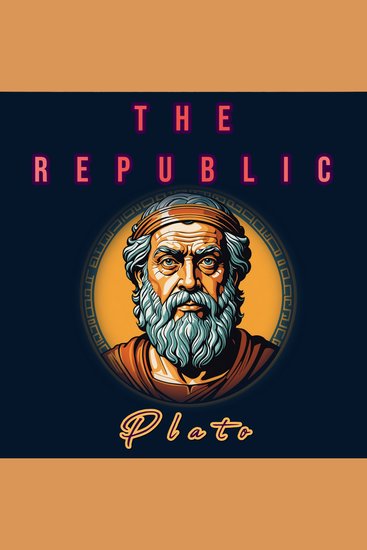
  • The Republic - cover

    The Republic

    Plato

    • 0
    • 0
    • 0
    The Republic (Greek: Politeia) is a Socratic dialogue, written by Plato around 380 BC, concerning the definition of (justice), the order and character of the just city-state and the just man, reason by which ancient readers used the name On Justice as an alternative title (not to be confused with the spurious dialogue also titled On Justice). The dramatic date of the dialogue has been much debated and though it must take place some time during the Peloponnesian War, "there would be jarring anachronisms if any of the candidate specific dates between 432 and 404 were assigned".    It is Plato's best-known work and has proven to be one of the most intellectually and historically influential works of philosophy and political theory. In it, Socrates along with various Athenians and foreigners discuss the meaning of justice and examine whether or not the just man is happier than the unjust man by considering a series of different cities coming into existence "in speech", culminating in a city (Kallipolis) ruled by philosopher-kings; and by examining the nature of existing regimes.    The participants also discuss the theory of forms, the immortality of the soul, and the roles of the philosopher and of poetry in society. Short Summary (Epilogue): X.1—X.8. 595a—608b. Rejection of Mimetic Art X.9—X.11. 608c—612a. Immortality of the Soul X.12. 612a—613e. Rewards of Justice in Life X.13—X.16. 613e—621d. Judgment of the Dead The paradigm of the city — the idea of the Good, the Agathon — has manifold historical embodiments, undertaken by those who have seen the Agathon, and are ordered via the vision. The centre piece of the Republic, Part II, nos. 2–3, discusses the rule of the philosopher, and the vision of the Agathon with the allegory of the cave, which is clarified in the theory of forms.    The centre piece is preceded and followed by the discussion of the means that will secure a well-ordered polis (City). Part II, no. 1, concerns marriage, the community of people and goods for the Guardians, and the restraints on warfare among the Hellenes. It describes a partially communistic polis. Part II, no. 4, deals with the philosophical education of the rulers who will preserve the order and character of the city-state. In Part II, the Embodiment of the Idea, is preceded by the establishment of the economic and social orders of a polis (Part I), followed by an analysis (Part III) of the decline the order must traverse. The three parts compose the main body of the dialogues, with their discussions of the "paradigm", its embodiment, its genesis, and its decline. The Introduction and the Conclusion are the frame for the body of the Republic.    The discussion of right order is occasioned by the questions: "Is Justice better than Injustice?" and "Will an Unjust man fare better than a Just man?" The introductory question is balanced by the concluding answer: "Justice is preferable to Injustice". In turn, the foregoing are framed with the Prologue (Book I) and the Epilogue (Book X). The prologue is a short dialogue about the common public doxai (opinions) about "Justice". Based upon faith, and not reason, the Epilogue describes the new arts and the immortality of the soul.
    Show book

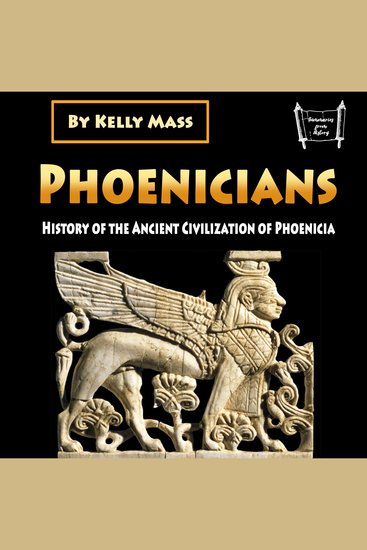
  • Phoenicians - History of the Ancient Civilization of Phoenicia - cover

    Phoenicians - History of the...

    Kelly Mass

    • 0
    • 0
    • 0
    The term "Phoenicians" describes the people living in Phoenicia, a sometimes-forgotten civilization that was age-old and remarkable. Let's check out the tradition, the history, and the specifics of Phoenicia. 
    Phoenicia was a thalassocratic (a state with mostly maritime worlds) society that thrived in the eastern Mediterranean's Levant area, mainly in modern-day Lebanon. It was fixated the coast of Lebanon, with some seaside parts of modern-day Syria and Galilee included for good procedure, varying as far north as Arwad and as far south as Acre and perhaps Gaza. Phoenician civilization stretched the Mediterranean from Cyprus to the Iberian Peninsula between 1100 and 200 BC. 
    The Phoenicians were a Semitic-speaking people who appeared in the Levant roughly 3000 BC and spoke a Semitic language. 
    In this book, you will learn more about this ancient civilization.
    Show book