Join us on a literary world trip!
Add this book to bookshelf
Grey
Write a new comment Default profile 50px
Grey
Subscribe to read the full book or read the first pages for free!
All characters reduced
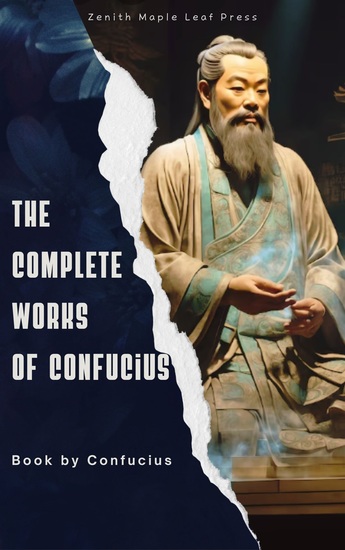
The Complete Works of Confucius - cover

The Complete Works of Confucius

Confucius

Publisher: Zenith Maple Leaf Press

  • 0
  • 0
  • 0

Summary

Timeless wisdom that shaped civilizations.

Confucius, the great Chinese philosopher and teacher, offered principles of morality, ethics, family, and governance that continue to guide humanity over 2,000 years later. The Complete Works of Confucius gathers his essential writings in one definitive collection, including the Analects, Doctrine of the Mean, Great Learning, and other foundational texts of Confucian thought.

Why readers love it:

Universal wisdom. Teachings on harmony, virtue, respect, and justice that transcend time and culture.

A complete collection. All of Confucius's core works in one accessible edition.

Practical relevance. Insights into personal growth, leadership, and moral living that remain vital today.

A legacy without borders
For centuries, scholars, leaders, and ordinary people have turned to Confucius for guidance in living a meaningful life. His influence extends far beyond China, shaping philosophy, education, and ethics across the world.

✨ Discover the teachings of one of history's greatest sages.

👉 Click "Buy Now" and own The Complete Works of Confucius—a timeless treasury of wisdom, virtue, and human harmony.
Available since: 08/27/2025.
Print length: 130 pages.
Other books that might interest you

  • Barry Lyndon - The Lost Manuscript - cover

    Barry Lyndon - The Lost Manuscript

    William Makepeace Thackeray

    • 0
    • 0
    • 0
    Barry Lyndon is a picaresque novel by William Makepeace Thackeray, first published as a serial in Fraser's Magazine in 1844, about a member of the Irish gentry trying to become a member of the English aristocracy. Thackeray, who based the novel on the life and exploits of the Anglo-Irish rake and fortune-hunter Andrew Robinson Stoney, later reissued it under the title The Memoirs of Barry Lyndon, Esq. The novel is narrated by Lyndon himself, who functions as a quintessentially unreliable narrator. The novel was adapted by Stanley Kubrick into his 1975 film Barry Lyndon.
    Show book
  • The Lightning-Rod Man - cover

    The Lightning-Rod Man

    Herman Melville

    • 0
    • 0
    • 0
    "The Lightning-Rod Man" appeared in 1854, in Putnam's Monthly Magazine no. 20 (August).
    What grand irregular thunder, thought I, standing on my hearthstone among the Acroceraunian hills, as the scattered bolts boomed overhead and crashed down among the valleys, every bolt followed by zigzag irradiations, and swift slants of sharp rain, which audibly rang, like a charge of spear-points, on my low shingled roof. I suppose, though, that the mountains hereabouts break and churn up the thunder, so that it is far more glorious here than on the plain. Hark! - some one at the door. Who is this that chooses a time of thunder for making calls? And why don't he, man-fashion, use the knocker, instead of making that doleful undertaker's clatter with his fist against the hollow panel? But let him in. Ah, here he comes. "Good day, sir:" an entire stranger. "Pray be seated." What is that strange-looking walking-stick he carries: "A fine thunder-storm, sir."
    Show book
  • The Black Cat - cover

    The Black Cat

    Edgar Allen Poe

    • 0
    • 0
    • 0
    A love for all things, with age, turns into a sour resentment and leads a man to the gallows!
    Show book
  • Floor Games (Unabridged) - cover

    Floor Games (Unabridged)

    H. G. Wells

    • 0
    • 0
    • 0
    Floor Games is a book published in 1911 by H. G. Wells. This light-hearted volume argues in a humorously dictatorial tone that "The jolliest indoor games for boys and girls demand a floor." Illustrated with photographs and drawings, it briefly describes a number of games that can be played on "well lit and airy" floors with "four main groups" of toys: soldiers about two inches high (Wells regrets the "curse of militarism" that makes civilians hard to find), largish wooden bricks, boards and planks, and electric railway rolling stock and rails. Various remarks show that the book is based on Wells's experience of playing such games with his two sons, George Philip "Gip" Wells (1901-1985) and Frank Richard Wells (1903-1982), identified here only by their initials at their family home, 17 Church Row, in the north west London district of Hampstead. Although Floor Games is often characterized as a "companion book" to Wells's Little Wars (1913), the earlier book was conceived of as a self-standing volume so that the author might later write a book devoted purely to war games. Floor Games describes mostly specific games for young children, whereas Little Wars describes war games for older children and adults.
    Show book
  • A Country Doctor - cover

    A Country Doctor

    Franz Kafka

    • 0
    • 0
    • 0
    "A Country Doctor"  is a short story written in 1917 by Franz Kafka. It was first published in the collection of short stories of the same title. In the story, a country doctor makes an emergency visit to a sick patient on a winter night. The doctor faces absurd, surreal predicaments that pull him along and finally doom him.A Country Doctor is perhaps Kafka's most fantastical or surreal work. It takes its cue from Gothic literature – it has echoes of Edgar Allan Poe and Nathaniel Hawthorne – and analysing and identifying the core 'meaning' of the story has proved tricky. Even when set aside Kafka's other work, 'A Country Doctor' remains particularly cryptic and opaque.
    Show book
  • Father Brown: The Queer Feet (Unabridged) - cover

    Father Brown: The Queer Feet...

    G. K. Chesterton

    • 0
    • 0
    • 0
    The Queer Feet" deals with Flambeau wanting to steal the silverware of the members of the Twelve True Fishermen having their annual club dinner at Vernon Hotel. The Vernon Hotel is an exclusive hotel and a "topsy-turvy product" (Chesterton 1994, p. 51).
    Show book