Join us on a literary world trip!
Add this book to bookshelf
Grey
Write a new comment Default profile 50px
Grey
Subscribe to read the full book or read the first pages for free!
All characters reduced
Paris Isn't Dead Yet - Surviving Gentrification in the City of Light - cover

Sorry, the publisher does not allow users to read this book from the country from which you are connecting.

Paris Isn't Dead Yet - Surviving Gentrification in the City of Light

Cole Stangler

Publisher: Saqi Books

  • 0
  • 0
  • 0

Summary

The Paris of popular imagination is lined with cobblestone streets and stylish cafés, a beacon for fashionistas and well-heeled tourists. But French American journalist Cole Stangler, celebrated for his reporting on Paris and French politics, argues that the beating heart of the City of Light lies elsewhere – in the striving, working-class districts, where residents are now being priced out.

Paris Isn't Dead Yet explores the past, present and future of the city through the lens of class conflict, highlighting the outsized role of immigrants in shaping the city's progressive, cosmopolitan and open-minded character – at a time when politics nationwide can feel like they're shifting in the opposite direction. This is the Paris many tourists too often miss: immigrant-heavy districts such as the 18th arrondissement, where crowded street markets still define everyday life. Stangler brings this view of the city to life, combining gripping, street-level reportage, stories of today's working-class Parisians, recent history and a sweeping analysis of the larger forces shaping the city.

An eye-opening portrait of one of the world's most vital urban centres,  Paris Isn't Dead Yet is a moment of reckoning for how cities everywhere serve us today.
Available since: 10/03/2023.
Print length: 256 pages.

Other books that might interest you

  • State of the Union 1984 - cover

    State of the Union 1984

    Ronald Reagan

    • 0
    • 0
    • 0
    The 1984 State of the Union address, delivered January 25, 1984, praises “bipartisan cooperation” and says: “For a time we forgot the American dream isn't one of making government bigger; it's keeping faith with the mighty spirit of free people under God.” “Inflation has been beaten down from 12.4 to 3.2 percent…” “Real after-tax income increased 5 percent last year.” “We're seeing rededication to bedrock values of faith, family, work, neighborhood, peace, and freedom…” 
    Let us agree on goals to keep America free and secure. Our first goal is vigorous economic growth. “We can begin by limiting the size and scope of government.” The Grace Commission has 2500 recommendations to reduce wasteful spending. Also, the line-item veto which 43 of the 50 States, including California, grant their Governors is a powerful tool against wasteful spending. 
    Additional programs are proposed including a permanently manned space station. Tuition tax credits are recommended for parents who pay private school tuition to improve education by increasing competition among schools. School prayer and a law to protect unborn children from abortion are advocated, as are enterprise zones for high-unemployment areas. 
    Finally, peace is our great goal and highest aspiration. “The future is best decided by ballots, not bullets.” We will seek concerted action to combat terrorism, and work for “freer world trade, greater competition, and more open markets.” “A nuclear war cannot be won and must never be fought.”  
    Carl Sandburg said, “I see America in the crimson light of a rising sun fresh from the burning, creative hand of God… I see great days ahead for men and women of will and vision.'' 
    Audio recording courtesy of the Ronald Reagan Presidential Library. 
    AspenLeafMedia.com
    Show book
  • Living and Dying with Marcel Proust - cover

    Living and Dying with Marcel Proust

    Christopher Prendergast

    • 0
    • 0
    • 0
    Living and Dying with Marcel Proust is the result of a lifetime's reading of, reflection on, and love for Proust's masterpiece, In Search of Lost Time. 


    One of the masterpieces of twentieth-century fiction, Proust's In Search of Lost Time describes a unique journey, combining elements drawn from the timeless narratives of great expectations and lost illusions. In this lively and entertaining book, Christopher Prendergast traces that journey as it unfolds on an arc defined by the polarities in his title: living and dying. 


    At once a careful contemplation Proust's masterwork and an exploration of the rich sensory and impressionistic tapestry of a lived world, Living and Dying with Marcel Proust addresses such disparate Proustian obsessions as insomnia, food, digestion, color, addiction, memory, breath and breathing, breasts, snobbism, music, and humor. 


    Entertaining and erudite, Prendergast's book will surely become the companion for all listeners either about to reembark on Proust's three-million-word journey or setting out for the first time.
    Show book
  • Exploring Lewis and Clark Along the Columbia - Audio stories with exclusive interviews with Lewis and Clark historians tribal leaders experts and enthusiasts - cover

    Exploring Lewis and Clark Along...

    Laura Reeves, Peter B. Lewis

    • 0
    • 0
    • 0
    Welcome to the Lewis and Clark Trail as you have never experienced it! Guided by the voices of historians, native elders and other experts, you’ll relive this historic odyssey: hear authentic music of the expedition, dozens of authentic natural sounds and the words of Meriwether Lewis, William Clark and others, as you rediscover the adventure, wildlife and culture along this remarkable Trail of Discovery. The three-hour audio story includes exclusive interviews with Dr. Gary Moulton, editor of the “Journals of the Lewis and Clark Expedition” and James Rhonda, author of many books including, “Lewis and Clark Among the Indians.” You’ll also hear from many Lewis and Clark scholars and enthusiasts, as well as modern day tribal leaders and descendants of those who met and aided the Corps of Volunteers for Northwestern Discovery more than 200 years ago. 
    Show book
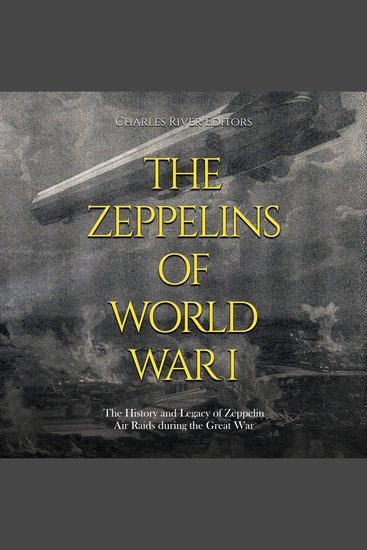
  • Zeppelins of World War I The: The History and Legacy of Zeppelin Air Raids during the Great War - cover

    Zeppelins of World War I The:...

    Editors Charles River

    • 0
    • 0
    • 0
    While airplanes had never before appeared above the field of war, other aerial vehicles had already been in use for decades, and balloons had carried soldiers above the landscape for centuries to provide a high observation point superior to most geological features. The French used a balloon for this purpose at the Battle of Fleurus in 1794, and by the American Civil War, military hydrogen balloons saw frequent use, filled from wagons generating hydrogen from iron filings and sulfuric acid.  
    	In fact, with advances in dirigible technology, many military thinkers and even aeronautical enthusiasts believed that blimps would remain the chief military aerial asset for the foreseeable future. These men thought airplanes would play a secondary role at best and might even prove a uselessly expensive gimmick soon to fade back into obscurity, leaving the majestic bulk of the dirigible as sole master of the skies.  
    	The Zeppelins, slow and large as they were, proved to be easy targets for fire from the ground, so they were too vulnerable for reconnaissance in the warzone. Instead, they were used for the task of bombing targets. Bombs were dropped on Paris in August 1914, and Zeppelins bombed Belgian forces as the Germans advanced on Liège. The Germans also used them to bomb England’s eastern ports and London in an attempt to disrupt military supplies. On the other side, British pilots destroyed a Zeppelin on the ground at Düsseldorf.  
    	This was bombing at its simplest; the explosives were kept on hooks on the side of the machines and dropped by a crew member by hand. These small forays into aerial bombardment barely even hinted at the bombing campaigns to come, but Zeppelin raids on Britain would continue for nearly four years, killing more than 500 people and injuring 1,300. These raids and the attempts to stop them would be carried out at the cutting edge of new technology. 
    Show book
  • Napoleon Bonaparte - His Life Death and Revolutionary Wars - cover

    Napoleon Bonaparte - His Life...

    Kelly Mass

    • 0
    • 0
    • 0
    Undoubtedly, Napoleon, the French revolutionist and emperor, has left his mark on European history. His vast empire stretched all over the continent, his unique image and posture have been emulated by many, and his infamous defeat in Russia was a precursor of the defeat Hitler experienced for similar reasons. 
    When we take a time machine to the end of the 18th century and the beginning of the 19th century, how can we better understand the culture and ideas of those times? How did someone from the relatively tiny island of Corsica become such an iconic figure in history? 
    In this comprehensive guide, we will take a look at some of the greatest achievements of Napoleon Bonaparte, as well as his virtues and vices, personal background, politics, exile, and death. You will gain a greater comprehension of his motives, the problems he faced, and how he solved said problems in his own way.
    Show book
  • If Women Ran the World Sh*t Would Get Done - Celebrating all the wonderful amazing stupendous inspiring butt-kicking things women do - cover

    If Women Ran the World Sh*t...

    Shelly Rachanow

    • 0
    • 0
    • 0
    Packed with little-known sheroes and empowering journaling prompts, this book and interactive journal is a must-have for those who believe the world would be a better place with women in charge. 


    Dream about the kind of world you'd run. Author Shelly Rachanow shares the many ways in which women do for others, from their families to their friends to the wider world (hint: the list goes on and on). She then asks listeners to consider how much woman power has shaped the world, and turns the question to us: what are our buttkicking ideas for changing the world around us? These empowering journal prompts ask us to look inward, at our own role as women, and decide how we will make the world a better place for our children and those who come after us.  


    Dive into this interactive journal and learn more about: 


    ● The many significant accomplishments of women throughout history 


    ● The role each of us plays in changing the world for the better 


    ● How to join the movement for female empowerment 


    If you enjoyed books like Badass Affirmations, Bad Girls Throughout History, The Book of Gutsy Women, or Made Out of Stars, then you'll love If Women Ran the World, Sh*t Would Get Done.
    Show book