Join us on a literary world trip!
Add this book to bookshelf
Grey
Write a new comment Default profile 50px
Grey
Subscribe to read the full book or read the first pages for free!
All characters reduced
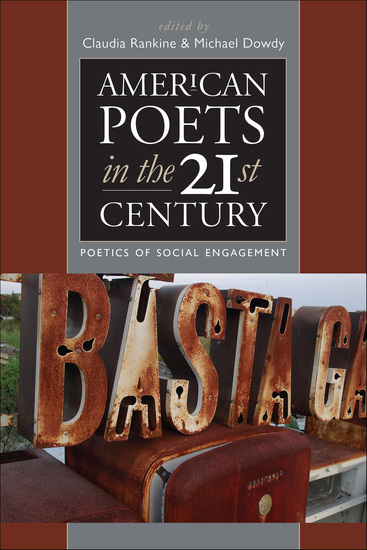
American Poets in the 21st Century - Poetics of Social Engagement - cover

American Poets in the 21st Century - Poetics of Social Engagement

Claudia Rankine, Michael Dowdy

Publisher: Wesleyan University Press

  • 0
  • 0
  • 0

Summary

Poetics of Social Engagement emphasizes the ways in which innovative American poets have blended art and social awareness, focusing on aesthetic experiments and investigations of ethnic, racial, gender, and class subjectivities. Rather than consider poetry as a thing apart, or as a tool for asserting identity, this volume's poets create sites, forms, and modes for entering the public sphere, contesting injustices, and reimagining the contemporary. Like the earlier anthologies in this series, this volume includes generous selections of poetry as well as illuminating poetics statements and incisive essays. This unique organization makes these books invaluable teaching tools. A companion website will present audio of each poet's work.Poets included:Rosa AlcaláBrian BlanchfieldDaniel BorzutzkyCarmen Giménez SmithAllison Hedge CokeCathy Park HongChristine HumeBhanu KapilMauricio Kilwein GuevaraFred MotenCraig Santos PerezBarbara Jane ReyesRoberto TejadaEdwin TorresEssayists included: John Alba CutlerChris NealonKristin DykstraJoyelle McSweeneyChadwick AllenDanielle PafundaMolly BendallEunsong KimMichael DowdyBrent Hayes EdwardsJ. Michael MartinezMartin Joseph PonceDavid ColónUrayoán Noel
Available since: 09/04/2018.
Print length: 466 pages.

Other books that might interest you

  • The Beginner's Guide to Cooperative Learning - Make your learners your main teaching resource - cover

    The Beginner's Guide to...

    Drew Howard, Jakob Werdelin

    • 0
    • 0
    • 0
    The Education Endowment Foundation's Teaching and Learning Toolkit describes collaborative learning as an approach which 'involves pupils working together on activities or learning tasks' and in such a way that enables 'everyone to participate on a collective task that has been clearly assigned'. In the context of this book, Cooperative Learning relates to a number of such activities from simple memorising to more complex analysis and debating which are designed to boost learners' interdependence, participation and interaction.
    Drawing upon both research-informed theory and real-world examples, Jakob Werdelin and Drew Howard present both an insightful introduction to Cooperative Learning as a practice and philosophy and a practical guide to classroom application.
    The authors share their expertise on how to amplify the effect of current pedagogical approaches and schemes of work, simplify performance management as an empowering tool for teachers and leaders, and create an inclusive environment in which every pupil is able to fulfil their learning potential. Jakob and Drew also discuss how Cooperative Learning relates to a range of other aspects of teaching, including assessment, metacognition and Rosenshine's Principles.
    The book focuses on Catch1Partner as an exemplary Cooperative Learning Interaction Pattern (CLIP) as, by fully grasping the principles of staging and running Catch1Partner in its many forms, readers will then be better equipped with the foundational know-how to deploy other CLIPs, such as Sage and Scribe, Word-Round and Rotating Role Reading. The authors also provide a variety of ready-to-photocopy (and downloadable) sample teaching materials, tools, guidelines and an activity transcript in the appendices.
    Suitable for teachers and leaders in both primary and secondary school settings.
    Show book
  • All Clear - Lessons From A Decade Managing School Crises - cover

    All Clear - Lessons From A...

    Chris Joffe

    • 0
    • 0
    • 0
    In All Clear: Lessons from a Decade Managing School Crises, safety expert Chris Joffe shows district and school leaders how to create safety in school environments and develop a plan for responding effectively in the event of emergency—whether it be from an allergy attack or an active shooter. In our ever-changing educational and cultural landscape, this is a critical resource. A sought-after safety trainer and consultant for schools, Chris draws on decades of experience to guide and empower district and school leaders to prepare for and execute crucial next steps in the wake of a school emergency. 


    The techniques in this book are not just hypothetical. Chris Joffe has a substantive background in emergency and crisis response, and Joffe Emergency Services has been trusted to put preparedness plans into place across US school districts, charter schools, private schools, and global companies. With this book, you'll learn how to prioritize the health and safety of your students in a way that considers the unique attributes of your school or district. 


    All Clear empowers district and school leaders, heads of school, and school security professionals—as well as teachers, parents, and other youth leaders—to create secure learning environments where students can feel safe.
    Show book
  • Oh God of Second Chances Here I Am Again - cover

    Oh God of Second Chances Here I...

    Christy Belz

    • 0
    • 0
    • 0
    Oh God of Second Chances, Here I am Again is part self improvement, part memoire based on Christy Belz's decades of work in helping people overcome challenges and their inner critics in their lives as a social worker and women's leadership and empowerment coach. It is a book about falling down and having the courage to get up and do it again. It is about having courage, vulnerability, and heart. Through personal stories of her own and additional voices from featured TEDx Talk women who Christy helped coach onto the stage, she shares raw, honest, and meaningful stories to help readers walk their journey to a full, authentic self. Starting with leading from the heart, Christy takes the reader through the twists, turns, stumbles, and successes of her own personal journey and shares the wonderful array of tools and techniques that have helped transform her life and the lives of those with whom she has worked. Filled with practices designed to help the reader pause, connect with their heart, step more fully into themselves, practice insane courage, and live more fully as their authentic, absolutely powerful, and beautiful self.
    Show book
  • All The King's Horses - cover

    All The King's Horses

    Brian Dry

    • 0
    • 0
    • 0
    This is not a fairy tale, not a love story, but bound into the truths of everyday deeds, in a world that doesn't exist today. 
    Once upon a time, near a century younger, lives so fresh, every experience cherished by a thought and a nation on the brink. 
    From the honesty of memory, we live for the moment, because our next might be our last, in a war to end all wars. 
    Hear from the lips of those that lived... those that felt... those that dreamed, and those that didn't make it. 
    This is their story, told from a small city called Perth. 
    (included... Eye witness accounts: picking up of German Raider "Kormoran" survivors, after she had sunk HMAS Sydney... 
    Thousands of American sailors hitting the streets of Perth, Western Australia, after their base in Surabaya, Java, was over run by the Japanese in WW2. 
    Joyce, one of four teenage girls, about to meet another nations servicemen for the first time.)
    Show book
  • Zulu Kingdom - Shaka Zulu's Military Genius and the Rise of a Warrior Nation - cover

    Zulu Kingdom - Shaka Zulu's...

    Rolf Hedger

    • 0
    • 0
    • 0
    Shaka Zulu was born in 1787 to Senzangakhona, a minor chief of the Zulu clan, and Nandi, a woman of the Langeni people. His birth was unconventional and shrouded in controversy. As a child born out of wedlock, Shaka and his mother faced rejection and humiliation from Senzangakhona’s family, leading to their exile from the Zulu kingdom. They found refuge among the Langeni and later with the Mthethwa, a powerful kingdom under the leadership of Chief Dingiswayo. These early experiences of hardship, resilience, and survival shaped Shaka’s character, instilling in him a determination to rise above adversity. 
    Growing up, Shaka displayed remarkable physical strength, intelligence, and leadership abilities. Among the Mthethwa, he trained as a warrior under Dingiswayo’s command, where he was exposed to innovative military tactics that later influenced his own strategies. He quickly gained recognition for his bravery and strategic mind, earning a place of prominence within the army. It was during this period that he began developing ideas to revolutionize warfare, questioning the effectiveness of traditional long-range throwing spears and loose battle formations. 
    The political landscape of the time was volatile. Various Nguni-speaking clans, including the Zulu, were engaged in constant skirmishes for power and resources. The Mthethwa, under Dingiswayo, sought to unify smaller groups to strengthen their influence against rival factions like the Ndwandwe, led by Zwide. Shaka’s abilities as a warrior and leader caught Dingiswayo’s attention, and he became a favored protégé. This mentorship provided Shaka with the opportunity to refine his tactical skills and forge alliances that would later aid his own rise to power.
    Show book
  • Getting Russia Right - 1st Edition - cover

    Getting Russia Right - 1st Edition

    Thomas Graham

    • 0
    • 0
    • 0
    As US-Russian relations scrape the depths of cold-war antagonism, the promise of partnership that beguiled American administrations during the first post-Soviet decades increasingly appears to have been false from the start. Why did American leaders persist in pursuing it? Was there another path that would have produced more constructive relations or better prepared Washington to face the challenge Russia poses today? 


    With a practitioner's eye honed during decades of work on Russian affairs, Thomas Graham deftly traces the evolution of opposing ideas of national purpose that created an inherent tension in relations. Getting Russia Right identifies the blind spots that prevented Washington from seeing Russia as it really is and crafting a policy to advance American interests without provoking an aggressive Russian response. Distilling the Putin factor to reveal the contours of the Russia challenge facing the United States whenever he departs the scene, Graham lays out a compelling way to deal with it so that the United States can continue to advance its interests in a rapidly changing world.
    Show book