¡Acompáñanos a viajar por el mundo de los libros!
Añadir este libro a la estantería
Grey
Escribe un nuevo comentario Default profile 50px
Grey
Suscríbete para leer el libro completo o lee las primeras páginas gratis.
All characters reduced
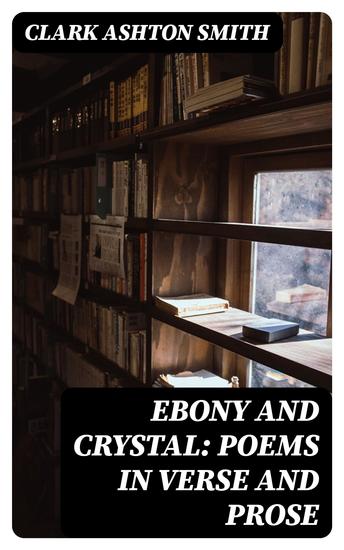
Ebony and Crystal: Poems in Verse and Prose - cover

Ebony and Crystal: Poems in Verse and Prose

Clark Ashton Smith

Editorial: DigiCat

  • 0
  • 0
  • 0

Sinopsis

In "Ebony and Crystal: Poems in Verse and Prose," Clark Ashton Smith masterfully intertwines lucid imagery with a vivid imagination, crafting a collection that is both a celebration of and an exploration into the realms of beauty and despair. The work is characterized by a flamboyant literary style, rich in ornate language and intricate symbolism, echoing the decadence of the Symbolist movement. Smith's unique blend of fantasy and lyricism invites readers into a multi-faceted world, where metaphysical musings and earthly concerns collide, revealing profound truths hidden beneath layers of lyrical prose. Clark Ashton Smith was not only a poet but also a sculptor and a painter, which deeply influenced his creative sensibilities. Born in 1893, his multifarious artistic pursuits and lifelong fascination with the arcane and the otherworldly shaped the contours of his literary voice. His experiences in the bohemian culture of the early 20th century California infused his work with a sense of artisanal craftsmanship, often reflecting themes of lost civilizations and the splendor of twilight worlds. "Ebony and Crystal" is a must-read for those captivated by exquisite verse and explorations of the human condition. It offers a deep dive into a world of imagination that transcends time, inviting readers to revel in the beauty of language and the haunting echoes of existence. Smith's work stands as a testament to the power of poetry to elevate the mundane into the realm of the extraordinary.
Disponible desde: 02/06/2022.
Longitud de impresión: 72 páginas.

Otros libros que te pueden interesar

  • This Was Meant to Find You - When You Needed It Most - cover

    This Was Meant to Find You -...

    Charlotte Freeman

    • 0
    • 0
    • 0
    If you are hurting, healing, feeling, letting someone go, or starting a new chapter and learning to open your heart back up again, this book was meant to find you when you needed it most. "This Was Meant To Find You (When You Needed It Most)" is Charlotte Freeman’s second book and was written to resonate deeply with the ones who seek comfort in reading the right words at the right time. It’s for the ones who are learning what it means to choose yourself a little more each day and be gentle with yourself through all phases of your journey.
    Ver libro
  • Testament to Beauty - A former Poet Laureate demonstrates his poetic talents in this tender and beautiful verse - cover

    Testament to Beauty - A former...

    Robert Seymour Bridges

    • 0
    • 0
    • 0
    Robert Seymour Bridges, OM was born on 23rd October 1844 at Walmer in Kent where he spent his early childhood in a house overlooking the anchoring ground of the British fleet.  
    His father died aged only 47 in 1853. A year later his mother remarried and the family relocated to Rochdale, where his stepfather was the vicar.  
    In 1854 Bridges was sent to Eton College and attended until 1863.  After Eton he went to Corpus Christi College at Oxford. There he became good friends with Gerard Manley Hopkins and would later compile an edition of his poems that is now considered a major contribution to English literature. 
    He graduated from Oxford, in 1867, with a second-class degree in literae humaniores.  Initially he planned to join the Church of England and travelled to the Middle East to broaden his religious horizons.  However, he soon decided that life as a physician would be a better path and, after 8 months studying German (that being the language of many scientific papers at the time) he began his study of medicine at St. Bartholomew's Hospital in 1869.  His long-term ambition was that by the age of forty he could retire from medicine to devote himself to writing. 
    Unfortunately Bridges failed his final medical examinations in 1873 and, as unable to immediately retake the papers, spent six months in Italy learning Italian as well as immersing himself in its art. In July 1874 he went to Dublin to continue his medical studies. Re-examined in December he passed and became a house physician at St Bartholomew's Hospital. It was whilst here that he engaged in a series of highly critical remarks about the Victorian medical establishment. One such was his claim that whilst working as a young doctor he saw a staggering 30,940 patients in one year. 
    A bout of severe pneumonia and lung disease forced his retirement from the medical profession in 1882 and so, slightly ahead of schedule, he began his literary career in earnest.  He already been writing for several years and had published his first poetry collection in 1873.  
    After his illness and a trip to Italy, Bridges moved, with his mother, to Yattendon in Berkshire.  It was during this time, from 1882 to 1904, that Bridges wrote most of his best-known lyrics as well as eight plays and two masques, all in verse.  
    It was also here, in 1884, that he married Monica Waterhouse. They would go on to have three children and spend the rest of their lives in rural seclusion, in an idyllic marriage, first at Yattendon, then at Boars Hill, Oxford. 
    Bridges made an important contribution to hymnody with the publication in 1899 of his Yattendon Hymnal. This collection of hymns became a bridge between the Victorian hymnody of the late 19th century and the modern hymnody of the early 20th century. He was also a chorister at Yattendon church for 18 years. 
    In 1902 Monica and his daughter Margaret became seriously ill with tuberculosis, and a move from Yattendon to a healthier climate was in order. After several temporary homes they moved abroad to spend a year in Switzerland before returning to settle again in England at Chilswell House, which Bridges had designed, and built on Boar's Hill overlooking Oxford University.   
    His greatest achievement though was still some years ahead of him.  The office of Poet Laureate was held by Alfred Austin but with his death it was offered first to Rudyard Kipling, who refused it, and then to Bridges. He was appointed Poet Laureate in 1913 by George V, the only medical graduate to have ever held the office. Bridges, at this time, was neither highly regarded nor well known but a safe pair of hands in a World rapidly being overshadowed by the storms about to erupt over Europe and the First World War. 
    The events of this War, including the wounding of his son, Edward, had a sobering effect on Bridges' poetry. His work became fiercely patriotic. In 1915 edited a volume of prose and poetry, The Spirit of Man, intended to appeal to readers living in war time
    Ver libro
  • Cortne Robinson Presents: Poetic Essays - cover

    Cortne Robinson Presents: Poetic...

    Kaashmir Gang

    • 0
    • 0
    • 0
    This audiobook is narrated by an AI Voice.   
    Thoughts that come from the mind of Cortne Robinson are usually poetic anyway so we put together a reading of his poems. Enjoy because this is dedicated to you.
    Ver libro
  • The Tragedy of Macbeth - cover

    The Tragedy of Macbeth

    William Shakespeare

    • 0
    • 0
    • 0
    Macbeth and his wife show how bad the evil that can possess human souls is. But evil is not all powerful. On the one hand, Macbeth is the gloomiest of the great Shakespeare's tragedies; on the other hand, it's more encouraging than Hamlet, Othello or King Lear. In no other tragedy as in Macbeth the evil is confronted by so many people, and nowhere else they are so active.
    Shakespeare is the author of the world famous sonnets and plays: Romeo and Juliet, Hamlet, Macbeth and Othello, as well as comedies Twelfth Night, A Midsummer's Night Dream, Love's Labour's Lost, The Merry Wives of Windsor, The Two Gentlemen of Verona and As You Like It. William Shakespeare is the most performed playwright, the works of the great English poet have been on top of the world theatre stages for some centuries already.
    Ver libro
  • The Legend of Sleepy Hollow - cover

    The Legend of Sleepy Hollow

    Washington Irving

    • 0
    • 0
    • 0
    "The Legend of Sleepy Hollow" is an 1820 short story by American author Washington Irving, contained in his collection of 34 essays and short stories titled The Sketch Book of Geoffrey Crayon, Gent. Irving wrote the story while living in Birmingham, England. "The Legend of Sleepy Hollow" is among the earliest examples of American fiction with enduring popularity, especially during Halloween because of a character known as the Headless Horseman believed to be a Hessian soldier who was decapitated by a cannonball in battle. The story is set in 1790 in the countryside around the Dutch settlement of Tarry Town (historical Tarrytown, New York), in a secluded glen known as Sleepy Hollow. Sleepy Hollow is renowned for its ghosts and the haunting atmosphere that pervades the imaginations of its inhabitants and visitors. Some residents say this town was bewitched during the early days of the Dutch settlement, while others claim that the mysterious atmosphere was caused by an old Native American chief, the "wizard of his tribe ... before the country was discovered by Master Hendrik Hudson." Residents of the town are seemingly subjected to various supernatural and mysterious occurrences. They are subjected to trance-like visions and frequented by strange sights, music, and voices "in the air." The inhabitants of Sleepy Hollow are fascinated by the "local tales, haunted spots, and twilight superstitions" on account of the mysterious occurrences and haunting atmosphere.
    Ver libro
  • Wandering Spirits of Exile - cover

    Wandering Spirits of Exile

    Monica Minott

    • 0
    • 0
    • 0
    In Wandering Spirits of Exile, poems converse with art, bridging words and visual representation. This powerful collection breathes life into images, capturing their essence and telling their stories. Through three sections, the collection reimagines the exilic journey.
    Section 1 interrogates and illuminates the Middle Passage. Section 2 delves into the spirit-life of Jamaica's Nanny of the Maroons, tracing the 'Nanny Spirit' through generations. Section 3 expands the narrative through artists like Mallica 'Kapo' Reynolds and Jean-Michel Basquiat, portraying the enduring legacy of Africans in the New World.
    With ekphrastic poetry at its core, Wandering Spirits of Exile weaves history and emotion, confronting institutional violence and social disenfranchisement. The Nanny spirit, a symbol of empowerment, guides readers through a journey of reclamation and resilience. This collection is a tribute to heritage, identity, and the uncontainable spirit of those far from home.
    Ver libro