Join us on a literary world trip!
Add this book to bookshelf
Grey
Write a new comment Default profile 50px
Grey
Subscribe to read the full book or read the first pages for free!
All characters reduced
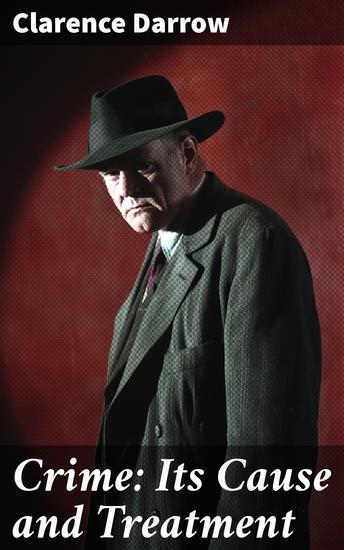
Crime: Its Cause and Treatment - Understanding the Roots of Crime and Innovations in Rehabilitation - cover

Crime: Its Cause and Treatment - Understanding the Roots of Crime and Innovations in Rehabilitation

Clarence Darrow

Publisher: Good Press

  • 0
  • 0
  • 0

Summary

In "Crime: Its Cause and Treatment," Clarence Darrow offers a penetrating exploration into the sociological, psychological, and economic factors contributing to criminal behavior. Drawing upon case studies, empirical data, and philosophical inquiry, Darrow employs a persuasive and accessible literary style that blends eloquence with rigorous argumentation. Set against the backdrop of the early 20th century, a time marked by significant social upheaven including the rise of industrialization and urbanization, this work seeks to dismantle the simplistic notions of criminality by arguing that individuals are often products of their environment. Clarence Darrow, renowned as one of America's preeminent defense attorneys, was deeply influenced by his roots in the progressive reform movement and his advocacy for the rights of the marginalized. His extensive legal experience, coupled with a passionate commitment to social justice, propelled Darrow to confront the systemic failures of societal institutions that contribute to crime. His insights are shaped by a lifetime spent challenging the status quo and defending those who are often vilified by society. "Crime: Its Cause and Treatment" is not just a work for legal scholars, but a critical read for anyone interested in understanding the deeper roots of criminal behavior. Darrow'Äôs compelling arguments invite readers to rethink their perceptions of justice and morality, making it a must-have for advocates of reform and for those who seek an empathetic perspective on crime.
Available since: 08/12/2023.
Print length: 164 pages.

Other books that might interest you

  • House of Our Queer - Healing Reframing and Reclaiming Your Spiritual Practice - cover

    House of Our Queer - Healing...

    Bex Mui

    • 0
    • 0
    • 0
    Queerness is a blessing. Reclaim your spiritual practice. 
    In House Of Our Queer, activist and organizer, Bex Mui M. Ed., takes readers on a winding path through her spiritual journey. Raised Catholic— with Buddhist influences from her father and his family— Bex shares the complexities that arise from being queer in religious spaces and shares her journey back to her spiritual roots after years of shutting out faith. Whether you have felt shut out by religion, or have wanted to find your own queer spiritual path, this book is for you. 
    Throughout the text, the author describes her own spiritual practices including energy work, astrology, tarot, ancestor altars, moon rituals, sacred sexuality, and reframed Christian practices and beliefs. Each chapter ends with offerings that readers can incorporate into their own spiritual practice. The author guides and inspires readers to reclaim spiritual practices that work for them. 
    Spiritual practices can help people find stability and community to develop trust in intuitions. Yet, too often, queer people feel that they must sacrifice queerness and pleasure to benefit from everything that spirituality has to offer. House Of Our Queer poses that great change can happen when queerness is held at the center, rather than at the margins of religious experience. Bex Mui creates the foundation for reclaiming faith and spirituality without sacrificing the essential parts o who we are. The text serves as a reminder that queerness is a blessing, and offers tools we can use to honor that truth in our daily lives.
    Show book
  • The Con - How Scams Work Why You're Vulnerable and How to Protect Yourself - cover

    The Con - How Scams Work Why...

    James Munton, Jelita McLeod

    • 0
    • 0
    • 0
    “[A] fascinating, informative, and highly entertaining primer on the various ways the uninitiated may find themselves ripped off by a con artist.” —Publishers Weekly   No one thinks it can happen to them, but Americans are forty times more likely to be defrauded than to have their cars stolen or their homes burgled. Con artists ruin people financially and emotionally, leaving in their wake a trail of destruction, broken hearts, and deflated dreams.    The first step to combating fraud is to understand it. What do scams look like? Why are they effective? The next step is to take action. How can we protect ourselves and our families? The Con: How Scams Work, Why You’re Vulnerable, and How to Protect Yourself informs and engages with accessible stories of ordinary people from all walks of life thrown into unexpected and disorienting circumstances. The book goes behind the scenes of real-world cons to examine the logistics and psychology that enable scams to succeed. The goal is to help people understand and recognize deception, and in the same way that they avoid other potentially dangerous situations, take a detour. Once readers have gained a clear idea of what scams look and sound like and learned simple strategies to reduce personal risk, protecting themselves will be just as instinctive as putting on a seat belt.  “This compelling work goes a long way toward putting distance between scammers and their prey.” —Foreword Reviews  “Completely fascinating and insightful.” —Booklist  
    Show book
  • Healing Your Inner Child First - Becoming the Best Version of Yourself by Letting Go of the Past Overcoming Trauma and Feeling Worthy - cover

    Healing Your Inner Child First -...

    Cher Hampton

    • 0
    • 0
    • 0
    What to do with your past when it keeps on following you? 
    What comes to your mind when you hear the term “inner child?” Is it that you are carrying a child within (as in you are pregnant) or that it is a hypothetical version of yourself? This is just the tip of the iceberg you have touched, take a full dive in to get to know more about your inner child. Yes! You have one too! Everyone has an inner child. 
    No matter how old you are, everyone has a child within. You are your inner kid, but it is not the infantile mentality you have clung to all these years. It’s your subconscious mind at work. It is you who possesses all your suppressed childhood memories and sentiments that return from time to time. It’s critical to your well-being and progress to heal your inner child FIRST. 
    Healing your inner child FIRST is critical because everything about whom you are originated in the experiences of the first years of your life. If you don’t find peace with your inner child, you can work on yourself as hard as you want, but you will never feel fully fulfilled in life as you will always carry the pain of your unfulfilled child with you. That’s why you must start with healing your inner child today! 
    This book is an excellent resource for discovering your inner child. Not only that, but it also explains how to reclaim your inner child following any major or minor trauma, and how to do so in order to reach your full potential. If you want to live a fulfilling life, you must not abandon this part of yourself.Even if you’re doing this all by yourself, you can start healing your inner child with ‘’Healing Your Inner Child First’’!
    Show book
  • The Republic - cover

    The Republic

    Plato

    • 0
    • 0
    • 0
    The Republic (Greek: Politeia) is a Socratic dialogue, written by Plato around 380 BC, concerning the definition of (justice), the order and character of the just city-state and the just man, reason by which ancient readers used the name On Justice as an alternative title (not to be confused with the spurious dialogue also titled On Justice). The dramatic date of the dialogue has been much debated and though it must take place some time during the Peloponnesian War, "there would be jarring anachronisms if any of the candidate specific dates between 432 and 404 were assigned".    It is Plato's best-known work and has proven to be one of the most intellectually and historically influential works of philosophy and political theory. In it, Socrates along with various Athenians and foreigners discuss the meaning of justice and examine whether or not the just man is happier than the unjust man by considering a series of different cities coming into existence "in speech", culminating in a city (Kallipolis) ruled by philosopher-kings; and by examining the nature of existing regimes.    The participants also discuss the theory of forms, the immortality of the soul, and the roles of the philosopher and of poetry in society. Short Summary (Epilogue): X.1—X.8. 595a—608b. Rejection of Mimetic Art X.9—X.11. 608c—612a. Immortality of the Soul X.12. 612a—613e. Rewards of Justice in Life X.13—X.16. 613e—621d. Judgment of the Dead The paradigm of the city — the idea of the Good, the Agathon — has manifold historical embodiments, undertaken by those who have seen the Agathon, and are ordered via the vision. The centre piece of the Republic, Part II, nos. 2–3, discusses the rule of the philosopher, and the vision of the Agathon with the allegory of the cave, which is clarified in the theory of forms.    The centre piece is preceded and followed by the discussion of the means that will secure a well-ordered polis (City). Part II, no. 1, concerns marriage, the community of people and goods for the Guardians, and the restraints on warfare among the Hellenes. It describes a partially communistic polis. Part II, no. 4, deals with the philosophical education of the rulers who will preserve the order and character of the city-state. In Part II, the Embodiment of the Idea, is preceded by the establishment of the economic and social orders of a polis (Part I), followed by an analysis (Part III) of the decline the order must traverse. The three parts compose the main body of the dialogues, with their discussions of the "paradigm", its embodiment, its genesis, and its decline. The Introduction and the Conclusion are the frame for the body of the Republic.    The discussion of right order is occasioned by the questions: "Is Justice better than Injustice?" and "Will an Unjust man fare better than a Just man?" The introductory question is balanced by the concluding answer: "Justice is preferable to Injustice". In turn, the foregoing are framed with the Prologue (Book I) and the Epilogue (Book X). The prologue is a short dialogue about the common public doxai (opinions) about "Justice". Based upon faith, and not reason, the Epilogue describes the new arts and the immortality of the soul.
    Show book
  • Parenting with Love & Logic - Teaching Children Responsibility - cover

    Parenting with Love & Logic -...

    Foster Cline, Jim Fay

    • 0
    • 0
    • 0
    Designed for preschool and beyond, this helpful and practical psychology-based parenting method is an invaluable guide for all parents! Teach your children healthy responsibility and encourage their character growth from a young age. Learn to establish healthy boundaries with your children through easy-to-implement steps without anger, threats, nagging, or power struggles. Trusted by generations of parents, counselors, and teachers to lovingly raise responsible children, Parenting with Love and Logic includes solutions for dozens of specific topics such as:  Tantrums  Managing screen time  Grades and report cards  Chores  Getting ready for school  Peer pressure  Cyberbullying  Navigating crisis situations and grief  And much more!  Each issue is indexed for easy reference. Learn how to tame tempers and re-establish a calm, healthy relationship and positive communication with your child today!
    Show book
  • Reckoning - cover

    Reckoning

    V

    • 0
    • 0
    • 0
    The work of a lifetime from the Tony Award–winning, bestselling author of The Vagina Monologues—political, personal, profound, and more than forty years in the making. 


    The newest book from V (formerly Eve Ensler), Reckoning invites you to travel the journey of a writer's and activist's life and process over forty years, representing both the core of ideas that have become global movements and the methods through which V survived abuse and self-hatred. Seamlessly moving from the internal to the external, the personal to the political, Reckoning is a moving and inspiring work of prose, poetry, dreams, letters, and essays drawn from V's lifelong journals that takes listeners from Berlin to Oklahoma to the Congo, from climate disaster, homelessness, and activism to family. 


    Unflinching, intimate, introspective, courageous, Reckoning explores ways to create an unstoppable force for change, to love and survive love, to hold people and states accountable, to reckon with demons and honor the dead, to reclaim the body, and to see oneself as connected to a greater purpose. It reimagines what seems fixed and intractable, providing a path to understand one's unique experience as deeply rooted in the world, to break through one's own boundaries, and to write oneself into freedom.
    Show book