Join us on a literary world trip!
Add this book to bookshelf
Grey
Write a new comment Default profile 50px
Grey
Subscribe to read the full book or read the first pages for free!
All characters reduced
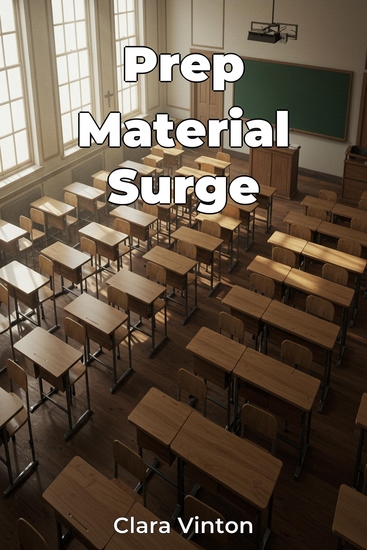
Prep Material Surge - cover

Prep Material Surge

Clara Vinton

Translator A AI

Publisher: Publifye

  • 0
  • 0
  • 0

Summary

Prep Material Surge examines the growing reliance on commercial academic support materials in higher education and professional certification. It explores whether students are truly learning or simply mastering test-taking through resources like outlines and test banks. This book investigates the economics of the prep material industry while analyzing student usage patterns and their impact on academic outcomes.

 
The book reveals intriguing facts, such as how the pressure to score high on standardized testing incentivizes students to seek shortcuts, and the potential for over-reliance on these materials to hinder the development of deeper knowledge. It is written in an accessible style, drawing upon student surveys and analyses of exam scores.

 
Providing actionable recommendations for educators and policymakers, the book progresses from an overview of the commercial prep material ecosystem to a detailed analysis of student usage and performance, concluding with strategies to promote effective learning.
Available since: 04/07/2025.
Print length: 81 pages.

Other books that might interest you

  • Michael Faraday - Theories about Electromagnetism and Electrochemistry - cover

    Michael Faraday - Theories about...

    Kelly Mass

    • 0
    • 0
    • 0
    Michael Faraday was born in Newington Butts, Surrey, on September twenty-second, 1791. (which is now part of the London District of Southwark). He grew up in a bad home. His dad, James, was a Christian who came from the Glasite sect. At the time of the winter season of 1790, James Faraday moved his marriage partner and 2 kids from Outhgill, Westmorland, where he had been an apprentice to the town blacksmith. In the fall of that year, Michael was born. Michael Faraday, the 3rd of 4 kids, needed to inform himself after getting just a primary school education. 
    He started working as an apprentice to George Riebau, a regional bookbinder and bookseller on Blandford Street, when he was fourteen years of age. 
    Faraday read a lot of literature throughout his seven-year apprenticeship, and that includes Isaac Watts' “The Improvement of the Mind”, which he actively adopted the concepts and recommendations in. He also ended up being intrigued by physics, specifically electrical power. Jane Marcet's book Discussions on Chemistry was specifically motivating to Faraday. 
    Let’s see what else he did. In this comprehensive guide, you will find out more.
    Show book
  • The US Congress - A Very Short Introduction - cover

    The US Congress - A Very Short...

    Donald A. Ritchie

    • 0
    • 0
    • 0
    Donald A. Ritchie, a congressional historian for forty years, takes listeners on a fascinating, behind-the-scenes tour of Capitol Hill, pointing out the key players, explaining their behavior, and translating parliamentary language into plain English. He also explores the essential necessity of compromise to accomplish anything significant in the legislative arena. However, recent events show that political polarization has hardened and produced gridlock. The 2020 election also produced a more diverse membership in terms of gender, ethnicity, religion, and ideology, with primary elections resulting in the defeat of moderate candidates, making bipartisan compromise harder to achieve. 


    Among the most significant events, the Senate ignored President Obama's last nomination to the Supreme Court and then adopted a "nuclear option" to streamline future Supreme Court confirmations. The House also twice impeached President Trump, processes that starkly expose the differences between the majority-rule requirements of the House and the super-majority requirements of the Senate. This new edition explains how the parties have changed in light of the unprecedented politics of the past four years, culminating in the mob attack on the U.S. Capitol on January 6, 2021, and how this development has affected both the House and the Senate.
    Show book
  • Testing Education - A Teacher's Memoir - cover

    Testing Education - A Teacher's...

    Kathy Greeley

    • 0
    • 0
    • 0
    Since the 2002 implementation of No Child Left Behind, the American public education system has been fundamentally changed. Excessive testing, standardized curriculums, destructive demands on children, corporate-­style evaluations, and top-­down mandates have become the norm. In response, record numbers of demoralized educators have quit, and millions of students have been left educationally impoverished. This troubling transformation has been exhaustively critiqued by scholars and commentators. Yet one crucial voice has been missing. 


    In Testing Education, Kathy Greeley recounts the impact of education reform from a teacher's point of view. Based on a teaching career ranging nearly forty years, Greeley details how schools went from learning communities infused with excitement, intellectual stimulation, and joy to sterile spaces of stress, intimidation, and fear. In this ultimately hopeful memoir, Greeley asks us to learn from the past to reimagine the future of public education.
    Show book
  • Gardening Can Be Murder - How Poisonous Poppies Sinister Shovels and Grim Gardens Have Inspired Mystery Writers - cover

    Gardening Can Be Murder - How...

    Marta McDowell

    • 0
    • 0
    • 0
    This fun, engrossing book takes a look at the surprising influence that gardens and gardening have had on mystery novels and their authors. With their deadly plants, razor-sharp shears, shady corners, and ready-made burial sites, gardens make an ideal scene for the perfect murder. But the outsize influence that gardens and gardening have had on the mystery genre has been underappreciated. Now, Marta McDowell, a writer and gardener with a near-encyclopedic knowledge of the genre, illuminates the many ways in which our greatest mystery writers, from Edgar Allen Poe to authors on today’s bestseller lists, have found inspiration in the sinister side of gardens. From the cozy to the hardboiled, the literary to the pulp, and the classic to the contemporary, Gardening Can Be Murder is the first book to explore the mystery genre’s many surprising horticultural connections. Meet plant-obsessed detectives and spooky groundskeeper suspects, witness toxic teas served in foul play, and tour the gardens—both real and imagined—that have been the settings for fiction’s ghastliest misdeeds. A New York Times bestselling author herself, McDowell also introduces us to some of today’s top writers who consider gardening integral to their craft, assuring that horticultural themes will remain a staple of the genre for countless twisting plots to come.    “This book is dangerous. A veritable cornucopia of crime fiction and gardening lore, it faces the reader with multiple temptations—books to seek out, plants to obtain, garden tours to book.” —Vicki Lane, author of the Elizabeth Goodweather Appalachian Mysteries
    Show book
  • Yours Truly - An Obituary Writer's Guide to Telling Your Story - cover

    Yours Truly - An Obituary...

    James R. Hagerty

    • 0
    • 0
    • 0
    Someday, your life story is likely to be boiled down to a few lines. If you leave things to chance, your obituary is almost sure to be solemn, formulaic, and full of errors—an obligatory final chapter written in haste by others. James R. Hagerty, longtime obit writer for The Wall Street Journal, knows how to get the job done right: Do it yourself, starting now, while you still can. 


    In this heartfelt and reassuring guide, Hagerty explains how to preserve your personal history—from crafting a brief obituary for newspapers and websites, to a more thoughtful and detailed mini-memoir for those close to you. Through his personal stories, on-the-job anecdotes, and insights, you will learn what to include, what to leave out, and how to provide historical context, record oral histories, and make the most of details, all with candor and wit. Best of all, you'll find that reviewing your life story helps you think about what you're doing with your time on Earth and whether you're on the right path. It isn't too late to improve the narrative with a stronger ending. 


    Telling your story your way can be the best gift you ever give to friends and loved ones—and yourself.
    Show book
  • Germany - Historic Events and Significant Changes - cover

    Germany - Historic Events and...

    Kelly Mass

    • 0
    • 0
    • 0
    This is a book with 3 different topics, all related to the 18th and 19th century history of Germany. The topics are the following: 
    Otto von Bismarck: Otto, Prince of Bismarck, Count of Bismarck-Schönhausen, Duke of Lauenburg, was a conservative German statesman, diplomat, and author who was born Junker Otto Eduard Leopold von Bismarck. Bismarck supervised Germany's unification in 1871 and functioned as its first chancellor till 1890, throughout which time he ruled Europe for 20 years. 
    The Unification of Germany: The Unification of Germany had a significant impact on the whole country, the empire, and the decades after that. It was the inauguration for Germany into the 20th century, and the dreaded World War I and World War II that were partially consequences of that unification. 
    On January 18th, 1871, in the Palace of Versailles in France, Germany was lawfully merged into the German Empire, a Prussia-dominated country state with federal components. Throughout the Franco-Prussian War, princes of German countries assembled there to declare King Wilhelm I of Prussia Emperor of the German Empire. 
    The Weimar Republic: To summarize everything about this topic, the Weimar Republic was a disaster. Perhaps the setup of the republic wasn’t as much as fault as just the world events that led to the Great Depression, the eventual surrender of Germany to France, Russia, and England in World War I before that, and other significant changes in the economy at the time. 
    Do you want to buy a few eggs with thousands of marks? How about a loaf of bread for ten thousand dollars? The inflation in the Weimar Republic led to a severe economic downturn, one that had probably never been there ever before. This led to other problems, which also explained the rise of Nazi Germany somewhat later.
    Show book