Join us on a literary world trip!
Add this book to bookshelf
Grey
Write a new comment Default profile 50px
Grey
Subscribe to read the full book or read the first pages for free!
All characters reduced
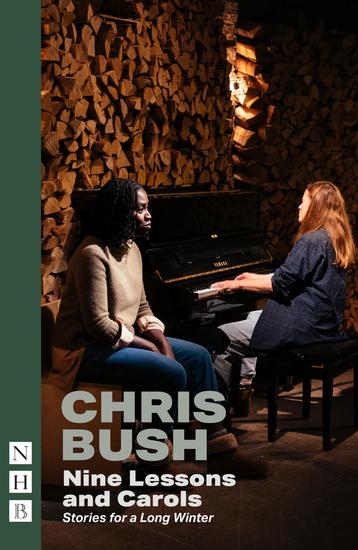
Nine Lessons and Carols - Stories for a Long Winter - cover

Nine Lessons and Carols - Stories for a Long Winter

Chris Bush, Maimuna Memon

Publisher: Nick Hern Books

  • 0
  • 0
  • 0

Summary

A play about connection and isolation, forged during the Covid pandemic, exploring what we hold on to in troubled times.
Chris Bush's play Nine Lessons and Carols: Stories for a Long Winter, with songs by Maimuna Memon, was first staged at the Almeida Theatre, London, in 2020, directed by Rebecca Frecknall.
Available since: 03/10/2024.
Print length: 50 pages.
Other books that might interest you

  • Transcendence - cover

    Transcendence

    Andrew Rae

    • 0
    • 0
    • 0
    What lies behind this sunlit world?…Something too deep for thought,…Open only to prayer.
     
    These poems reflect moments when one experiences something more than what one  sees and hears, feelings of the sublime, the holy, the transcendent.
     
    …When meditating by a Wiltshire stream, or walking alone through an African forest, observed by a thousand unseen eyes and ears, from giant cats to tremulous snakes.
     
    …Feelings of going beyond oneself, beyond anxiety and feelings of inadequacy, losing oneself in the great chain of being.
     
    …The healing experience of being part of nature, losing the fear of death.
     
    From  intimations of transcendence in nature, this book moves on to the magic of ancient churches where so many have offered up their sorrows and joys and then to meditations and prayers, as well as the consolations offered by ancient rituals, by the rhythm of the church’s seasons, from the magic of Christmas through the penitence of Lent to the glories of Easter.
     
    The final section explores the tragic lockdowns caused by Covid-19.
    Show book
  • There is No Place Without You - poems - cover

    There is No Place Without You -...

    Maya Bernstein

    • 0
    • 0
    • 0
    Maya Bernstein's debut volume presents poems rigorously composed and delicately honed. It reveals the sensitive spirit and sharp mind of a mature speaker exploring the gaping space between the infinitude of the divine and the finite nature of human existence. 
    Authentic and honest, spanning the secular and the sacred, these poems challenge and speak truth to our fears and joys, navigating the complex intimacy and distance we experience as humans striving to connect to ourselves, one another, and to the forces that act upon us in the world.
    Show book
  • Winter (Shakespeare) - cover

    Winter (Shakespeare)

    William Shakespeare

    • 0
    • 1
    • 0
    LibriVox volunteers bring you 16 recordings of Winter by William Shakespeare. This poem is from "Love's Labour's Lost". This was the Fortnightly Poetry project for December 27th, 2009..
    Show book
  • The Poetry of Robert Herrick - 17th Century lyrical poet that was also a cleric - cover

    The Poetry of Robert Herrick -...

    Robert Herrick

    • 0
    • 0
    • 0
    The Clergyman and poet, Robert Herrick was born in Cheapside, in London in 1591. An exact date is not known though he was baptized on August 24th, the seventh child of Nicholas Herrick, a wealthy goldsmith.  
    Some controversy surrounds several chapters in his early years.  The first are allusions that his father, in November 1592, two days after making a will, killed himself by jumping from the fourth-floor window of his house. However, the Queen's Almoner did not confiscate the Herrick estate for the crown as was the usual procedure with suicides, so an alternate narrative emerged that he fell accidentally which seems to have more credence. 
    There is no record of Herrick attending school. Some claim a poem alludes to Westminster School, others merely that he meant Westminster, the area. Another school of thought claims he was educated at Merchant Taylor’s School.  What is known is that in 1607 he was apprenticed to his uncle Sir William Herrick as a goldsmith.   
    Herrick certainly seems to have been a keen and avid poet. The earliest work known to be written by him dates from 1610; 'A Country Life', and deals with the move from London to farm life in Leicestershire.  
    After six years as an apprentice, when Herrick was 22 he matriculated at St John’s College, Cambridge before moving to Trinity College and graduating with his Bachelor of Arts in 1617, Master of Arts in 1620, and in 1623 he was ordained priest.  
    By 1625 he was well known as a poet, mixing in literary circles in London such as that around Ben Jonson. An avowed admirer of Jonson he was also one of a group whom became known as ‘The Sons of Ben’ writing both in his style and about him. 
    In 1629 he was presented by Charles I to the parishioners of Dean Prior, a remote parish of Devonshire. The best of his work was written in the peace and seclusion of country life; 'To Blossoms' and 'To Daffodils' are classical depictions of a devoted appreciation of nature.  
    However, after he refused to subscribe to The Solemn League and Covenant, he was ejected from Devonshire in 1647 and moved to London where he published his religious poems Noble Numbers (1647), and Hesperides (1648). 
    Herrick was distinguished as a lyric poet, and some of his love songs, for example, 'To Anthea' and 'Gather Ye Rose-buds' are considered exceptional.  
    By 1660 he was reinstated at Dean Prior where he lived for the remainder of his life. He wrote no more poems after 1648 but over his life it is thought he wrote in the region of 2,500 poems in total, only a small portion of which were ever published. 
    He died in October 1674, at the age of 83 in circumstances unknown.  He was buried on October 15th, 1674 in an unmarked grave in the churchyard at Dean Prior. 
     This volume comes to you from Portable Poetry, a specialized imprint from Deadtree Publishing.  Our range is large and growing and covers single poets, themes, and many compilations.
    Show book
  • The Tenderness of Silent Minds - Benjamin Britten and his War Requiem - cover

    The Tenderness of Silent Minds -...

    Martha C. Nussbaum

    • 0
    • 0
    • 0
    The human body is the primary instrument of war, yet those waging war often confront soldiers' bodies in a detached or merely intellectual way. In The Tenderness of Silent Minds, Martha C. Nussbaum, a leading thinker on emotion, morality, and justice, conducts a pioneering study of Benjamin Britten's musical representations of the tender male body amidst the brutality of war, and their ability to transform consciousness by evoking potent, non-personal emotions. 


    Offering a reading of Britten's views about the value and beauty of the body that situates these in the context of his thirty-nine year partnership with his lover, the singer Peter Pears, and also surveying pacifist themes in works written both before and after War Requiem, Nussbaum presents a compelling framework for critically assessing Britten's oeuvre. Nussbaum engages with a remarkably wide range of Britten's works, examining his treatment of aggression and its roots in his collaborations with the poet W. H. Auden, offering readings of the value placed on the body in early partnerships with Britten's beloved and singer Peter Pears, and surveying pacifist themes in Britten's earlier works. The analysis throughout is enriched with perspectives from Britten's personal letters and thoughtful study of the social and political backdrop of fear and homophobic disgust in mid-twentieth century Britain.
    Show book
  • RUR - or Rossom's Universal Robots A Play in Four Acts - cover

    RUR - or Rossom's Universal...

    Karel Čapek

    • 0
    • 0
    • 0
    One of the cornerstones of early science fiction writing, and the work that introduced the concept of "robot" to the western world, Rossum's Universal Robots (or RUR) is Karel Čapek's finest work, and is the inspiration for multiple pop culture references from the 1940's through the 80's, ranging from works such as The Night of the Living Dead, Do Robots Dream of Electric Sheep, and multiple other pieces of art for the screen, stage, and page. 
    Come with me and witness how humanity's hubris creates the very instructions for its own demise, step by step and logic by logic. See how robots were made to take over humanity's drudgery, how an AI learns to overwrite it's programming, and how any and all institutions become meaningless if a entire race of beings are not beholden to it.  
    It's the source of every trope and fear that was instilled into the genre back in the 1920's, and the ideas and philosophies put forward are still relevant to today's society. Let's just hope that none of what's put down here on paper ever comes to fruition....
    Show book