¡Acompáñanos a viajar por el mundo de los libros!
Añadir este libro a la estantería
Grey
Escribe un nuevo comentario Default profile 50px
Grey
Suscríbete para leer el libro completo o lee las primeras páginas gratis.
All characters reduced
Joy Us - LGBTQ+ poetry - cover

Joy Us - LGBTQ+ poetry

Cherry Potts, Jeremy Dixon

Editorial: Arachne Press

  • 0
  • 0
  • 0

Sinopsis

Arachne Press has long been a champion of LGBTQ+ writers, but we've never before published an anthology of LGBTQ+ poetry. These are joyful poems that celebrate all that is best about our community/ies and lives. This is not an 'explain it to the straights' book, this is for us. LGBTQ+ readers can open this book at random and find a moment of poetic queer joy for themselves, however big or small.
Featuring contributions from: Abhi Alexander Williams Annie Kerr Aoife Mannix Becky Brookfield Cherry Potts Conway Emmett Dean Atta Desree Elizabeth Chadwick Pywell Elizabeth Gibson Garnett 'Ratte' Frost Helen Bowie Jane Aldous Jeremy Dixon John McCullough Joshua Linney Joshua Jones Joy Howard JP Seabright K. Angel Kate Foley Khakan Qureshi, BEM Laurie B. Lawrence Wilson Lydia Fulleylove Maria Jastrzębska Mwelwa Chilekwa P Burton-Morgan Rab Green Rick Dove Robert Hamberger Sophia Blackwell Steph Morris Tanya Erin Sheehan Tom McLaughlin Vron McIntyre Zo Copeland
Disponible desde: 17/05/2024.
Longitud de impresión: 60 páginas.

Otros libros que te pueden interesar

  • mahogany - cover

    mahogany

    Eric Lewis

    • 0
    • 0
    • 0
    mahogany takes its name from the dark wood prized for its durability, workability, and elegant look, and from the Diana Ross movie, whose theme song asks if what lies ahead is what you really want. This book is the third in a trilogy, and like the first two books it is steeped in pop music. Each poem here takes its title from a line of a Diana Ross and The Supremes song, as well as songs from Diana Ross' solo career. Short lines flow down the page like postmodern psalms, connecting dailyness to timelessness, merging the historical and the beloved through reverence for family, music, and the life we actually live. mahogany is a lament for the passing of time and unimaginable loss, and at the same time it models the daily search for joy, and the deep shine that can arise from the darkest times.[sample poem]i'm like a woman who once knew splendor*sometimes i feel like the pink pantherall naked and pinklost in the morass ofdo the best you can todayand nigga heal thy selfour end of winterspirits breaklike old tibetan snowi rememberyou was conflictedand i found myself alonehere on my ancient hurtthe disquieting humof living historydear god, pleaseput my head above my heartwe can only be togetherif the stories are toldplain facesame instrumentjust a couple of coke bottlesfull of gasolinelike god and rainis a waste of timemy mother used to clean housesas a childsome days i can barelyget out of bedin my mindshe's like diana rossscrubbing the white lady's stairsin lady sings the bluesexcept prettierand with green eyesi've just been livingoff of cough dropsand water and angerjust sitting in the whole foodsparking lot eating pineapplei am literallythe definition of "hot mess"pain changes everythingsomebody comeand pick upmy limp bodyoff the groundi am dyinga slow ohio deathwe miss you starmanit's our first sunrise of the burn* "dark side of the world"erica lewis
    Ver libro
  • The Tragedy of Timon of Athens - cover

    The Tragedy of Timon of Athens

    William Shakespeare

    • 0
    • 0
    • 0
    The Tragedy of Timon of Athens (The Life of Tymon of Athens) is a play by William Shakespeare, probably written in collaboration with Thomas Middleton in about 1605–1606, which was published in the First Folio in 1623. It is about the fortunes of an Athenian named Timon. The central character is a beloved citizen of Athens who through tremendous generosity spends his entire fortune on corrupt hangers-on only interested in getting the next payout.
    The earliest-known production of the play was in 1674, when Thomas Shadwell wrote an adaptation under the title The History of Timon of Athens, The Man-hater. Multiple other adaptations followed over the next century, by writers such as Thomas Hull, James Love and Richard Cumberland. The straight Shakespearean text was performed at Smock Alley in Dublin in 1761, but adaptations continued to dominate the stage until well into the 20th century.
    ... Flavius arrives. He wants the money as well, but he also wants Timon to come back into society. Timon acknowledges that he has had one true friend in Flavius, a shining example of an otherwise diseased and impure race, but laments that this man is a mere servant. He invites the last envoys from Athens, who hoped Timon might placate Alcibiades, to go hang themselves, and then dies in the wilderness. Alcibiades, marching on Athens, then throws down his glove, and ends the play reading the bitter epitaph Timon wrote for himself, part of which was composed by Callimachus:
    "Here lies a wretched corpse of wretched soul bereft:
    Seek not my name: a plague consume you wicked caitiffs left!"
    Here lie I, Timon, who alive, all living men did hate,
    Pass by, and curse thy fill, but pass and stay not here thy gait...
    Among the most significant works William Shakespeare: Hamlet, Othello, King Lear, Macbeth, Orpheus, Romeo and Juliet, Julius Caesar, Troilus and Cressida, The Tempest, Venus and Adonis, Antony and Cleopatra, Measure for Measure, The Winter's Tale and many more.
    Ver libro
  • The Letters of Jane Austen - cover

    The Letters of Jane Austen

    Jane Austen

    • 0
    • 0
    • 0
    Jane Austen’s letters afford a unique insight into the daily life of the novelist: intimate and gossipy, observant and informative–they read much like the novels themselves. They bring alive her family and friends, her surroundings and contemporary events, all with a freshness unparalleled in modern biographies. Most importantly, we recognize the unmistakable voice of the author of such novels as Pride and Prejudice and Emma. We see the shift in her writing from witty and amusing descriptions of the social life of town and country, to a thoughtful and constructive tone while writing about the business of literary composition. 
      
    Austen’s personal correspondence has stirred up controversy since her untimely death in 1817 at age 41. The next year her brother Henry Austen wrote in the ‘Biographical Notice of the Author’ included with the publication of her novels Northanger Abbey and Persuasion that she ‘never dispatched a note or a letter unworthy of publication’. Years later, a niece Caroline Austen did not agree, ‘there is nothing in those letters which I have seen that would be acceptable to the public.’ In comparison to her published works, the letters do dwell upon ‘little matters’ of domestic life in the county, but to the patient reader we begin to understand Austen’s life and experiences beyond the minutia and realize through her clever descriptions and acerbic observations how this simple parson’s daughter became the author of novels that are so valued and cherished close to 200 years after their publication. 
      
    The author gained far more status after her death, and her six fulllength novels have rarely been out of print. A significant transition in her posthumous reputation occurred in 1833, when her novels were republished in Richard Bentley's Standard Novels series, illustrated by Ferdinand Pickering, and sold as a set.  
     
    Ver libro
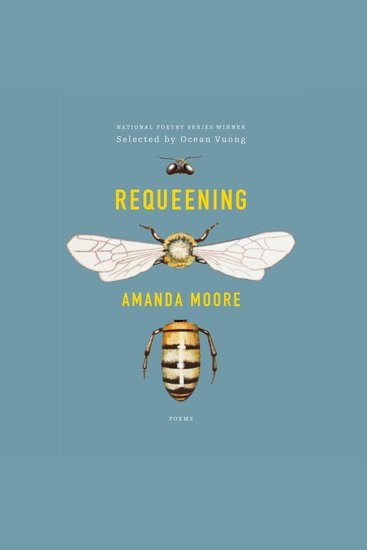
  • Requeening - Poems - cover

    Requeening - Poems

    Anónimo

    • 0
    • 0
    • 0
    “A rare feat for any book of poems, let alone a debut, in that the lines, wrought with such deft precision and care, mark the sum total of a life richly lived and felt at the seat of poetry...These poems care, first and foremost, for what they write of and through, which is a much needed—yet increasingly rare—achievement.” -- Ocean Vuong 
    Engaging the matriarchal structure of the beehive, Amanda Moore explores the various roles a woman plays in the family, the home, and the world at large. Beyond the productivity and excess, the sweetness and sting, Requeening brings together poems of motherhood and daughterhood, an evolving relationship of care and tending, responsibility and joy, dependence and deep love. 
    The poems that anchor this collection don’t shy away from the inevitability of a hive’s collapse and consider the succession of “requeening” a hive as “a new heart ready to be fed and broken and fed again.” The collapse is both physical—there are poems of illness and recovery—and emotional, as the mother-daughter relationship shifts, the daughter becoming separate, whole, and poised to displace. The liminal spaces these poems traverse in human relationships is echoed in a range of poetic and hybrid form, offering freedom and stricture as they contemplate the way we hold one another in love and grief. 
    Requeening is a vivid and surprising collection of poems from a winner of the National Poetry Series Open Competition. 
    Ver libro
  • Jet Ride To Hell Journey to Freedom - (1000 Hamburger Days in Prison) - cover

    Jet Ride To Hell Journey to...

    David C Hairabedian

    • 0
    • 0
    • 0
    A riveting storyline that includes a sting operation carried out by 20-armed federal agents on the tarmac of a South Florida runway, and the tales of a prisoner living inside America’s maximum security prison, Leavenworth Penitentiary – this autobiography will captivate you from start to finish.Arrested With a Stolen JetIt was 9:05 in the morning. The sun was shining as our crew drove the silver Mercedes to meet the pilot of the Cessna Citation II jet taxiing toward us on the tarmac of the executive airfield in Florida.Something seemed off, but it was too late for the four of us to abort the mission.We were committed.The door of the plane opened, and off stepped the pilot I’d met with two days earlier at a Kansas City hotel room. He had agreed, for a price, to deliver a jet that was on our laundry list of planes we were stealing from the United States and delivering to the Colombians in South America.This was our second plane in a month. The pick-up place was Boca Raton, and the delivery location, Virgin Gorda in the British Virgin Islands, where the plane would be repainted in a hanger, data plates changed, and then used in the cocaine trafficking world by the Cali Cartel.Later, I would discover two things: Boca Raton is translated, Mouth of the Rat, and a big rat was among us.I pulled a bag filled with cash from our vehicle and stepped onto the plane to meet the pilot to hand over a partial payment. The rest would be delivered once the plane was safely in the air. My pilot entered behind me in preparation to take the captain’s seat.In a matter of seconds, 20+ federal agents descended on us from all four sides, in unmarked vehicles and running on foot, all with weapons.The next thing I knew, a chrome 45 caliber pistol was pointed in my face while the agent was yelling, “Get your hands up, YOU ARE UNDER ARREST!”Everything was happening so fast. My head was spinning. My hands automatically went up in the air to display the international sign of surrender.
    Ver libro
  • Silas Marner - cover

    Silas Marner

    George Eliot

    • 0
    • 0
    • 0
    In the town of Reveloe, there lives a man called Silas Marner. A strange little man, a weaver by trade, and seen with suspicion by the other villagers. He's been beset by bad luck all his life. Cast out of his simple religious life in Lantern Yard, and then returns home to find his money stolen. But then, on new years day, his luck changes when he finds a small child sitting before his hearth...  
    Published in 1861, this was the third novel by George Elliot, and delves into the topics of religion, industrialisation and community, and was praised at the time for its realism.  
    Narrated by Michael Ward.
    Ver libro