Join us on a literary world trip!
Add this book to bookshelf
Grey
Write a new comment Default profile 50px
Grey
Subscribe to read the full book or read the first pages for free!
All characters reduced
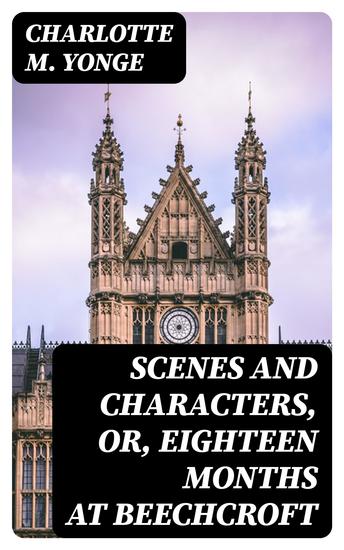
Scenes and Characters or Eighteen Months at Beechcroft - Enriched edition - cover

Scenes and Characters or Eighteen Months at Beechcroft - Enriched edition

Charlotte M. Yonge

Publisher: DigiCat

  • 0
  • 0
  • 0

Summary

In "Scenes and Characters, or, Eighteen Months at Beechcroft," Charlotte M. Yonge presents a vivid exploration of domestic life through the lens of an English community during the mid-19th century. This semi-autobiographical narrative delves into the intricacies of social interactions and moral dilemmas faced by a group of inhabitants over a year and a half. Yonge's literary style is characterized by its engaging, conversational tone and detailed characterizations, enabling readers to immerse themselves in the psychological landscapes of her protagonists. Set against the backdrop of Victorian society, the novel grapples with themes of duty, faith, and the significance of female agency within a rigid social framework, reflective of the author's own experiences and observations as a woman of her time. Charlotte M. Yonge, a prominent figure in 19th-century literature, was known for her prolific writing and her commitment to addressing the lives of women and moral education. Living during a time of significant social change, Yonge's views were shaped by her strong Anglican faith and her active participation in community life, deeply informing her characters' struggles and triumphs in "Scenes and Characters." Her background in education and her role as a contributor to various periodicals positioned her as a compassionate observer of societal norms, making her narratives both relevant and relatable. This book is a must-read for those interested in the dynamics of Victorian society and the intricate portrayal of character development. Yonge's insightful examination of personal growth and community connections invites readers to reflect on their own lives and the societal landscapes that shape them. Whether you are a scholar of Victorian literature or a casual reader, "Scenes and Characters" promises a rich and thought-provoking journey through the human experience.

In this enriched edition, we have carefully created added value for your reading experience:
- A succinct Introduction situates the work's timeless appeal and themes.
- The Synopsis outlines the central plot, highlighting key developments without spoiling critical twists.
- A detailed Historical Context immerses you in the era's events and influences that shaped the writing.
- A thorough Analysis dissects symbols, motifs, and character arcs to unearth underlying meanings.
- Reflection questions prompt you to engage personally with the work's messages, connecting them to modern life.
- Hand‐picked Memorable Quotes shine a spotlight on moments of literary brilliance.
- Interactive footnotes clarify unusual references, historical allusions, and archaic phrases for an effortless, more informed read.
Available since: 09/16/2022.
Print length: 210 pages.
Other books that might interest you

  • Gabriel-Ernest - From their pens to your ears genius in every story - cover

    Gabriel-Ernest - From their pens...

    Saki Saki

    • 0
    • 0
    • 0
    Hector Hugh Munro, more familiarly known by his pen-name ‘Saki’ was born in what was then Akyab in British Burma on 18th December 1870. His father was an Inspector General for the Indian Imperial Police, and his mother the daughter of a Rear Admiral. 
    When he was 2 his mother died and he and his siblings were sent back to England to be raised by their grandmother and paternal maiden aunts in a strict, puritanical household near Barnstaple, Devon. Educated by governesses Saki used many of these women as character models for his later writing. 
    At 17 his father retried and returned to England and then embarked on a series of European travels with Saki and his siblings. 
    After a short stint working in Burma with the Indian Imperial Police Saki decided to move to London to make a living as a writer. Initially he wrote as a journalist for a number of newspapers and magazines before attempting an historical study, ‘The Rise of the Russian Empire’, whose real value lay in directing him to writing short stories instead, the first of which, ‘Dogged’, he published in 1899. 
    From here it was a short stab of the pen to writing political satire before in 1902 he became the foreign correspondent for The Morning Post, first in the Balkans, then Russia, Paris and back to London in 1908, where 'the agreeable life of a man of letters with a brilliant reputation awaited him.'  
    Collections of his short stories full of witty, mischievous and often macabre stories that satirized Edwardian society and two novels now appeared in the years up to the Great War.  At its’ outbreak he was 43 but managed to join as an ordinary trooper. More than once he returned to the battlefield when officially too sick or injured.  
    On 14th November 1916 Hector Hugh Munro was sheltering in crater during the Battle of the Ancre, when he was shot and killed by a German sniper. According to several sources, his last words were "Put that bloody cigarette out!"
    Show book
  • Midsummer Night in the Workhouse - cover

    Midsummer Night in the Workhouse

    Diana Athill

    • 0
    • 0
    • 0
    A woman trapped in an agonising love affair; a writer avoiding the group seducer at a writers’ retreat; a girl experiencing her first kiss. Set in 1950s England, as well as Italy and France, Midsummer Night in the Workhouse is a collection of short stories written and read  by distinguished editor and author, Diana Athill. Written in the late 1950s, these short stories mainly centre around female protagonists. Several stories are based on events from Athill’s own life. From holidays abroad to love affairs and sexual encounters, these brilliant, touching narratives provide subtle snapshots of human experiences and stage portrayals of memory, conflict and adventure. Midsummer Night in the Workhouse is part of the Persephone Audiobook Collection, a series of forgotten classics including neglected fiction and non-fiction by women writers. First published in 1962, this edition includes a preface by the author.
    Show book
  • Hamlet | Simple Shakespeare Series - The classic play adapted to modern language - cover

    Hamlet | Simple Shakespeare...

    Jeanette Vigon

    • 0
    • 0
    • 0
    This modern adaptation of "Hamlet" breathes new life into Shakespeare's legendary tale, presenting it in contemporary English to draw readers into the vortex of betrayal, revenge, and existential angst at the heart of the play. With Prince Hamlet's story unfurling in the modern vernacular, the timeless tragedy of the Danish prince wrestling with grief, moral uncertainty, and the specter of vengeance becomes more accessible and immediate. Whether you're meeting Hamlet for the first time or returning to the shadowed corridors of Elsinore Castle, this version is crafted to convey the raw emotion and profound insights of Shakespeare's work in a language that speaks directly to the modern reader. 
    Key features of this modern version of "Hamlet":Showcases Shakespeare's intricate narrative and deep philosophical queries in clear, modern English, broadening its appeal.Maintains the original's narrative depth and existential themes, ensuring the essence of Shakespeare's vision remains intact without the need for external commentary.Perfect for educational settings and readers seeking an intuitive understanding of the play’s themes, characters, and complex storyline.Draws in readers of today with an age-old exploration of revenge, sanity, loyalty, and existential musings, proving the play's enduring relevance.Preserves the emotional intensity and character complexity that Shakespeare is renowned for, allowing a direct connection to the dilemmas and passions of his characters.Stimulates critical thought and discussion around perennial human concerns such as justice, the effects of grief, and the essence of existence, inviting readers to ponder deeply.Opens up Shakespeare's oeuvre to new audiences, encouraging exploration and appreciation of literary artistry with ease and enthusiasm.
    Show book
  • Faust - cover

    Faust

    Johann Wolfgang von Goethe

    • 0
    • 0
    • 0
    A man who wants everything. A devil who offers it. A bargain that no one can escape unchanged.
    In Goethe's monumental drama, the scholar Faust—exhausted by limits of knowledge and longing for deeper meaning—strikes a fateful pact with Mephistopheles. Promised pleasure, power, and limitless experience, Faust plunges into a world of beauty, temptation, and moral peril. Yet every moment gained carries a shadow, and every desire leads him closer to the edge of damnation.
    
    Praised as "one of the greatest works of world literature," this epic explores ambition, love, sin, redemption, and the eternal struggle between light and darkness. Readers are captivated by its poetic force, philosophical depth, and unforgettable characters.
    
    If you crave dramatic storytelling, probing ideas, and a journey that tests the limits of the human spirit, Faust delivers a timeless and transformative experience.
    
    Open the book—and follow Faust into the fire of his own desires.
    Show book
  • Father Brown: The Three Tools of Death (Unabridged) - cover

    Father Brown: The Three Tools of...

    G. K. Chesterton

    • 0
    • 0
    • 0
    Both by calling and conviction Father Brown knew better than most of us, that every man is dignified when he is dead. But even he felt a pang of incongruity when he was knocked up at daybreak and told that Sir Aaron Armstrong had been murdered. There was something absurd and unseemly about secret violence in connection with so entirely entertaining and popular a figure. For Sir Aaron Armstrong was entertaining to the point of being comic; and popular in such a manner as to be almost legendary.
    Show book
  • Madame Bovary - cover

    Madame Bovary

    Gustave Flaubert

    • 0
    • 0
    • 0
    "Emma was looking for a reason to live, a reason to die."
    
    Emma Rouault is a woman born out of her time. Raised on a diet of sentimental romance novels and dreams of Parisian high society, she marries Charles Bovary—a dull, well-meaning country doctor—only to find herself suffocated by the grey monotony of provincial life. In a desperate bid to find the "ecstasy" she has read about, Emma enters a spiral of illicit affairs and reckless luxury, unaware that her pursuit of the ideal is leading her toward inevitable ruin. Flaubert's meticulous prose captures the heartbreaking gap between our grandest fantasies and the brutal reality of our lives.
    
    The Architect of Realism: Flaubert famously spent days searching for le mot juste (the right word). Madame Bovary is celebrated for its precise, unemotional observation of human folly. By pioneering the "Free Indirect Discourse" technique, Flaubert allows the reader to step inside Emma's delusional mind while maintaining a critical distance, creating a reading experience that is both intimate and chillingly objective.
    
    A Critique of Romanticism: Emma is the ultimate victim of her own imagination. She views life as a stage, her lovers as heroes, and her surroundings as mere set dressing. Flaubert uses her story to critique the shallow romanticism of the 19th century, showing how the refusal to accept "the ordinary" can become a toxic force that destroys not only the self but everyone in its wake.
    
    Witness the birth of the modern novel. Purchase "Madame Bovary" today and experience the beauty of a tragedy told with surgical precision.
    Show book