Join us on a literary world trip!
Add this book to bookshelf
Grey
Write a new comment Default profile 50px
Grey
Subscribe to read the full book or read the first pages for free!
All characters reduced
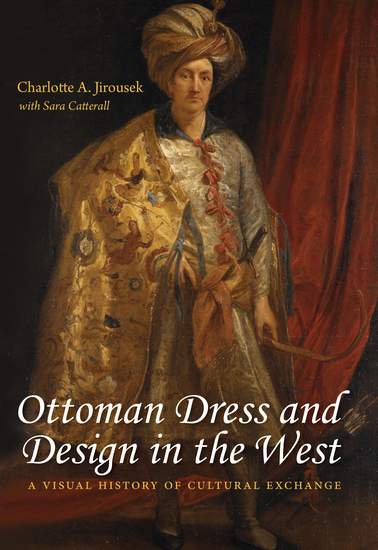
Ottoman Dress and Design in the West - A Visual History of Cultural Exchange - cover

Ottoman Dress and Design in the West - A Visual History of Cultural Exchange

Charlotte Jirousek, Sara Catterall

Publisher: Indiana University Press

  • 0
  • 1
  • 0

Summary

“This amply illustrated, attractive book is valuable for dress history scholars . . . [an] ideal textbook for courses on clothing and cultural history.” —The Journal of Dress History Ottoman Dress and Design in the West is a richly illustrated exploration of the relationship between West and Near East through the visual culture of dress. Charlotte Jirousek examines the history of dress and fashion in the broader context of western relationships with the Mediterranean world from the dawn of Islam through the end of the twentieth century. The significance of dress is made apparent by the author’s careful attention to its political, economic, and cultural context. The reader comes to understand that dress reflects not simply the self and one’s relation to community but also that community’s relation to a wider world through trade, colonization, religion, and technology. The chapters provide broad historical background on Ottoman influence and European exoticization of that influence, while the captions and illustrations provide detailed studies of illuminations, paintings, and sculptures to show how these influences were absorbed into everyday living. Through the medium of dress, Jirousek details a continually shifting Ottoman frontier that is closely tied to European and American history. In doing so, she explores and celebrates an essential source of influence that for too long has been relegated to the periphery.
Available since: 01/25/2019.
Print length: 272 pages.

Other books that might interest you

  • The Closed Partisan Mind - A New Psychology of American Polarization - cover

    The Closed Partisan Mind - A New...

    Matthew D. Luttig

    • 0
    • 0
    • 0
    American politics today can be defined by the intense and increasingly toxic divide between Democrats and Republicans. Matthew D. Luttig explores why so many Americans have endorsed this level of political conflict. 


    Luttig illustrates how the psychological need for closure leads people, regardless of whether they identify as Democrat or Republican, to express more polarized political attitudes. This association between closed minds and partisan polarization is a new phenomenon and can be traced to broader changes in American society, such as the creation of ideologically distinct political parties and a fragmented media environment. These developments have simplified politics into a black-or-white, us-versus-them, conflict—making politics appeal to those with closed minds. 


    Today, strong partisans do not just cheer for their political party to win elections. Instead, more akin to religious true believers, strong partisans use their affiliation as a means of understanding right and wrong, friend and enemy, true and false. The Closed Partisan Mind reveals that these dynamics have manifested in both a new type of partisanship and a new type of partisan. The emergence of this new closed partisanship illustrates the dangers that polarization has wrought on society, politics, and the minds of Americans.
    Show book
  • The Power of the Other - The startling effect other people have on you from the boardroom to the bedroom and beyond-and what to do about it - cover

    The Power of the Other - The...

    Anonymous

    • 0
    • 0
    • 0
    An expert on the psychology of leadership and the bestselling author of Integrity, Necessary Endings, and Boundaries For Leaders identifies the critical ingredient for personal and professional wellbeing. 
    Most leadership coaching focuses on helping leaders build their skills and knowledge and close performance gaps. These are necessary, but not sufficient. Using evidence from neuroscience and his work with leaders, Dr. Henry Cloud shows that the best performers draw on another vital resource: personal and professional relationships that fuel growth and help them surpass current limits. 
    Popular wisdom suggests that we should not allow others to have power over us, but the reality is that they do, for better or for worse. Consider the boss who diminishes you through cutting remarks versus one who challenges you to get better. Or the colleague who always seeks the limelight versus the one who gives you the confidence to finish a difficult project. Or the spouse who is honest and supportive versus the one who resents your success. No matter how talented, intelligent, or experienced, the greatest leaders share one commonality: the power of the others in their lives. 
    Combining engaging case studies, persuasive findings from cutting-edge brain research, and examples from his consulting practice, Dr. Cloud argues that whether you’re a Navy SEAL or a corporate executive, outstanding performance depends on having the right kind of connections to fuel personal growth and minimize toxic associations and their effects. Presenting a dynamic model of the impact these different kinds of connections produce, Dr. Cloud shows readers how to get more from themselves by drawing on the strength and expertise of others. You don’t have a choice whether or not others have power in your life, but you can choose what kinds of relationships you want.
    Show book
  • Illinois 1000 - cover

    Illinois 1000

    Henry Isham

    • 0
    • 0
    • 0
    Illinois 1000 is a quick dive into the lives of the English and the Indians of the Upper Midwest a thousand years ago.
     
    Building on The Year 1000 by British historians Robert Lacey and Danny Danzinger, the author 
    moves from one side of the Atlantic to the other. The contrasts are as much from the past to the present as between the two very different cultures. ‘Primitive’ is often used to describe the Indians’ way of life, and not without at least some reason. So much of what characterized and made English life possible was entirely absent in North America.
     
    Yet, centuries later, hundreds, even thousands of Europeans joined the Indians, preferring their way of living to that which they had known in Europe or colonial America. The Indians, the first people, survived and prospered in what was at that time not amber fields of grain but a very 
    ungenerous landscape. If they were brutal, they were hardly unique. In their affinity to the earth they lived on, there were few like them.
    Show book
  • Evicted: Book Summary & Analysis - cover

    Evicted: Book Summary & Analysis

    Briefly Summaries

    • 0
    • 0
    • 0
    This is a concise summary and analysis of Evicted, by Matthew Desmond. It is not the original book and is not affiliated with or endorsed by Matthew Desmond. Ideal for those seeking a quick and insightful overview.
     
    This gripping work of narrative nonfiction explores the devastating impact of eviction on the lives of low-income families. Set in a Midwestern city, the book follows several tenants and landlords as they navigate the complex web of poverty, housing policies, and economic inequality. Through vivid storytelling and meticulous research, it reveals how eviction is not just a consequence of poverty but a driving force that perpetuates it. This powerful account sheds light on the urgent need for housing reform and social justice.
    Show book
  • Grateful Living Feeling Joy in the moment Course Coaching session healing meditations & hypnosis session - conscious awareness everyday growth joy living in the now thankfulness true happiness - cover

    Grateful Living Feeling Joy in...

    Love, And, Bloom

    • 0
    • 0
    • 0
    It is easy for us to catch up on the past or in the future. We often forgot to take time to appreciate the wondering things happening in our daily lives. When your thoughts are constantly in the past or future, you feel more anxious, fearful, or restless. When you appreciate and live in the moment, you give yourself room to receive joy love, and abundance. 
    In this course, we will be your personal coach. We use coaching sessions, and healing meditations to help you be more grateful and stay in the present moment. We let go of any toxic thoughts in your mind through our therapeutic coaching session. We deeply forgive the past and give room for our wonderful future. We take our time to stay in the present moment and be grateful for what we have 
    In this course, we willLet go of toxic thoughtBe your personal coachBring you back from the past to the present momentLet go of anxiousnessDeeply forgive yourself & othersLetting goAnchor your frequencies into gratefulnessSimply live in the momentAnd much more
    Show book
  • Nudges from Grandfather - Honoring Indigenous Spiritual Technologies - cover

    Nudges from Grandfather -...

    Chris Kavelin

    • 0
    • 0
    • 0
    In 1938 the German Reich inflicted a wave of violent, all night attacks on several Jewish communities (Kristallnacht). Far away in Australia, William Cooper, a distinguished Elder of the Yorta Yorta Nation, led a little-known march to the German Consulate to deliver his protest regarding the violation of those human rights. 
    How contemporary Jewish and Aboriginal communities re-connected with that protest is but one chapter in a book recounting true stories of many miraculous chains of events. 
    Each chapter has its own story, each story its own theme, but common throughout are lessons on the reality of spiritual technologies: following steps of prayerful, contemplative action; acting with ceaseless energy; working mindfully with ancestors; and expressing gratitude for the emerging blessings. 
    We are each connected with the spiritual realm. Some may call spiritual forces ancestors, others angels or still others, the names of forms of divine power in their traditions. Whatever their names, these forces work intimately with us when we seek to be of service to others. When asked to perform an act of service beyond one’s abilities or education, there are those in the next world who can make suggestions.
    Show book