Join us on a literary world trip!
Add this book to bookshelf
Grey
Write a new comment Default profile 50px
Grey
Subscribe to read the full book or read the first pages for free!
All characters reduced
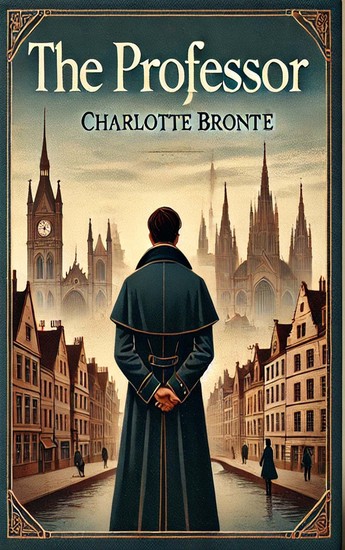
The Professor - A Tale of Love Ambition and Self-Discovery - cover

The Professor - A Tale of Love Ambition and Self-Discovery

Charlotte Brontë, Zenith Blue Ridge Books

Publisher: Zenith Blue Ridge Books

  • 0
  • 0
  • 0

Summary

A Story of Ambition, Love, and Triumph from the Author of Jane Eyre
Step into the world of William Crimsworth, a determined young Englishman who seeks his fortune in Belgium. In The Professor, Charlotte Brontë crafts a deeply personal and evocative tale of self-discovery, resilience, and love, offering a fresh perspective on ambition and identity.

William, rejecting the comforts of aristocracy, embarks on a journey that takes him from the dreary confines of London to the vibrant streets of Brussels. As he navigates the complexities of teaching, cultural differences, and personal rivalries, he encounters the enigmatic and intelligent Frances Henri. Their connection challenges his perceptions of love, independence, and what it truly means to succeed.

Filled with rich characterization, sharp social critique, and Brontë's signature wit, The Professor is a hidden literary gem—a precursor to her later masterpiece, Villette.

What Readers Are Saying:
⭐ "A compelling and underrated classic—Brontë's unique voice shines!"
⭐ "A must-read for fans of Jane Eyre—intelligent, heartfelt, and beautifully written."
⭐ "A fascinating look into Brontë's early work, filled with passion and depth."

Discover Charlotte Brontë's First Novel—A Timeless Story of Love and Self-Determination. Get Your Copy Today!
Available since: 01/29/2025.
Print length: 240 pages.

Other books that might interest you

  • Imaginative Woman An - From their pens to your ears genius in every story - cover

    Imaginative Woman An - From...

    Thomas Hardy

    • 0
    • 0
    • 0
    Thomas Hardy was born in the hamlet of Upper Bockhampton about three miles east of Dorchester in Dorset, England, on 2nd June 1840.  
    Despite a fairly wide education and being an avid reader his parents thought it unlikely he would lead a successful scholarly or clerical career and he was apprenticed in 1856, at age 16, to a local architect whose speciality was in church restoration.  Hardy’s only opportunity to read was in the morning before work between the hours of five and eight.  
    On the back of a failed love affair he moved to London and spent five years working as an assistant to the architect Arthur Blomfield, also a restorer and designer of churches. Hardy though had by now become disillusioned with institutionalised forms of Christianity and abandoned any lingering hopes of ordination in the Anglican Church.  However, his writing of poetry was now flourishing, although it was still rejected for publication.  
    His novel ‘Desperate Remedies’, was published anonymously in 1871 and he now resolved to write full time though he was not yet in a position to achieve financial security or literary success. His second novel, ‘Under the Greenwood Tree’, appeared in 1872 and in 1873 ‘A Pair of Blue Eyes’, the most autobiographical of his works arrived. With ‘Far From the Madding Crowd’ in 1874, came critical acclaim, public attention and financial success. This was repeated in 1878 with ‘The Return of the Native’, and the ensuing years saw him rise to ever greater popularity.  
    His classic ‘The Mayor of Casterbridge’ arrived in 1886 and 5 years later ‘Tess of the d’Urbervilles’. The latter only saw publication after extensive alterations to its plot and the deletion of long passages to lessen the shock to the prudish Victorian audience who were dismayed by the seduction and ruin of a young girl by a rakish aristocrat.  
    ‘Jude the Obscure’, his last novel, suffered the same fate when it was published in 1895.  The uproar so disturbed him that he returned to poetry. In 1898 he had an earlier poetry collection, ‘Wessex Poems’ published. 
    Hardy spent the years between 1903 and 1908 writing ‘The Dynasts’, an epic poem on the Napoleonic Wars. 
    In his twilight years came honours and awards from the great and the good in recognition of his stature as one of the most outstanding of British authors across novels, short stories and poetry. George V conferred on him the Order of Merit in 1910. 
    From 1920 to 1927 he worked, in secret, on his autobiography, which was later published after his death as the work of his second wife, Florence Hardy.  
    Thomas Hardy OM died on the 11th January 1928. 
    His heart was buried alongside his first wife in Stinsford churchyard, Dorchester.
    Show book
  • The Encantadas - cover

    The Encantadas

    Herman Melville

    • 0
    • 0
    • 0
    "The Encantadas, or Enchanted Isles" is a novella by American author Herman Melville. First published in Putnam's Magazine in 1854, it consists of ten philosophical "Sketches" on the Encantadas, or Galápagos Islands. It was collected in The Piazza Tales in 1856. The Encantadas was a success with the critics, and contained some of Melville's "most memorable prose".
    An anonymous narrator unites the ten disparate "Sketches", each of which begin with a few lines of poetry, mostly taken from Edmund Spenser's The Faerie Queene. All of the stories are replete with symbolism reinforcing the cruelty of life on the Encantadas. "Sketch First" is a description of the islands; though they are the Enchanted Isles they are depicted as desolate and hellish. "Sketch Second" is a meditation on the narrator's encounter with ancient Galápagos tortoises, while "Sketch Third" concerns the narrator's trip up the enormous tower called the Rock Rodondo. "Sketch Fourth" details the narrator's musings from atop the tower, and his recollection of the islands' accidental discovery by Juan Fernández. "Sketch Fifth" describes the USS Essex' encounter with a phantom British ship near the area during the War of 1812.
    Show book
  • Iliad The (Unabridged) - cover

    Iliad The (Unabridged)

    Homer

    • 0
    • 0
    • 0
    Dating to the ninth century B.C., Homer's timeless poem still vividly conveys the horror and heroism of men and gods wrestling with towering emotions and battling amidst devastation and destruction, as it moves inexorably to the wrenching, tragic conclusion of the Trojan War. Renowned classicist Bernard Knox observes in his superb introduction that although the violence of the Iliad is grim and relentless, it coexists with both images of civilized life and a poignant yearning for peace.
    Show book
  • The Strange Case of Dr Jekyll and Mr Hyde - cover

    The Strange Case of Dr Jekyll...

    Robert Louis Stevenson

    • 0
    • 0
    • 0
    Robert Louis Stevenson's classic tale of science and madness brought to life. 
    Mr Utterson suspects something is wrong with his friend, Henry Jekyll. Ever since Dr. Jekyll made out a will giving everything to an utter unknown- one Mr. Edward Hyde- Mr. Utterson has had suspicions. Now, stories are starting to circulate about Edward Hyde, and Mr. Utterson sets out to discover the truth behind this strange character who roams foggy London streets.
    Show book
  • The Republic of the Southern Cross - One of the earliest dystopian stories written in 1903 this one of Russian origin about a disease causing madness - cover

    The Republic of the Southern...

    Valery Bryusov

    • 0
    • 0
    • 0
    Valery Yakovlevich Bryusov was born on 13th December 1873 into a merchant's family in Moscow.  
     
    His parents did little to involve themselves with his upbringing and Bryusov seems to have spent long periods immersed in books until studying in two private Moscow gymnasia between 1885 and 1893. 
     
    Whilst a student at Moscow State University he completed translations of the French Symbolists and some of Edgar Allan Poe.  Bryusov, influenced by both the Symbolist and Decadent movements, also began to publish his own poems.  
     
    With the appearance of ‘Tertia Vigilia’ he became acknowledged by other Symbolists as an authority in matters of art and then, in 1904, he became the editor of ‘The Balance’, the influential literary magazine.  
     
    With his poems gradually being seen as outdated he worked harder at prose and two historical novels ‘The Altar of Victory’ (regarding life in Ancient Rome) and ‘The Fiery Angel’ (based in 16th century Germany) brought him much recognition as did a series of science fiction short stories.  Over the decades he also translated authors as diverse as Hugo, Racine, Byron, Verlaine, Goethe and Virgil. 
     
    After the 1917 Revolution Bryusov supported the Bolsheviks and was given a position in the cultural ministry of the new state.  
     
    For his Russian translation of the Armenian folk epic ‘David of Sasun,’ he was designated the People's Poet of Armenia in 1923.   
     
    Valery Yakovlevich Bryusov died on 9th October 1924.  He was 50.
    Show book
  • Rise of Historical Criticism The (Unabridged) - cover

    Rise of Historical Criticism The...

    Oscar Wilde

    • 0
    • 0
    • 0
    Oscar Wilde (16 October 1854 - 30 November 1900) was an Irish poet and playwright. After writing in different forms throughout the 1880s, he became one of the most popular playwrights in London in the early 1890s.
    THE RISE OF HISTORICAL CRITICISM: This Essay was written for the Chancellor's English Essay Prize at Oxford in 1879, the subject being 'Historical Criticism among the Ancients.' The prize was not awarded. To Professor J. W. Mackail thanks are due for revising the proofs.
    Show book