Join us on a literary world trip!
Add this book to bookshelf
Grey
Write a new comment Default profile 50px
Grey
Subscribe to read the full book or read the first pages for free!
All characters reduced
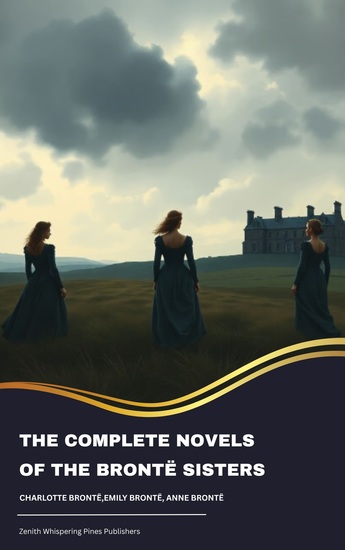
The Complete Novels of the Brontë Sisters - cover

The Complete Novels of the Brontë Sisters

Charlotte Brontë, Emily Brontë, Anne Brontë

Publisher: Zenith Whispering Pines Publishers

  • 0
  • 0
  • 0

Summary

Step onto the Storm-Swept Moors of Literary Genius.

In the secluded parsonage of Haworth, three sisters—Charlotte, Emily, and Anne—forged some of the most powerful, rebellious, and enduring novels in the English language. This comprehensive collection brings together their complete works, showcasing the raw emotion and psychological depth that shocked Victorian society and redefined the novel forever.

This collection features the distinct voices of the three sisters:

Charlotte Brontë: The master of the "inner life," whose heroines fight for independence and love in a world designed to constrain them.

Emily Brontë: The visionary poet of the moors, whose singular novel remains the ultimate exploration of obsessive, destructive, and eternal passion.

Anne Brontë: The boldest realist of the trio, who tackled social injustice and the struggle for female agency with unflinching honesty.

From the haunting corridors of Thornfield Hall to the desolate heights of the Yorkshire moors, the Brontës' writing is characterized by its atmospheric intensity and its revolutionary focus on the individual spirit. Whether you are returning to their most famous haunts or discovering their lesser-known gems, this volume is an essential cornerstone for every lover of classic literature and Gothic romance.

Experience the passion of the moors. Buy "The Complete Novels of the Brontë Sisters" today and own the legacy of a legendary dynasty.
Available since: 12/19/2025.
Print length: 2418 pages.

Other books that might interest you

  • Fathers and Sons - cover

    Fathers and Sons

    Ivan Turgenev

    • 0
    • 0
    • 0
    "Fathers and Sons" is not only a portrait of individual characters but also a reflection of the broader societal changes taking place in 19th-century Russia. Turgenev's narrative captures the tension between traditional aristocratic values and the rise of revolutionary ideas that would shape the course of Russian history. He offers a poignant critique of both generations, showcasing their strengths, weaknesses, and their struggle to adapt to the shifting dynamics of a changing world. With its lyrical prose, nuanced characterizations, and profound exploration of social and philosophical themes, "Fathers and Sons" is a timeless masterpiece that resonates with readers across generations. Turgenev's insightful portrayal of the human condition, the complexities of familial bonds, and the clash of ideas and ideologies make this novel a compelling and thought-provoking work of literature.
    Show book
  • The Prisoner of Zenda - cover

    The Prisoner of Zenda

    Anthony Hope

    • 0
    • 0
    • 0
    Rudolf Rassendyll travels to the small kingdom of Ruritania for what should be a quiet holiday. But when the newly crowned king is drugged and kidnapped, Rudolf’s uncanny resemblance to him pulls him into a dangerous plan. 
    To prevent a national crisis, he agrees to impersonate the king. As he steps into royal life, Rudolf must navigate court politics, betrayal, and a plot to seize the throne. 
    At the heart of it all is Princess Flavia, whose loyalty is torn between duty and the man who only pretends to rule. 
    The Prisoner of Zenda is a fast-paced story of disguise, honor, and impossible choices. It remains one of the most enduring adventure novels of its time. 
    Perfect for readers who enjoy political intrigue, romantic tension, and classic heroism.
    Show book
  • Tale of Two Cities A (Book the Second: The Golden Thread) - cover

    Tale of Two Cities A (Book the...

    Charles Dickens

    • 0
    • 0
    • 0
    Book 2: The Golden Thread: A Tale of Two Cities is an 1859 historical novel by Charles Dickens, set in London and Paris before and during the French Revolution. The novel tells the story of the French Doctor Manette, his 18-year-long imprisonment in the Bastille in Paris and his release to live in London with his daughter Lucie, whom he had never met. The story is set against the conditions that led up to the French Revolution and the Reign of Terror.
    Dickens' best-known work of historical fiction, A Tale of Two Cities is regularly cited as the best-selling novel of all time. In 2003, the novel was ranked 63rd on the BBC's The Big Read poll. The novel has been adapted for film, television, radio, and the stage, and has continued to have an influence on popular culture.
    Show book
  • They Were Sisters - cover

    They Were Sisters

    Dorothy Whipple

    • 0
    • 0
    • 0
    When three sisters marry very different men, the choices they make determine whether they will flourish, be tamed or be repressed. Set in 1930’s middle-class England, the classic domestic drama, They Were Sisters, is a compelling but harrowing novel by Dorothy Whipple. Meet three women with contrasting partners: Lucy's husband is her beloved companion; Vera's husband bores her and she turns elsewhere; and Charlotte's husband is a horrifying bully who turns a high-spirited naive young girl into a deeply unhappy woman. This is the story of how those marriages shape the sister’s lives, the consequences of their decisions, and the sisterly love that hopes to save them from tragedy.They Were Sisters is part of the Persephone Audiobook Collection, a series of forgotten classics that includes neglected fiction and non-fiction by women writers. This audiobook of a novel first published in 1943 breathes new life into Whipple's work; with a fascinating introduction by novelist Celia Brayfield.
    Show book
  • The Tragedy of Timon of Athens - cover

    The Tragedy of Timon of Athens

    William Shakespeare

    • 0
    • 0
    • 0
    The Tragedy of Timon of Athens (The Life of Tymon of Athens) is a play by William Shakespeare, probably written in collaboration with Thomas Middleton in about 1605–1606, which was published in the First Folio in 1623. It is about the fortunes of an Athenian named Timon. The central character is a beloved citizen of Athens who through tremendous generosity spends his entire fortune on corrupt hangers-on only interested in getting the next payout.
    The earliest-known production of the play was in 1674, when Thomas Shadwell wrote an adaptation under the title The History of Timon of Athens, The Man-hater. Multiple other adaptations followed over the next century, by writers such as Thomas Hull, James Love and Richard Cumberland. The straight Shakespearean text was performed at Smock Alley in Dublin in 1761, but adaptations continued to dominate the stage until well into the 20th century.
    ... Flavius arrives. He wants the money as well, but he also wants Timon to come back into society. Timon acknowledges that he has had one true friend in Flavius, a shining example of an otherwise diseased and impure race, but laments that this man is a mere servant. He invites the last envoys from Athens, who hoped Timon might placate Alcibiades, to go hang themselves, and then dies in the wilderness. Alcibiades, marching on Athens, then throws down his glove, and ends the play reading the bitter epitaph Timon wrote for himself, part of which was composed by Callimachus:
    "Here lies a wretched corpse of wretched soul bereft:
    Seek not my name: a plague consume you wicked caitiffs left!"
    Here lie I, Timon, who alive, all living men did hate,
    Pass by, and curse thy fill, but pass and stay not here thy gait...
    Among the most significant works William Shakespeare: Hamlet, Othello, King Lear, Macbeth, Orpheus, Romeo and Juliet, Julius Caesar, Troilus and Cressida, The Tempest, Venus and Adonis, Antony and Cleopatra, Measure for Measure, The Winter's Tale and many more.
    Show book
  • The Cossacks - cover

    The Cossacks

    Leo Tolstoy

    • 0
    • 0
    • 0
    Dmitry Andreich Olenin, in the hope of escaping the hollowness of his privilege, joins the army and heads to the Caucasus.
    
    There among the foothills he will meet the Cossacks: a people he considers to be at one with the land. In their company he will hunt, he will drink, he will fall in love and, slowly, he will begin to understand that between people, between cultures, there is often a space that cannot be traversed.
    Show book