Join us on a literary world trip!
Add this book to bookshelf
Grey
Write a new comment Default profile 50px
Grey
Subscribe to read the full book or read the first pages for free!
All characters reduced
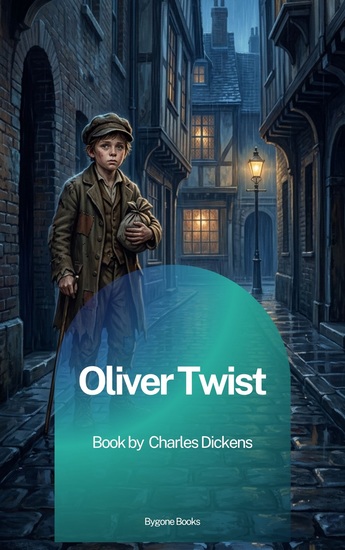
Oliver Twist - cover

Oliver Twist

Charles Dickens

Publisher: Bygone Books

  • 0
  • 0
  • 0

Summary

A young orphan's journey through hardship, injustice, and the search for a better life.

Oliver Twist is one of the most powerful and enduring novels by Charles Dickens, offering a moving portrayal of poverty, inequality, and compassion in Victorian England.

The story follows Oliver Twist, a young orphan who grows up in difficult conditions and faces cruelty, exploitation, and hardship. After escaping a harsh workhouse, Oliver encounters a world of criminals and vulnerable people in the streets of London, where he must navigate danger while holding onto his innocence and hope.

Through unforgettable characters, including the mysterious Fagin and the kind-hearted individuals who seek to help Oliver, Dickens explores themes of social injustice, morality, family, and redemption.

A landmark of English literature, Oliver Twist remains a timeless classic that continues to inspire readers with its powerful storytelling and unforgettable emotional depth.
Available since: 06/22/2026.
Print length: 292 pages.


Other books that might interest you

  • Ananga Ranga - cover

    Ananga Ranga

    Richard Francis Burton

    • 0
    • 0
    • 0
    The Ananga Ranga (Stage of Love) or Kamaledhiplava (Boat in the Sea of Love) is an Indian sex manual written by Kalyana malla in the 15th or 16th century. The poet wrote the work in honor of Lad Khan, son of Ahmed Khan Lodi. He was related to the Lodi dynasty, which from 1451 to 1526 ruled from Delhi. Later commentators have said it is aimed specifically at preventing the separation of a husband and wife. This work is often compared to the Kama Sutra, on which it draws. It was translated into English in the year 1885, under the editorship of Richard Francis Burton and consequently burnt by his wife Isabel Burton in the weeks following his death.
    Show book
  • Notes from the Underground - A Confession from a Petersburg Corner - cover

    Notes from the Underground - A...

    Fyodor Dostoevsky

    • 0
    • 0
    • 0
    A retired civil servant lives in a corner of Petersburg and spends forty pages telling the reader why every comfortable idea about reason and progress is a lie, before he consents to tell a story at all. The story, when it comes, is worse than the argument. The Gilded Library edition places paintings of snowbound Petersburg and solitary lamplit rooms beside the text, with ornament of candlestick, inkwell and a street lamp under snow.
    Show book
  • The Case of Lady Sannox - cover

    The Case of Lady Sannox

    Arthur Conan Doyle

    • 0
    • 0
    • 0
    The Case of Lady Sannox (also published as "The Kiss of Blood") is a short story by Sir Arthur Conan Doyle published in The Idler in November 1893.The story features an arrogant surgeon, Douglas Stone, who is in love with the married Lady Sannox, one of the most beautiful women in London. On his way to a rendezvous with her, the surgeon is asked by a Turkish man to operate on the latter's wife, who has cut her lip with a poison envenomed scimitar. The doctor is informed the woman will die if the poison is not cut out.Because of his desire to meet his lover, his need for money, his professional arrogance, and the opinion of the Turk that any delay would kill his wife, the surgeon goes ahead with the operation on the heavily drugged wife, whose face is obscured by a veil. After he has performed the operation, Dr. Stone realizes his patient is Lady Sannox, and the Turk her husband, who believes the disfigurement will be morally good for his wife. The surgeon suffers a breakdown.
    Show book
  • The Adventures of Tom Sawyer - cover

    The Adventures of Tom Sawyer

    Mark Twain

    • 0
    • 0
    • 0
    The Adventures of Tom Sawyer (also simply known as Tom Sawyer) is an 1876 novel by Mark Twain about a boy growing up along the Mississippi River. It is set in the 1840s in the town of St. Petersburg, which is based on Hannibal, Missouri, where Twain lived as a boy. In the novel, Tom Sawyer has several adventures, often with his friend Huckleberry Finn. Originally a commercial failure, the book ended up being the best-selling of Twain's works during his lifetime. Though overshadowed by its sequel, Adventures of Huckleberry Finn, the book is considered by many to be a masterpiece of American literature. It was one of the first novels to be written on a typewriter.
    Show book
  • Anna Karenina - cover

    Anna Karenina

    Lev Nikolayevich Tolstoy

    • 0
    • 0
    • 0
    Love and social expectations collide in Tolstoy's unforgettable portrait of relationships, family, and nineteenth-century Russian society.
    
    Leo Tolstoy's Anna Karenina follows Anna as her life becomes increasingly complicated by love, marriage, desire, and the rigid expectations of the society around her.
    
    Alongside Anna's story, Tolstoy explores the lives of other characters whose relationships, ambitions, family concerns, and personal beliefs provide different perspectives on love and happiness.
    
    Rich in psychological detail and social observation, the novel examines marriage, family, class, morality, passion, and the search for meaning.
    
    Discover one of world literature's great classics and experience Tolstoy's profound exploration of love, society, and human relationships.
    Show book
  • War and Peace (Book Eleven: 1812) - cover

    War and Peace (Book Eleven: 1812)

    Leo Tolstoy

    • 0
    • 0
    • 0
    War and Peace is a literary work mixed with chapters on history and philosophy by the Russian author Leo Tolstoy. It was first published serially, then published in its entirety in 1869. It is regarded as one of Tolstoy's finest literary achievements and remains an internationally praised classic of world literature.
    Book 11: 1812: Absolute continuity of motion is not comprehensible to the human mind. Laws of motion of any kind become comprehensible to man only when he examines arbitrarily selected elements of that motion; but at the same time, a large proportion of human error comes from the arbitrary division of continuous motion into discontinuous elements.
    Show book