Join us on a literary world trip!
Add this book to bookshelf
Grey
Write a new comment Default profile 50px
Grey
Subscribe to read the full book or read the first pages for free!
All characters reduced
Great Expectations - cover

Great Expectations

Charles Dickens

Publisher: Zenith Whispering Pines Publishers

  • 0
  • 0
  • 0

Summary

A mysterious fortune. A chance to change his life. A love that may break his heart.
When orphaned Pip is unexpectedly lifted from poverty into the world of gentlemen, he believes his dreams are finally within reach—especially the dream of winning the beautiful but cold Estella. But as secrets unravel and old ghosts return, Pip discovers that his "great expectations" come with painful lessons about loyalty, pride, and what true gentleness really means.

Praised as "one of Dickens's most unforgettable masterpieces," this novel blends mystery, romance, betrayal, and emotional growth into a story that resonates across generations. Its vivid characters—Pip, Estella, Miss Havisham, Magwitch—remain icons of English literature.

If you love coming-of-age stories filled with heart, tension, and moral depth, this classic will stay with you long after the final page.

Open the book—and follow Pip on a journey that reshapes everything he thinks he wants.
Available since: 12/08/2025.
Print length: 309 pages.

Other books that might interest you

  • The King's Highway - cover

    The King's Highway

    G. P. R. James

    • 0
    • 0
    • 0
    England in 1714, with the Jacobites waiting: a young man with a name he cannot use, a highwayman who is a gentleman, a smuggler's coast and a plot that reaches to the throne. James was Historiographer Royal to William IV and later British consul in Massachusetts, and wrote over a hundred novels — enough for Thackeray to parody him affectionately. The Jacobite politics here are exact.
    Show book
  • Thomas Mann - New Selected Stories - cover

    Thomas Mann - New Selected Stories

    Thomas Mann

    • 0
    • 0
    • 0
    Lit Hub: Most Anticipated Books of 2023 


    A towering figure in the pantheon of twentieth-century literature, Thomas Mann has often been perceived as a dry and forbidding writer—"the starched collar," as Bertolt Brecht once called him. But in fact, his fiction is lively, humane, sometimes hilarious. In these fresh renderings of his best short work, award-winning translator Damion Searls casts new light on this underappreciated aspect of Mann's genius. 


    The headliner of this volume, "Chaotic World and Childhood Sorrow" (in its first new translation since 1936)—a subtle masterpiece that reveals the profound emotional significance of everyday life—is Mann's tender but sharp-eyed portrait of the "Bigs" and "Littles" of the bourgeois Cornelius family as they adjust to straitened circumstances in hyperinflationary Weimar Germany. Here, too, is a free-standing excerpt from Mann's first novel, Buddenbrooks—a sensation when it was first published. "Death in Venice" (also included in this volume) is Mann's most famous story, but less well known is that he intended it to be a diptych with another, comic story—included here as "Confessions of a Con Artist, by Felix Krull." "Louisey"—a tale of sexual humiliation that gives a first glimpse of Mann's lifelong ambivalence about the power of art—rounds out this revelatory, transformative collection.
    Show book
  • The Lottery Ticket - From their pens to your ears genius in every story - cover

    The Lottery Ticket - From their...

    Anton Chekhov

    • 0
    • 0
    • 0
    Anton Pavlovich Chekhov was born on 29th January 1860 in Taganrog, on the south coast of Russia.  
    His family life was difficult; his father was strict and over-bearing but his mother was a passionate story-teller, a subject Chekhov warmed to. As he later said; ‘our talents we got from our father, but our soul from our mother’.  
    At school Chekhov was distinctly average. At 16 his father mis-managed his finances and was declared bankrupt. His family fled to Moscow. Chekhov remained and eked out a living by various means, including writing and selling short sketches to newspapers, to finish his schooling. That completed and with a scholarship to Moscow University obtained he rejoined his family. 
    He was able to help support them by selling satirical sketches and vignettes of Russian lifestyles and gradually obtained further commissions. In 1884, he qualified as a physician and, although it earned him little, he often treated the poor for free, he was fond of saying ‘Medicine is my lawful wife, and literature is my mistress.’ 
    His own health was now an issue as he began to cough up blood, a symptom of tuberculosis.  Despite this his writing success enabled him to move the family into more comfortable accommodation.  
    Chekhov wrote over 500 short stories which included many, many classics including ‘The Kiss’ and ‘The Lady with a Dog’.  His collection ‘At Dusk’ won him the coveted Pushkin Prize when was only 26.  
    He was also a major playwright beginning with the huge success of ‘Ivanov’ in 1887.   
    In 1892 Chekhov bought a country estate north of Moscow. Here his medical skills and money helped the peasants tackle outbreaks of cholera and bouts of famine. He also built three schools, a fire station and a clinic.  It left him with less time for writing but the interactions with real people gained him detailed knowledge about the peasantry and their living conditions for his stories.  
    His most famous work, ‘The Seagull’ was received disastrously at its premiere in St Petersburg. It was later restaged in Moscow to highlight its psychological aspects and was a huge success. It led to ‘Uncle Vanya’, ‘The Three Sisters’ and ‘The Cherry Orchard’.  
    Chekhov suffered a major lung hemorrhage in 1897 while visiting Moscow. A formal diagnosis confirmed tuberculosis and the doctors ordered changes to his lifestyle.  
    Despite a dread of weddings the elusive literary bachelor quietly married the actress Olga Knipper, whom he had met at rehearsals for ‘The Seagull’, on 25th May 1901. 
    By May 1904 with his tuberculosis worsening and death imminent he set off for the German town of Badenweiler writing cheerful, witty letters to his family and assuring them his health was improving.  
    On 15th July 1904 Anton Chekhov died at Badenweiler.  He was 44.
    Show book
  • Merry Springtime - From their pens to your ears genius in every story - cover

    Merry Springtime - From their...

    William Pett Ridge

    • 0
    • 0
    • 0
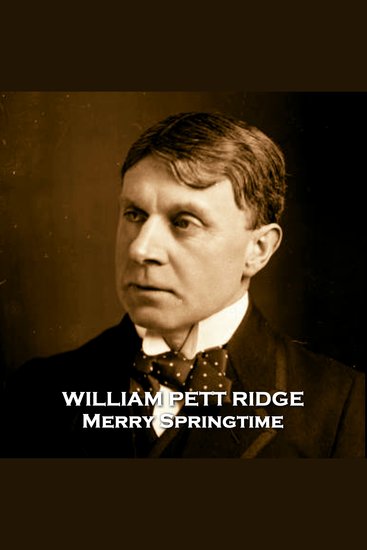
    William Pett Ridge was born at Chartham, near Canterbury, Kent, on 22nd April 1859. 
    His family’s resources were certainly limited. His father was a railway porter, and the young Pett Ridge, after schooling in Marden, Kent became a clerk in a railway clearing-house. The hours were long and arduous, but self-improvement was Pett Ridge’s goal.  After working from nine until seven o’clock he would attend evening classes at Birkbeck Literary and Scientific Institute and then to follow his passion; the ambition to write.  He was heavily influenced by Dickens and several critics thought he had the capability to be his successor. 
    From 1891 many of his humourous sketches were published in the St James's Gazette, the Idler, Windsor Magazine and other literary periodicals of the day. 
    Pett Ridge published his first novel in 1895, A Clever Wife. By the advent of his fifth novel, Mord Em'ly, a mere three years later in 1898, his success was obvious.  His writing was written from the perspective of those born with no privilege and relied on his great talent to find humour and sympathy in his portrayal of working class life. 
    Today Pett Ridge and other East End novelists including Arthur Nevinson, Arthur Morrison and Edwin Pugh are being grouped together as the Cockney Novelists.   
    In 1924, Pugh set out his recollections of Pett Ridge from the 1890s: “I see him most clearly, as he was in those days, through a blue haze of tobacco smoke. We used sometimes to travel together from Waterloo to Worcester Park on our way to spend a Saturday afternoon and evening with H. G. Wells. Pett Ridge does not know it, but it was through watching him fill his pipe, as he sat opposite me in a stuffy little railway compartment, that I completed my own education as a smoker... Pett Ridge had a small, dark, rather spiky moustache in those days, and thick, dark, sleek hair which is perhaps not quite so thick or dark, though hardly less sleek nowadays than it was then”. 
    With his success, on the back of his prolific output and commercial success, Pett Ridge gave generously of both time and money to charity. In 1907 he founded the Babies Home at Hoxton.  This was one of several organisations that he supported that had the welfare of children as their mission.  
    His circle considered Pett Ridge to be one of life's natural bachelors. In 1909 they were rather surprised therefore when he married Olga Hentschel.  
    As the 1920’s arrived Pett Ridge added to his popularity with the movies. Four of his books were adapted into films.  
    Pett Ridge now found the peak of his fame had passed. Although he still managed to produce a book a year he was falling out of fashion and favour with the reading public and his popularity declined rapidly.  His canon runs to over sixty novels and short-story collections as well as many pieces for magazines and periodicals. 
    William Pett Ridge died, on 29th September 1930, at his home, Ampthill, Willow Grove, Chislehurst, at the age of 71. 
    He was cremated at West Norwood on 2nd October 1930.
    Show book

  • The Water Babies - cover

    The Water Babies

    Charles Kingsley

    • 0
    • 0
    • 0
    Charles Kingsley's "The Water-Babies" stands as a timeless masterpiece that has captured the hearts and imaginations of readers since its first publication in 1863. A remarkable Victorian clergyman, author, and social reformer, Kingsley wove together a captivating narrative that transcends its era, providing readers with a delightful blend of fantasy, morality, and social commentary. 
    Set against the backdrop of the Industrial Revolution, "The Water-Babies" reflects the societal concerns and moral dilemmas of Kingsley's time. In this enchanting tale, we follow the journey of Tom, a chimney sweep's apprentice who undergoes a miraculous transformation into a water-baby after a series of trials and adventures. As Tom explores the aquatic world, encountering an array of whimsical characters and undergoing moral lessons, Kingsley invites readers to reflect on their own lives and the world around them. 
    One of the novel's unique features is its dual nature as both a charming fairy tale and a vehicle for social critique. Kingsley uses the fantastical underwater realm to address issues of child labour, environmental degradation, and the moral conduct of society. Through humour, wit, and imaginative storytelling, he imparts valuable lessons about compassion, responsibility, and personal growth. 
    "The Water-Babies" remains relevant today as it resonates with universal themes and moral insights that extend beyond the Victorian context. The narrative's enduring appeal lies not only in its engaging storyline but also in the profound messages that it conveys about human nature and societal values. 
    Head Stories Audio presents " The Water Babies" by Charles Kingsley - narrated by Simon Hester. With original music.
    Show book
  • Concerning the American Language - From their pens to your ears genius in every story - cover

    Concerning the American Language...

    Mark Twain

    • 0
    • 0
    • 0
    Samuel Langhorne Clemens was born in Florida, Missouri on the 30th November 1835 and is far better known by his pen name of Mark Twain.  An American writer and humorist of the first order he is perhaps best known for his novels ‘The Adventures of Tom Sawyer’ and its sequel ‘The Adventures of Huckleberry Finn’ which are often described with that mythic line The Great American Novel. 
    Twain grew up in Hannibal, Missouri which would later provide the backdrop to these great novels.  Apprenticed to a printer he also became a typesetter and then a master riverboat pilot on the Mississippi.  Later, heading west with his brother Orion to make his fortune, he failed at gold mining and instead turned to journalism and thence his true calling as a writer of humorous stories where his wit and humor sparkled from every paragraph, his craft evident with every page and punctured target. 
    A staunch supporter of copyright protections this helped him keep much of the wealth his writing created, though much money was also lost on investments that he pursued in his love for science and technology as well as investing in his own inventions. 
    Twain was born during a visit by Halley’s comet, and he predicted that he would go out with it as well.  He died the day after its subsequent return on 21st April 1910, at his house, Stormfield, located in Redding, Connecticut.
    Show book