Join us on a literary world trip!
Add this book to bookshelf
Grey
Write a new comment Default profile 50px
Grey
Subscribe to read the full book or read the first pages for free!
All characters reduced
The History of Byzantine Empire - The Rise and Fall of an Influential Empire: Insights into Byzantine Culture and Politics - cover

The History of Byzantine Empire - The Rise and Fall of an Influential Empire: Insights into Byzantine Culture and Politics

Charles Oman

Publisher: Good Press

  • 0
  • 0
  • 0

Summary

In "The History of the Byzantine Empire," Charles Oman presents a comprehensive and meticulously researched narrative that chronicles the rise and fall of one of history'Äôs most influential civilizations. Oman'Äôs literary style is characterized by rich detail and a clear, engaging prose that draws readers into the complexities of Byzantine politics, culture, and society. The book situates itself within the broader context of early medieval studies, showcasing Byzantium'Äôs role as a bridge between the classical and modern worlds, while thoroughly analyzing its internal dynamics and external challenges. Charles Oman, a noted historian and author, dedicated his career to the exploration of military history and empire, heavily influenced by his own scholarly pursuits and travels throughout Europe and the Mediterranean. His deep admiration for Byzantium'Äîas a remnant of Roman grandeur and a center of Christian architecture and thought'Äîlikely shaped his intent to illuminate its significance in the historical narrative. Oman was notably well-versed in both primary and secondary sources, providing a balanced view that reflects extensive scholarly discourse of his era. Readers interested in understanding the origins of modern Europe and the evolution of religious and political institutions will find this book invaluable. Oman'Äôs ability to weave captivating stories with rigorous scholarship makes "The History of the Byzantine Empire" not only an academic resource but also a compelling read for anyone fascinated by the intricate tapestry of history.
Available since: 01/18/2024.
Print length: 230 pages.
Other books that might interest you

  • Smart Brevity (Revised and Updated) - The Power of Saying More with Less - cover

    Smart Brevity (Revised and...

    Jim VandeHei, Mike Allen, Roy...

    • 0
    • 0
    • 0
    Brevity is confidence. Length is fear. This is the guiding principle of Smart Brevity, a communication formula built by Axios journalists to prioritize essential news and information, explain its impact and deliver it in a concise and visual format. In this revised and updated edition, the co-founders of Axios have created an essential guide for communicating effectively and efficiently using Smart Brevity—think Strunk and White’s Elements of Style for the digital age.   In Smart Brevity​: The Power of Saying More with Less, Axios co-founders Jim VandeHei, Mike Allen, and Roy Schwartz teach readers how to say more with less in virtually any format. They also share communications lessons learned from their decades of experience in media, business and communications.
    Show book
  • Props - A History Of Power In 7 Lessons - cover

    Props - A History Of Power In 7...

    Norm Coady

    • 0
    • 0
    • 0
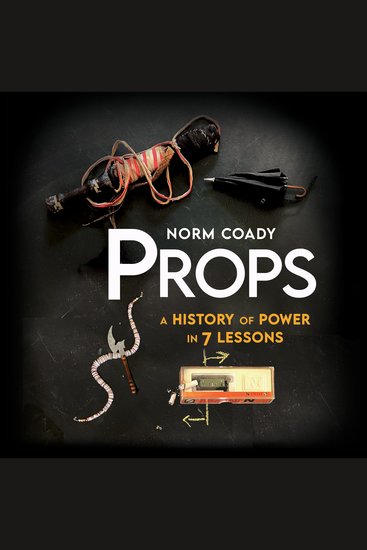
    Are you nostalgic for simpler times? Do you miss your favorite history teacher, the one that gave you perspective and kept you laughing? Come back to class. Buy Props and let Norm Coady take you on a trip from Caesar to Kennedy, from Wittenberg to St. Petersburg. Learn how seashells led to the first global conflict. Discover how a piece of chalk laid the groundwork for totalitarianism. Follow an umbrella’s strange journey from sunny Munich to rainy Dallas. Norm Coady takes well known historical events, turns them upside down, and shakes out new revelations. Equal parts illuminating and hilarious, Props is for, “people who take history so seriously, they read it for fun.”
    Show book
  • The Montessori Method - cover

    The Montessori Method

    Maria Montessori

    • 0
    • 0
    • 0
     In the early 1900's Dr. Maria Montessori began to reform educational methods with her work the 'Case dei Bambini' in Rome, Italy. Montessori began her work by developing methods to educate mentally retarded children, the method she developed was used with several children who at age eight took the state examinations in reading and writing, the children passed with above average scores. Because of this success (which is known as the 'first Montessori Miracle') Dr. Montessori was asked to open a school for children in Rome which she did. It was called the Case dei Bambini or “Children's House”. Now 101 years after the opening of the first Children's House we have recorded the first English translation of "The Montessori Method" by Maria Montessori. This book explains the Montessori Method of Education which supports “spontaneous self-development” of children and is used in the Case dei Bambini as well as many many Montessori Schools through out the world.
    Show book
  • African Mythology: Enthralling Myths Fables and Legends from Africa - cover

    African Mythology: Enthralling...

    Billy Wellman

    • 0
    • 0
    • 0
    Africa is huge and varied, and so is its mythology. 
    African ideas of how the world began are very different from the story of Genesis. Though the creator god is repeatedly seen as having withdrawn from the world, people often have a very direct and intense relationship with demigods, ancestors, and bush spirits. The entire landscape is permeated by spiritual meanings and inhabited by gods and spirits. While many Africans today formally follow the Christian or Muslim faiths, they often blend these beliefs with traditional lore and rites. 
    This audiobook examines the central themes of African mythology—the creation, gods and goddesses, trickster tales, animals, monsters, heroes, and mythical rulers—and shows how some motifs recur throughout the corpus of myths. It also looks at how African myths are becoming better known because of writers and filmmakers, particularly from the Black diaspora, who draw on this rich heritage for inspiration. 
    This introductory guide to African myths will allow you to do the following:Learn why the original creator decided to withdraw from Earth.Find out how ancient Egypt had several different creation stories, depending on which god was in ascendancy at the time.Listen to the medieval African emperor said to have been the richest man in history.Find out where Br’er Rabbit really came from.Check out how Anansi the Spider gained ownership of all the stories in the world.Get to know Oshun, the Yoruba river goddess, and how she arrived in Latin America.Learn about Haile Selassie, the emperor who brought Ethiopia into the League of Nations, and how he became a living god to Jamaican Rastafarians.Understand how Voodoo (Vodou) grew out of traditional West African religion. 
    Scroll up and click the “add to cart” button to learn more about African mythology!
    Show book
  • Why Privacy Matters - cover

    Why Privacy Matters

    Neil Richards

    • 0
    • 0
    • 0
    Everywhere we look, companies and governments are spying on us—seeking information about us and everyone we know. Ad networks monitor our web—surfing to send us "more relevant" ads. Databases of human information are assembled for purposes of "training" artificial intelligence programs designed to predict everything from traffic patterns to the location of undocumented migrants. We're even tracking ourselves, using personal electronics like Apple watches, Fitbits, and other gadgets. As Mark Zuckerberg once put it, "the Age of Privacy is over." But Zuckerberg and others who say "privacy is dead" are wrong. In Why Privacy Matters, Neil Richards explains that privacy isn't dead, but rather up for grabs. 


    Richards shows how the fight for privacy is a fight for power that will determine what our future will look like, and whether it will remain fair and free. Privacy matters because good privacy rules can promote the essential human values of identity, power, freedom, and trust. If we want to preserve our commitments to these precious yet fragile values, we will need privacy rules. Richards explains why privacy remains so important and offers strategies that can help us protect it from the forces that are working to undermine it. Pithy and forceful, this is a must-listen for anyone interested in a topic that sits at the center of so many current problems.
    Show book
  • Wired for Connection - The counterintuitive lessons a therapist learned from her clients - cover

    Wired for Connection - The...

    Carolyn Klassen

    • 0
    • 0
    • 0
    Wired for Connection are the lessons clients taught a therapist over a career about love, courage, vulnerability, shame and authenticity 
    Therapists learn and grow from therapy with clients--and now you can too!  
    Carolyn graduated from counselling school with a ton of head knowledge. Carolyn read 1000’s of pages and written hundreds more and learned the models and the approaches in the books. Did this therapist know enough to actually help people? 
    Turns out she didn’t. 
    That’s where her clients come in. They taught her about life, about therapy, and about relationships. 
    So much of what clients taught her was paradoxical. Actually, they didn’t teach her—the most important lessons in life are better caught than taught. The lessons were counterintuitive to conventional relationship wisdom. 
    Together they learned the way to real relationships was messiness, mistakes and discomfort. They noticed the route to acceptance was authenticity, that tears make life better, and that raw courage is often about tender things like saying, “I’m sorry” and “I love you”. And so much more. 
    Relationships are hard—but we are wired for them. We are wired for struggle and growth. Watching people struggle with their own lives has inspired her to struggle and grow in hers. 
    Relationships are hard for us all. But if we show up to connect, and we do it anything like right, we learn from each other. We learn from each other in ways that surprise and delight us. 
    We are wired for connection.
    Show book