Join us on a literary world trip!
Add this book to bookshelf
Grey
Write a new comment Default profile 50px
Grey
Subscribe to read the full book or read the first pages for free!
All characters reduced
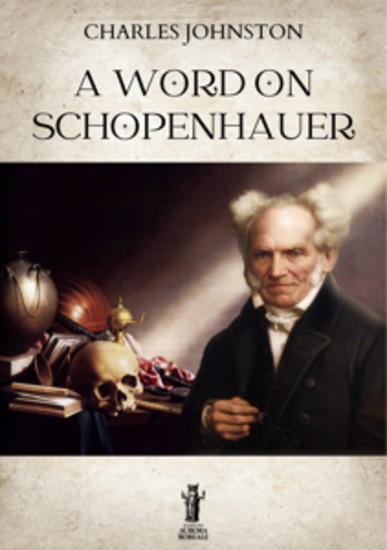
A Word on Schopenhauer - cover

A Word on Schopenhauer

Charles Johnston

Publisher: Edizioni Aurora Boreale

  • 0
  • 0
  • 0

Summary

Charles Johnston (1867-1931) was an Irish writer, journalist, theosophist, linguist, naturalist, and Sanskrit scholar. Johnston He wrote numerous books on Indian philosophy, translating works from Sanskrit as well as on Theosophy. He was married to the niece of Madame Blavatsky and was involved in the development of the Theosophical Society in the United States.Johnston translated several works from Sanskrit and Russian. As an author, he devoted himself primarily to philosophical and theosophical topics, and wrote a great number and variety of articles and books, ranging from scholarly writings on scriptures to popular volumes of humor, travel, and history.The Johnston’s article A Word on Schopenhauer, which we propose to our readers today, was published in October 1904 in the Theosophical Forum.According to Johnston, the great achievement of Schopenhauer was the perception of the fact that an hypothetical outer something, a force that provoked the changing appearances, was not so hopelessly unknowable.
Available since: 03/06/2025.

Other books that might interest you

  • Dark Psychology 10 - Master the Secrets Science of Silent Domination Subconscious Influence and Unseen Behavioral Control Techniques - cover

    Dark Psychology 10 - Master the...

    Halbert Ward

    • 0
    • 0
    • 0
    Peek Behind the Curtain:  
    Uncover and Harness Dark Psychology 101! 
    Hey there, have you heard about Dark Psychology?  
    Has anyone ever broached the subject with you?  
    Chances are, most people haven't, which is typical. In the gloomy recesses of consciousness, ideas echo and feelings swirl, this is the domain of Dark Psychology, an underappreciated subfield of psychology. Because of the associated taboos, people avoid talking about this subject. In addition to illuminating the forces, "Dark Psychology 1.0" will teach you how to harness or fight against their power.  
    Come explore the uncharted territory of subconscious influence with Halbert Ward, where your thoughts are both your weapon and your strategy. Prepare to be swept away into the shadowy realm of Dark Psychology as he grants you access to the hidden playbook of the human mind. 
    Beyond being just a book, "Dark Psychology 1.0" is your ticket to deciphering the unseen influences that mold our emotions, ideas, and deeds. Ward encourages you to think about the moral quandaries that come with Dark Psychology and to use psychological knowledge responsibly by posing ethical questions. 
    Fasten your seatbelts for a mind-bending voyage that will reveal secrets and test your perceptions. 
    Are you brave enough to flip the page? 
    Get Your Copy Now!
    Show book
  • Everybody's Political What's What - cover

    Everybody's Political What's What

    George Bernard Shaw

    • 0
    • 0
    • 0
    Confronted with these facts our sentimental hearthstone vaporing about parental care and me sacredness of the family as the inviolable unit of human society is only an excuse for doing nothing. Element­ary civilization is impossible without a moral code like the Ten Commandments, a technique of language, writing, and arithmetic, and a legal code of compulsory behavior completely abolishing individual liberty and free will within its scope. Unless people can be depended on to behave in an expected manner they cannot live in society, and must be either corrected or, if incorrigible, killed. Their life must be mostly dictated and institutional, and mere activities determined and predicable. And somebody must teach me codes to the children. They must be imposed on the child dogmatic­ally until it is old enough to understand them. 
    They can be imposed in various ways, by merciless whippings of children and cruel punishments of adults as well as by less savage and mischievous methods ; but they must be imposed somehow, or me human world will be an Alsatian madhouse. The necessity is fundamental; and the statesman who imagines that a formula of Liberty, Equality, Fraternity, will solve all his problems will discover, if he is capable of learning from experience, that liberty must give way to equality and that fraternity may mean either the fraternity of Cain and Abel or the friendship of David and Jonathan. Children, if they are to grow up as citizens, must learn a good deal that their parents could not teach them even if they had the necessary time. The statesman must make provision for this teaching or he will presently find himself faced with the impossible task of maintaining civilization witl1 savages instead of citizens.
    Show book
  • Treaty Justice - The Northwest Tribes the Boldt Decision and the Recognition of Fishing Rights - cover

    Treaty Justice - The Northwest...

    Charles Wilkinson

    • 0
    • 0
    • 0
    In 1974, Judge George Boldt issued a ruling that affirmed the fishing rights and tribal sovereignty of Native nations in Washington State. The Boldt Decision transformed Indigenous law and resource management across the United States and beyond. The case also brought about far-reaching societal changes, reinforcing tribal sovereignty and remedying decades of injustice. 


    Eminent legal historian and tribal advocate Charles Wilkinson tells the story of the Boldt Decision against the backdrop of salmon's central place in the cultures and economies of the Pacific Northwest. In the 1960s, Native people reasserted their fishing rights as delineated in nineteenth-century treaties. In response, state officials worked with non-Indian commercial and sport fishing interests to forcefully oppose Native actions. These "fish wars" spurred twenty tribes and the United States government to file suit in federal court. Boldt pointedly waited until Lincoln's birthday to hand down a decision recognizing the tribes' right to half of the state's fish. The case's aftermath led from the Supreme Court's affirmation of Boldt's opinion to collaborative management of the harvest of salmon. 


    Treaty Justice weaves personalities and local detail into the definitive account of one of the twentieth century's most important civil rights cases.
    Show book
  • The Hebrew Saga - cover

    The Hebrew Saga

    Gershon Rubin

    • 0
    • 0
    • 0
    A personal and philosophical meditation on the Hebrew Bible, its stories, and its sages.In this volume, Gershon Rubin attempts to draw the secrets of the antediluvian world into the modern day. Through the lens of a lifetime of spiritual learning, he explores the ancient saga of creation, Adam and Eve, and the generations to come after. As Rubin states by way of introduction to The Hebrew Saga, “My first name, Gershon, is similar to the Greek word geron (old man). Thus through my ‘geronoscope,’ I view the over-four-thousand-year-long written history of the Hebrew nation, which resulted in the origination of this my world-view, or world outlook.”
    Show book
  • Visibility Interrupted - Rural Queer Life and the Politics of Unbecoming - cover

    Visibility Interrupted - Rural...

    Carly Thomsen

    • 0
    • 0
    • 0
    Today most LGBTQ rights supporters take for granted the virtue of being "out, loud, and proud." Most also assume that it would be terrible to be LGBTQ in a rural place. By considering moments in which queerness and rurality come into contact, Visibility Interrupted argues that both positions are wrong. In the first monograph on LGBTQ women in the rural Midwest, Carly Thomsen deconstructs the image of the rural as a flat, homogenous, and anachronistic place where LGBTQ people necessarily suffer. And she suggests that visibility is not liberation and will not lead to liberation. 


    Far from being an unambiguous good, argues Thomsen, visibility politics can, in fact, preclude collective action. They also advance metronormativity, postraciality, and capitalism. To make these interventions, Thomsen develops the theory of unbecoming: interrogating the relationship between that which we celebrate and that which we find disdainful—the past, the rural, politics—is crucial for developing alternative subjectivities and politics. Unbecoming precedes becoming. Drawing from critical race studies, disability studies, and queer Marxism, in addition to feminist and queer studies, the insights of this book will be useful to scholars theorizing issues far beyond sexuality and place and to social justice activists who want to move beyond visibility.
    Show book
  • Grant Unleashed - A Biography of Ulysses S Grant - cover

    Grant Unleashed - A Biography of...

    Aeon History

    • 0
    • 0
    • 0
    Grant Unleashed offers a fresh perspective on Ulysses S. Grant, presenting him not just as a Civil War general and president, but as a complex figure whose leadership principles and human struggles remain deeply relevant today. The biography explores Grant's journey from military commander to president, examining his strategic brilliance at battles like Shiloh and Vicksburg, while also delving into his personal challenges and controversies. 
    The book highlights Grant's resilience through various adversities - from financial hardships to his battle with cancer - showcasing his unwavering integrity and determination. It particularly emphasizes his role in Reconstruction, detailing his efforts to rebuild the South and protect freed slaves' rights, demonstrating his commitment to equality and justice. 
    Rather than presenting an idealized portrait, the biography acknowledges Grant's imperfections and controversies during his presidency. This honest approach makes his story more relatable and impactful, offering valuable lessons in leadership, perseverance, and the complex pursuit of justice. The narrative explores how Grant's reputation has evolved over time, from a controversial figure to being increasingly recognized as a champion of civil rights and national unity. 
    The book provides detailed insights into Grant's military expertise, which continues to be studied in military academies today. It also uncovers lesser-known aspects of his presidency and examines how his legacy influences contemporary American values and discussions about equality and justice.
    Show book