Join us on a literary world trip!
Add this book to bookshelf
Grey
Write a new comment Default profile 50px
Grey
Subscribe to read the full book or read the first pages for free!
All characters reduced
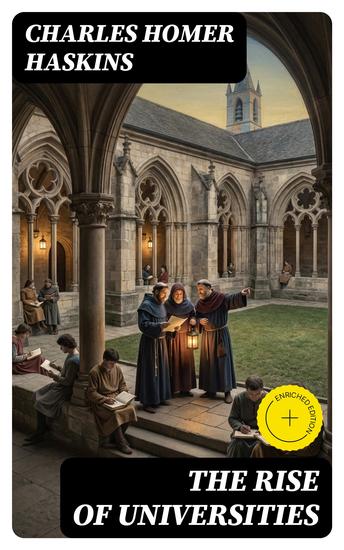
The Rise of Universities - Enriched edition The Rise of Universities - cover

The Rise of Universities - Enriched edition The Rise of Universities

Charles Homer Haskins

Publisher: DigiCat

  • 0
  • 0
  • 0

Summary

In "The Rise of Universities," Charles Homer Haskins offers a seminal exploration of the emergence and evolution of medieval universities, situated within the broader context of European intellectual life. Haskins employs a narrative style that is both scholarly and engaging, deftly intertwining historical accounts, cultural shifts, and the transformative impact of educational institutions. By examining key figures and pivotal moments, he paints a vivid portrait of the universities as catalysts for knowledge and societal change during the Middle Ages, presenting them not merely as places of learning but as thriving centers of intellectual exchange and innovation. Haskins, a notable historian and a pioneer in the study of medieval scholarship, was significantly influenced by the academic environment of his time. His extensive research and deep understanding of the period informed his arguments regarding the role of universities in shaping modern thought. Haskins' work is a product of his dedication to illuminating the complexities surrounding the medieval intellectual tradition, reflecting his belief in the importance of education as the foundation for societal progress. This book is highly recommended for scholars, students, and anyone interested in the history of education and thought. Haskins' insightful analysis not only enriches our understanding of the past but also provides a framework for contemplating the future of education in an ever-changing world.

In this enriched edition, we have carefully created added value for your reading experience:
- A succinct Introduction situates the work's timeless appeal and themes.
- The Synopsis outlines the central plot, highlighting key developments without spoiling critical twists.
- A detailed Historical Context immerses you in the era's events and influences that shaped the writing.
- A thorough Analysis dissects symbols, motifs, and character arcs to unearth underlying meanings.
- Reflection questions prompt you to engage personally with the work's messages, connecting them to modern life.
- Hand‐picked Memorable Quotes shine a spotlight on moments of literary brilliance.
- Interactive footnotes clarify unusual references, historical allusions, and archaic phrases for an effortless, more informed read.
Available since: 11/14/2023.
Print length: 58 pages.

Other books that might interest you

  • How Well-Intentioned Ideas Are Failing Our Kids - "Explore the truth! Uncover the failures of well-meaning ideas in shaping our children's futures" - cover

    How Well-Intentioned Ideas Are...

    Rowan Galbraith

    • 0
    • 0
    • 0
    How Well-Intentioned Ideas Are Failing Our Kids 
    ⭐⭐ A Simplified Guide & Explanations Included ⭐⭐ 
    Are you eager to enhance your parenting skills and deepen your understanding of what truly supports children's success? 
    Looking for a thorough guide that encapsulates everything you need to foster your child's growth effectively? 
    Your search ends here! 
    This guide is your essential resource for enriching your knowledge, applying effective strategies, and engaging in practical exercises. With this, you're on the road to success. 
    Now updated to reflect the latest insights on children's development. 
    Key features of this insightful guide: 
    - In-depth exploration of modern parenting ideas and their impacts on children 
    - Comprehensive breakdown of empowering strategies for effective parenting 
    - Practical techniques for promoting children's resilience and success 
    Our guide stands out through its extensive coverage, which is crucial for your parenting journey. Concepts are not just touched upon; they are examined thoroughly with clarity. 
    Please note that this guide is an independent resource and not affiliated with any official parenting entity. 
    Structured clearly with accessible language, our guide on empowering your parenting ensures seamless transitions between topics. Bid farewell to complicated jargon and embrace clear, concise, and precise content. 
    So, why delay? Click the BUY NOW button, secure your guide, and embark on your journey toward empowering your parenting for children's success! 
    Unlock insights for a brighter future for your children today!
    Show book
  • Mr Horniman's Walrus - Legacies of a Remarkable Victorian Family - cover

    Mr Horniman's Walrus - Legacies...

    Clare Paterson

    • 0
    • 0
    • 0
    Mr Horniman's Walrus tells the story of the rise and fall of three generations of a remarkable and dysfunctional Victorian family - the Hornimans - exploring the lives and loves behind their extraordinary and varied legacies. 
     
    Family patriarch John Horniman established the tea company that bore his name in 1826, which went on to become one of the best-known brands of nineteenth-century Britain. His son Frederick created the eclectic and wonderful Horniman Museum in London, and his granddaughter Annie was a theatrical impresario responsible for founding Ireland's national theatre, the Abbey. Across more than a century, the family embodied changing middle-class attitudes from patriarchy to the new spirit of modernity; and their progress mirrored the high point of Victorian entrepreneurialism and the changes ushered in by the Edwardian age. 
     
    Drawing on her years of research and unfettered access to the family archive, Clare Paterson has written a riveting tale of trade, collecting, the stage, sex and politics in Victorian Britain. For the first time, Mr Horniman's Walrus unpicks the lives of this fascinating family, including their slips from grace as well as their astounding achievements. It's a story of capital and culture, philanthropy and empire, but also bankruptcy, betrayal, intrigue, lunacy and deep involvement in the esoterica of the occult.
    Show book
  • Forgiveness - An Alternative Account - cover

    Forgiveness - An Alternative...

    Matthew Ichihashi Potts

    • 0
    • 0
    • 0
    A deeply researched and poignant reflection on the practice of forgiveness in an unforgiving world 


    In this sensitive and probing book, Matthew Ichihashi Potts explores the complex moral terrain of forgiveness, which he claims has too often served as a salve to the conscience of power rather than as an instrument of healing or justice. Though forgiveness is often linked with reconciliation or the abatement of anger, Potts resists these associations, asserting instead that forgiveness is simply the refusal of retaliatory violence through practices of penitence and grief. It is an act of mourning irrevocable wrong, of refusing the false promises of violent redemption, and of living in and with the losses we cannot recover. 


    Drawing on novels by Kazuo Ishiguro, Marilynne Robinson, Louise Erdrich, and Toni Morrison, and on texts from the early Christian to the postmodern era, Potts diagnoses the real dangers of forgiveness yet insists upon its enduring promise. Sensitive to the twenty-first-century realities of economic inequality, colonial devastation, and racial strife, and considering the role of forgiveness in the New Testament, the Christian tradition, philosophy, and contemporary literature, this book heralds the arrival of a new and creative theological voice.
    Show book
  • St Petersburg - cover

    St Petersburg

    Kelly Mass

    • 0
    • 0
    • 0
    St Petersburg's structures lay over the skeletons of the press-ganged servant workers who worked to build it, making it the label "the city built on bones." Historians approximate that 100,000 18th-century slaves are buried underneath the city's stunning Italianate estates and large Parisian-style streets.They passed away of cold, appetite, illness, or, if they were truly unfortunate, wolves. They were drawn from all around the Russian Empire at the time. They dedicated their lives for the magnificence of Imperial Russia, and the city they built, St Petersburg, stands as a testimony to the Russian state's single-mindedness.Its extravagant palaces radiate European elegance and were actively built in a Western way to bring Russia closer to Europe.Still, more than 3 centuries later, Russia has yet to finish this journey, and St Petersburg is a witness to the trouble of the journey.Let’s take a look at what else makes Saint Petersburg such a unique place.
    Show book
  • World War II in 1940: The History of the Fighting that Culminated with the German Conquest of Western Europe and the Battle of Britain - cover

    World War II in 1940: The...

    Editors Charles River

    • 0
    • 0
    • 0
    One of the most famous people in the world came to tour the city of Paris for the first time on June 28, 1940. Over the next three hours, he rode through the city’s streets, stopping to tour L’Opéra Paris. He rode down the Champs-Élysées toward the Trocadero and the Eiffel Tower, where he had his picture taken. After passing through the Arc de Triomphe, he toured the Pantheon and old medieval churches, though he did not manage to see the Louvre or the Palace of Justice. Heading back to the airport, he told his staff, “It was the dream of my life to be permitted to see Paris. I cannot say how happy I am to have that dream fulfilled today.” Four years after his tour, Adolf Hitler would order the city’s garrison commander, General Dietrich von Choltitz, to destroy Paris, warning his subordinate that the city "must not fall into the enemy's hand except lying in complete debris." Of course, Paris was not destroyed before the Allies liberated it, but it would take more than 4 years for them to wrest control of France from Nazi Germany after they took the country by storm in about a month in 1940. 
    The surrender of more than 1,200,000 isolated troops followed quickly in June 1940, yet in the midst of this disaster, the Allies contrived one coup that took even the victorious Wehrmacht aback: the evacuation of over 300,000 soldiers from the port of Dunkirk. This escape, hailed as “miraculous” at the time, provided England with a solid defensive force, the French with the kernel of a “Free French” army for the future, and the Western Allies with an invaluable boost to their morale during one of the war's darkest moments. With the clarity of historical hindsight, events proved Churchill correct. Operation Dynamo, as the British named the Dunkirk evacuation mission, bolstered British morale and defenses sufficiently to keep the “Sceptered Isle” in the war.
    Show book
  • What Is Stoicism? - A Brief and Accessible Overview - cover

    What Is Stoicism? - A Brief and...

    Tanner Campbell, Kai Whiting

    • 0
    • 0
    • 0
    An easy, jargon-free introduction to stoicism that covers the full range of stoic thought in a single compact volume 
     
    Divided into short chapters that can be read in brief sittings, What Is Stoicism? compiles two millennia of Stoic thought into simple conversational prose. This whistle-stop tour of Stoicism covers a surprising number of core topics: 
     
    • the three pillars of Stoic philosophy: logic, physics, and ethics 
    • the ultimate goal of Stoicism: virtue 
    • the Stoic concept of circles of concern: our individual obligations to our family, community, and world 
    • the Stoic ideal of living in accordance with nature 
     
    Readers will come to appreciate the vitality of Stoicism and realize how the wisdom of the past can meet the challenges of the present and the future.
    Show book