Join us on a literary world trip!
Add this book to bookshelf
Grey
Write a new comment Default profile 50px
Grey
Subscribe to read the full book or read the first pages for free!
All characters reduced
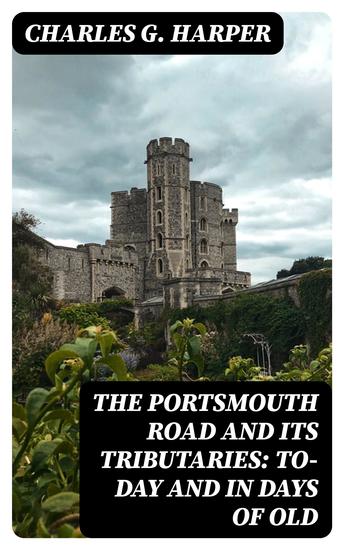
The Portsmouth Road and Its Tributaries: To-Day and in Days of Old - cover

The Portsmouth Road and Its Tributaries: To-Day and in Days of Old

Charles G. Harper

Publisher: DigiCat

  • 0
  • 0
  • 0

Summary

In "The Portsmouth Road and Its Tributaries: To-Day and in Days of Old," Charles G. Harper embarks on a vivid exploration of an iconic thoroughfare, unraveling its historical significance and cultural landscape. Harper's prose elegantly weaves together narrative and description, offering readers an engaging account infused with anecdotal evidence and rich illustrations that enliven the text. This comprehensive work reflects the Victorian era's preoccupation with travel and nostalgia, serving not only as a guidebook but also as a social commentary on the evolution of England's roadways from pastoral pathways to bustling routes. Charles G. Harper was a multifaceted artist and author, driven by a profound appreciation for the landscapes of Britain. His background in illustration and literature intersected perfectly, allowing him to capture both the aesthetic and historical facets of the Portsmouth Road. A passionate advocate for the preservation of cultural heritage, Harper's perspective was shaped by his extensive travels, instilling in him an admiration for the intersections of history and modernity. Harper's "The Portsmouth Road and Its Tributaries" is an essential read for those fascinated by transport history, geography, and the intermingling of past and present. It beckons enthusiasts of travel writing, historians, and anyone intrigued by the unearthing of England's stories, inviting readers to traverse not only the physical journey of the road but also its rich tapestry of human experiences.
Available since: 09/04/2022.
Print length: 230 pages.


Other books that might interest you

  • Platform Capitalism - cover

    Platform Capitalism

    Nick Srnicek

    • 0
    • 0
    • 0
    What unites Google and Facebook, Apple and Microsoft, Siemens and GE, Uber and Airbnb? Across a wide range of sectors, these firms are transforming themselves into platforms: businesses that provide the hardware and software foundation for others to operate on. This transformation signals a major shift in how capitalist firms operate and how they interact with the rest of the economy: the emergence of platform capitalism. 


    This book critically examines these new business forms, tracing their genesis from the long downturn of the 1970s to the boom and bust of the 1990s and the aftershocks of the 2008 crisis. It shows how the fundamental foundations of the economy are rapidly being carved up among a small number of monopolistic platforms, and how the platform introduces new tendencies within capitalism that pose significant challenges to any vision of a post-capitalist future. This book will be essential for anyone who wants to understand how the most powerful tech companies of our time are transforming the global economy.
    Show book
  • Over the Edge of the World - Magellan's Terrifying Circumnavigation of the Globe - cover

    Over the Edge of the World -...

    Anonymous

    • 0
    • 0
    • 0
    A majestic tale of discovery thatchanged many long-held views about the world 
     In 1519 Magellan and his fleet of five ships set sail from Seville, Spain, to discover a water route to the fabled Spice Islands in Indonesia, where the most sought-after commodities -- cloves, pepper, and nutmeg -- flourished. Three years later, a handful of survivors returned with an abundance of spices from their intended destination, but with just one ship carrying eighteen emaciated men. During their remarkable voyage around the world the crew endured starvation, disease, mutiny, and torture. Many men died, including Magellan, who was violently killed in a fierce battle. 
    This is the first full account in nearly half a century of this voyage into history: a tour of the world emerging from the Middle Ages into the Renaissance; a startling anthropological account of tribes, languages, and customs unknown to Europeans; and a chronicle of a desperate grab for commercial and political power.
    Show book
  • Knowledge and Learning are Two Different Things - Eight Public Meetings with Young People Claremont Colleges USA 1968 - cover

    Knowledge and Learning are Two...

    Jiddu Krishnamurti

    • 0
    • 0
    • 0
    A radical transformation in the psyche itself," 8 November 1968. Duration: 80 minutes.To communicate we must know that the word is not the thing and also be in that state of mind whose quality is attention, care. That can take place only if we are serious.We are the world, and the world is us. To bring about a radical transformation, which is so essential in society, there must be radical transformation in ourselves.Analysis of violence does not end violence, nor is violence ended by thinking of nonviolence.There is no teacher outside, no saviour, no master; you yourself have to change, and therefore you have to learn to observe, to know yourself.Knowledge and learning are two different things.What is this silence you talk about? The silence that I am experiencing comes and goes."Thought is the cause of fear," 10 November 1968. Duration: 76 minutes.Though we have plenty of energy, apparently we lack the drive, enthusiasm, vitality to bring about a change in ourselves.As long as there is fear, there must be violence, aggression, anger, hatred. Thought is the source of fear.Is it possible to live everyday life without thought interfering?
    Show book
  • HBR's 10 Must Reads on AI (with bonus article "How to Win with Machine Learning" by Ajay Agrawal Joshua Gans and Avi Goldfarb) - cover

    HBR's 10 Must Reads on AI (with...

    Harvard Business Review

    • 0
    • 0
    • 0
    The next generation of AI is here—use it to lead your business forward. 


    If you read (or listen to) nothing else on artificial intelligence and machine learning, listen to these ten articles. We've combed through hundreds of Harvard Business Review articles and selected the most important ones to help you understand the future direction of AI, bring your AI initiatives to scale, and use AI to transform your organization. This book will inspire you to: create a new AI strategy, learn to work with intelligent robots, get more from your marketing AI, be ready for ethical and regulatory challenges, understand how generative AI is game changing, and stop tinkering with AI and go all in. 


    This collection of articles includes "Competing in the Age of AI," by Marco Iansiti and Karim R. Lakhani; "How to Win with Machine Learning," by Ajay Agrawal, Joshua Gans, and Avi Goldfarb; "Developing a Digital Mindset," by Tsedal Neeley and Paul Leonardi; "Learning to Work with Intelligent Machines," by Matt Beane; "Getting AI to Scale," by Tim Fountaine, Brian McCarthy, and Tamim Saleh; "Why You Aren't Getting More from Your Marketing AI," by Eva Ascarza, Michael Ross, and Bruce G. S. Hardie; "The Pitfalls of Pricing Algorithms," by Marco Bertini and Oded Koenigsberg; "A Smarter Strategy for Using Robots," by Ben Armstrong and Julie Shah; and more.
    Show book
  • Rise and Fall of the Stuart Dynasty in Britain The: The History of the Stuarts from the Tudor Era to the Glorious Revolution and the Jacobites - cover

    Rise and Fall of the Stuart...

    Editors Charles River

    • 0
    • 0
    • 0
    England has more often been faced with the claims of competing kings and queens than with a period of no monarch at all. The major exception to that rule came in the 11 years between 1649 and 1660, when England was a republic. Following the disastrous reign of Charles I and the civil wars that led to his execution, Parliament and the army ruled England. England’s republican experiment started out as a work of collaboration and compromise; lords, army officers and members of Parliament (MPs) worked together to find a political settlement that did not include the despised royal House of Stuart. Nonetheless, religious and political division made collective rule unworkable, and ultimately, one man emerged from the chaos to rule the country. He had risen from a humble background to become the leading general of the Civil Wars, and as a man of staunch beliefs and ruthless pragmatism, he controlled England from 1653-1658 under the title of Lord Protector. In essence, he was a king in all but name. That man was Oliver Cromwell, and in the popular imagination, Cromwell has overshadowed the rest of the leaders of the parliamentary cause and the New Model Army.  
    Cromwell’s death would lead to a restoration of the royal line, but an uprising of a completely different nature would soon unfold on English soil – the Glorious Revolution, an intriguing story of a power war exacerbated by ruthless ambition, under-the-table plotting, and the treachery of familial betrayal. That said, it’s important to remember that the deposed James II did try to return to England, and there would be generations of war waged for the Stuart cause by the Jacobites, who were not only supporters of the exiled Stuart monarchy, but also against the political and religious settlements agreed to across the British Isles. It’s no surprise the Jacobites continue to interest so many people, as do the plot twists, near misses, and “what-ifs” involved. 
    Show book
  • Colonial Vietnam: The History of the Division Between North and South Vietnam - cover

    Colonial Vietnam: The History of...

    Editors Charles River

    • 0
    • 0
    • 0
    Before the Vietnam War, most Americans would have been hard pressed to locate Vietnam on a map. South Vietnamese President Diệm’s regime was extremely unpopular, and war broke out between Communist North Vietnam and South Vietnam around the end of the 1950s. Kennedy’s administration tried to prop up the South Vietnamese with training and assistance, but the South Vietnamese military was feeble. A month before his death, Kennedy signed a presidential directive withdrawing 1,000 American personnel, and shortly after Kennedy’s assassination, new President Lyndon B. Johnson reversed course, instead opting to expand American assistance to South Vietnam. 
    	The post-analysis of war is a complicated and process that benefits from hindsight, and the involvement of the United States in Vietnam over about a decade was no exception. Never formally declared as a “war,” the Vietnam War was not fought in clean lines or with clear missions. Viewers of the evening news listening to the “box score” of killed and wounded each night had at best a hazy notion of what was happening a world away in Southeast Asia. If anything, their leaders were both attentive to reelection and on a certain level were themselves unsure of what was truly taking place. A military draft that sent over 50,000 American soldiers to their deaths was triggered by a resolution sought by President Lyndon B. Johnson in a decision to contain communism in a distant Asian land. 
    Show book