Join us on a literary world trip!
Add this book to bookshelf
Grey
Write a new comment Default profile 50px
Grey
Subscribe to read the full book or read the first pages for free!
All characters reduced
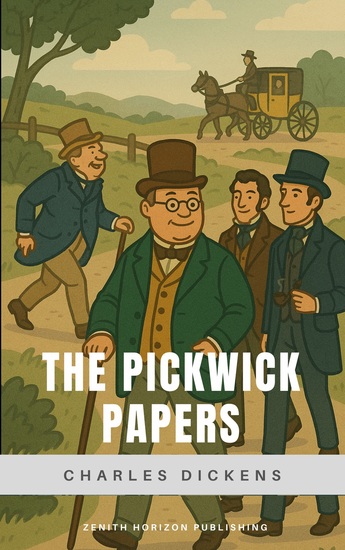
The Pickwick Papers - Charles Dickens' Hilarious First Novel - cover

The Pickwick Papers - Charles Dickens' Hilarious First Novel

Charles Dickens, Zenith Horizon Publishing

Publisher: Zenith Horizon Publishing

  • 0
  • 0
  • 0

Summary

Before Scrooge, before Oliver Twist—there was Pickwick.

The Pickwick Papers, Charles Dickens' debut novel, introduced the world to his unmatched talent for humor, satire, and unforgettable characters. Follow the absurd adventures of Mr. Pickwick and his charming companions as they navigate the social quirks of 19th-century England.

Packed with misadventures, mistaken identities, and biting social commentary, this episodic novel is both laugh-out-loud funny and rich in historical charm. A must-read for lovers of British wit and classic literature.

🎩 This edition includes:

The complete, unabridged original text

Kindle-enhanced formatting for seamless reading

Perfect for fans of Dickens, literary humor, and British classics

📚 Step into a world of whimsy, wit, and Victorian mischief.

Download now and enjoy Dickens' first and funniest novel.
Available since: 06/17/2025.
Print length: 866 pages.

Other books that might interest you

  • Nana - Audiobook - cover

    Nana - Audiobook

    Émile Zola, Classic Audiobooks,...

    • 0
    • 0
    • 0
    In Nana, Émile Zola tells the provocative story of a beautiful but doomed courtesan who rises to fame in the decadent society of Second Empire Paris. As she ascends through the ranks of high society, she leaves a trail of ruin behind her—destroying powerful men and exposing the moral decay of the world around her.Bold, scandalous, and psychologically complex, Nana is not just the tale of one woman, but a mirror reflecting the collapse of an era. Zola's fearless exploration of desire, power, and self-destruction makes this novel both shocking and unforgettable.
    Show book
  • Crocker's Hole - From their pens to your ears genius in every story - cover

    Crocker's Hole - From their pens...

    R D Blackmore

    • 0
    • 0
    • 0
    Richard Doddridge Blackmore was born on 7th June, 1825 at Longworth in Berkshire (now part of Oxfordshire), where his father, John Blackmore, was Curate-in-charge of the parish. His mother died a few months after his birth the victim of an outbreak of typhus. With this loss the family moved to Bushey, Hertfordshire, then on to their native Devon.  His elder brother Richard (by a year), however, was taken by his aunt to live near Oxford. His father married again in 1831, whereupon Richard returned to live with them.  With much of his childhood spent in the lush and pastoral "Doone Country" of Exmoor, and along the Badgworthy Water, Blackmore came to love the very countryside he immortalised in Lorna Doone.  In November 1853 he married his wife Lucy.  And the following year, 1854, his literary career began with a collection of Poems and for the next 15 years he would write in the winters and garden in the summers.  In 1860 with inherited money he built a house in Teddington just outside of London and established a market garden for the cultivation of fruit.  He loved horticulture but having little business experience could never really exploit it.  However with the publication of Lorna Doone in 1869 he was catapulted to fame.  And although he continued to write extensively nothing caught the public imagination quite like Lorna Doone.  RD Blackmore died at Teddington on 20th January, 1900 after a long and painful illness, and was buried next to his wife in Teddington cemetery.
    Show book
  • Rilla of Ingleside - cover

    Rilla of Ingleside

    L. M. Montgomery

    • 0
    • 0
    • 0
    "Rilla is Anne and Gilbert Blythe’s youngest daughter, an excitable 15-year-old who is unaware of how the world works, and is only interested in having fun. But the world is on the brink of a global war, and soon Rilla’s family and life are turned upside down, as several of her brothers enlist in the army and are sent to fight overseas.The book follows Rilla’s life through the duration of World War I, as she grows up quickly from the responsibilities put on young women in this time. She adopts an orphaned child and raises him, runs the local Junior Red Cross, falls in love with a soldier just before he deploys, and even assists in the elopement of a soldier to his beloved.This novel captures the anxiety of living with one’s family away at war, as well as captures the unique perspective of a woman’s life at home during the First World War (and is the only Canadian novel that shows this perspective written by a contemporary of the war). Through the sadness and bleak moments brought to the world in this war, and the loss that the Blythes face, there is yet again hope to be found in the love of the families and neighbors of Ingleside."
    Show book
  • Conscience - A Judith Lee Detective Story - cover

    Conscience - A Judith Lee...

    Richard Marsh

    • 0
    • 0
    • 0
    Richard Bernard Heldmann was born on 12th October 1857, in St Johns Wood, North London.  
     
    By his early 20’s Heldmann began publishing fiction for the myriad magazine publications that had sprung up and were eager for good well-written content.  
     
    In October 1882, Heldmann was promoted to co-editor of Union Jack, a popular magazine, but his association with the publication ended suddenly in June 1883.  It appears Heldman was prone to issuing forged cheques to finance his lifestyle.  In April 1884 he was sentenced to 18 months hard labour. 
      
    In order to be well away from the scandal and the damage that this had caused to his reputation Heldmann adopted a pseudonym on his release from jail.  Shortly thereafter the name ‘Richard Marsh’ began to appear in the literary periodicals.  The use of his mother’s maiden name as part of it seems both a release and a lifeline. 
     
    A stroke of very good fortune arrived with his novel ‘The Beetle’ published in 1897.  This would turn out to be his greatest commercial success and added some much-needed gravitas to his literary reputation.   
     
    Marsh was a prolific writer and wrote almost 80 volumes of fiction as well as many short stories, across many genres from horror and crime to romance and humour.   His unusual characters, plotting devices and other literary developments have identified his legacy as one of the best British writers of his time.   
     
    Richard Marsh died from heart disease in Haywards Heath in Sussex on 9th August 1915.  He was 57.
    Show book
  • Last Words (Unabridged) - cover

    Last Words (Unabridged)

    Booker T. Washington

    • 0
    • 0
    • 0
    Booker Taliaferro Washington (April 5, 1856 - November 14, 1915) was an American educator, author, orator, and adviser to several presidents of the United States. Between 1890 and 1915, Washington was the dominant leader in the African American community and of the contemporary black elite. Washington was from the last generation of black American leaders born into slavery and became the leading voice of the former slaves and their descendants. They were newly oppressed in the South by disenfranchisement and the Jim Crow discriminatory laws enacted in the post-Reconstruction Southern states in the late 19th and early 20th centuries.
    LAST WORDS: We have come to the close of another school year. Some of you will go out from among us now, not to return. Others will go home for the summer vacation and return at the end of that for the next school year.
    Show book
  • The Tempest - cover

    The Tempest

    William Shakespeare

    • 0
    • 0
    • 0
    The Tempest is a play by English playwright William Shakespeare, probably written in 1610-1611, and thought to be one of the last plays that Shakespeare wrote alone. After the first scene, which takes place on a ship at sea during a tempest, the rest of the story is set on a remote island, where the sorcerer Prospero, a complex and contradictory character, lives with his daughter Miranda, and his two servants: Caliban, a savage monster figure, and Ariel, an airy spirit. The play contains music and songs that evoke the spirit of enchantment on the island. It explores many themes, including magic, betrayal, revenge, and family. In Act IV, a wedding masque serves as a play-within-a-play, and contributes spectacle, allegory, and elevated language.
    Although The Tempest is listed in the First Folio as the first of Shakespeare's comedies, it deals with both tragic and comic themes, and modern criticism has created a category of romance for this and others of Shakespeare's late plays. The Tempest has been put to varied interpretations, from those that see it as a fable of art and creation, with Prospero representing Shakespeare, and Prospero's renunciation of magic signaling Shakespeare's farewell to the stage, to interpretations that consider it an allegory of Europeans colonizing foreign lands.
    Show book