Join us on a literary world trip!
Add this book to bookshelf
Grey
Write a new comment Default profile 50px
Grey
Subscribe to read the full book or read the first pages for free!
All characters reduced
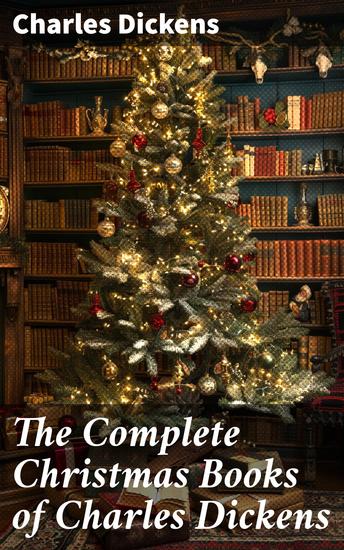
The Complete Christmas Books of Charles Dickens - A Christmas Carol The Chimes The Cricket on the Hearth A Christmas Tree A House to Let… - cover

The Complete Christmas Books of Charles Dickens - A Christmas Carol The Chimes The Cricket on the Hearth A Christmas Tree A House to Let…

Charles Dickens

Publisher: Good Press

  • 0
  • 0
  • 0

Summary

In "The Complete Christmas Books of Charles Dickens," the reader is invited into a rich tapestry of Victorian England, where the themes of social justice, compassion, and the spirit of giving take center stage. This compendium features the beloved "A Christmas Carol" alongside lesser-known tales such as "TheChimes," "The Cricket on the Hearth," and "The Haunted Man." Dickens'Äôs signature prose, characterized by vivid imagery and intricate characterizations, captivates readers while subtly critiquing the societal norms of his time, encapsulating the Victorian ethos of philanthropy and warmth during the festive season. Charles Dickens, a towering figure in English literature, drew inspiration from his challenging upbringing and a keen awareness of social injustices that plagued his contemporaries. His works often reflect his transformative experiences, particularly the importance of benevolence amidst hardship. Dickens, who famously emphasized the notion of redemption, utilized the Christmas stories to promote ethical values and communal responsibility'Äîa reflection of his own beliefs shaped by personal trials and societal observations. This invaluable collection is recommended for both devoted Dickens enthusiasts and newcomers alike, as it encapsulates the essence of the human spirit through the lens of Christmas cheer. Dive into these narratives to uncover timeless lessons of hope, generosity, and the enduring belief in the possibility of change.
Available since: 12/23/2023.
Print length: 1720 pages.
Other books that might interest you

  • Tarzan of the Apes - cover

    Tarzan of the Apes

    Edgar Rice Burroughs

    • 0
    • 0
    • 0
    Tarzan of the Apes is the thrilling origin story of one of the most iconic characters in literary history. 
    When English aristocrats John and Alice Clayton are marooned on the African coast, their newborn son is orphaned in the heart of the jungle. Raised by a tribe of great apes, the boy grows into a powerful, intelligent, and instinct-driven man—one who will come to be known as Tarzan. Straddling the worlds of civilization and savagery, Tarzan’s journey is one of identity, survival, and discovery, as he uncovers his noble birthright and must choose where he truly belongs. 
    Packed with wild adventure, deep emotional stakes, and timeless questions of nature versus nurture, Tarzan of the Apes launched a cultural phenomenon and remains a gripping tale of heroism and human potential. 
    This new narration by Veronica Saretsky brings Burroughs’ lush jungle world to life with clarity, drama, and emotional depth.
    Show book
  • Shades A Phantasy - Ukranian born Korolenko creates a fictional dialogue of Socrates to examine lifes biggest questions - cover

    Shades A Phantasy - Ukranian...

    Vladimir Korolenko

    • 0
    • 0
    • 0
    Vladimir Galaktionovich Korolenko was born in Zhytomyr, Ukraine, then part of the Russian Empire on 27th July 1853. 
     
    His father died when he was 13 and life was then often struck with bouts of poverty, which resulted in his education being somewhat erratic.   A spell in exile at 23 was followed by another as the politics of the times opposed his volatile but heart-felt passions. 
     
    Writing was also coming to the fore and in 1879 his debut short story telling of a young Narodnik searching for social and spiritual identity, was published. 
     
    In 1881, Korolenko refused to swear allegiance to the new Russian Tsar and was again exiled, this time much farther afield.  He spent the next three years doing manual work, but took time to study local customs and history.  These impressions in exile provided rich material for his writings. 
     
    In 1885 he was allowed to settle in Nizhny, where again he repeatedly questioned the authorities.  That same year ‘Makar's Dream’ established his literary reputation and was part of his first collection ‘Sketches and Stories’, the following year. 
     
    In the early 1890’s when famine struck Central Russia, he went to work on relief missions, collecting donations, supervising the delivery and distribution of food, opening 45 free canteens, all this while writing the graphic reports that would later be published as ‘In the Year of Famine’ in 1893. 
     
    By 1896 despite some psychological disorders, he was well regarded amongst Russian writers and was even a member of the Russian Academy of Sciences.  Throughout his writing career Korolenko was a staunch advocate of human rights, putting that sacred activity above what he called his 'part-time-writing'. 
     
    In the Revolutionary year of 1905, under his editorship, Russkoye Bogatstvo published the Manifest by the Petersburg Soviet of the Workers' deputies. Korolenko was now repeatedly harassed by the authorities, had his flat raided many times and materials confiscated. 
     
    As a lifetime opponent of Tsarism, he guardedly welcomed the Revolution of 1917.  Once the nature of Bolshevism was established, he soon started to criticize it. During the Russian Civil War that ensued, he condemned both the Red Terror and the White Terror.  
     
    Despite suffering from a progressive heart disorder, he collected food packages for children in famine-stricken Moscow and Petrograd as well as organised orphanages and shelters for the homeless.  
     
    Vladimir Korolenko died in Poltava, Ukraine, of the complications of pneumonia on 25th December 1921.  He was 68. 
     
    In this story Korolenko invokes the characters of Socrates and Elpidias who, after their deaths, involve themselves in a debate on God.  This is a tour-de-force of conception and execution.
    Show book
  • Lord Peter Views the Body - The Lord Peter Wimsey Mysteries Vol: 4 - cover

    Lord Peter Views the Body - The...

    Dorothy L. Sayers

    • 0
    • 0
    • 0
    "Lord Peter Views the Body" by Grapevine Press is a delightful collection of shorter adventures featuring the inimitable Lord Peter Wimsey. In this anthology, readers will accompany Lord Peter on a series of intriguing cases that highlight his brilliant deductive skills and quick wit. With each story, Dorothy L Sayers crafts a mini-mystery that captivates readers and showcases her mastery of the detective genre.From perplexing puzzles to clever solutions, these tales offer a taste of Sayers' storytelling finesse and the enduring charm of Lord Peter Wimsey. Whether you're a seasoned fan of the detective or new to his world of crime-solving, "Lord Peter Views the Body" provides a compelling and entertaining journey through the enigmatic and witty realms of Dorothy L Sayers.
    Show book
  • A Tale of Two Cities - cover

    A Tale of Two Cities

    Charles Dickens

    • 0
    • 0
    • 0
    "A Tale of Two Cities" by Charles Dickens is a historical novel written in the mid-19th century. Set against the backdrop of the French Revolution, the story begins by exploring the social and political turmoil of the era, introducing key themes such as resurrection, sacrifice, and the contrast between oppression and liberty.  
    The narrative follows Mr. Jarvis Lorry on his mission to retrieve Dr. Alexandre Manette, an imprisoned former physician who has been "recalled to life" after years of suffering. Dickens vividly depicts the contrasting conditions in England and France, highlighting the hardships faced by ordinary people. 
    A notable scene unfolds as Mr. Lorry travels on a Dover mail coach and encounters a mysterious messenger who delivers a message concerning Dr. Manette. Upon arriving in Paris, the ominous undertones of the Revolution are palpable, with Madame Defarge's wine shop symbolizing the growing discontent.  
    The story hints at the challenges ahead as the characters intertwine in a tale of personal and political upheaval, setting the stage for a drama that explores the quest for justice in the face of tyranny.
    Show book
  • The Dunwich Horror — Part 2 of 10 - cover

    The Dunwich Horror — Part 2 of 10

    H. P. Lovecraft

    • 0
    • 0
    • 0
    Title: The Dunwich Horror — Part 2 of 10 
    Author: H. P. Lovecraft 
    Narrator: Jonathan Dunne 
    Original Publication: 1929 
    Public Domain: Yes 
    Series Placement: Timeless Terrors No. 62 — Part 2 of 10 
    Description: 
    Welcome to Timeless Terrors No. 62, featuring one of H. P. Lovecraft’s most infamous works of cosmic dread: The Dunwich Horror. 
    In the remote Massachusetts village of Dunwich, something is terribly wrong. The Whateley family — feared, shunned, whispered about — has welcomed a child into the world… but Wilbur Whateley is no ordinary boy. He grows unnaturally fast, speaks strange languages, and seeks forbidden knowledge from the Necronomicon itself. 
    Locked away in their decaying farmhouse, Wilbur and his occult-obsessed grandfather nurture a monstrous secret — a presence too large, too hungry, and too alien to remain hidden much longer. 
    As livestock vanish, the hills tremble, and the air fills with unholy sounds, the truth becomes undeniable: 
    an unseen horror is waiting to break free. 
    Narrated by Amazon-bestselling horror author Jonathan Dunne, this fresh performance resurrects a groundbreaking tale of ancient gods, corrupted bloodlines, and the terrifying thinness of reality. 
    This is Part 2 of a 10-part complete audiobook. Stay tuned — the nightmare has only begun.
    Show book
  • Don Quixote - cover

    Don Quixote

    Miguel de Cervantes

    • 0
    • 0
    • 0
    Don Quixote is a Spanish novel by Miguel de Cervantes. It was originally published in two parts, in 1605 and 1615. Considered a founding work of Western literature, it is often labelled as the first modern novel. Don Quixote is also one of the most-translated books in the world and one of the best-selling novels of all time.The plot revolves around the adventures of a member of the lowest nobility, an hidalgo[d] from La Mancha named Alonso Quijano, who reads so many chivalric romances that he loses his mind and decides to become a knight-errant (caballero andante) to revive chivalry and serve his nation, under the name Don Quixote de la Mancha. He recruits as his squire a simple farm labourer, Sancho Panza, who brings a unique, earthy wit to Don Quixote's lofty rhetoric. In the first part of the book, Don Quixote does not see the world for what it is and prefers to imagine that he is living out a knightly story meant for the annals of all time. However, as Salvador de Madariaga pointed out in his Guía del lector del Quijote (1972 [1926]), referring to "the Sanchification of Don Quixote and the Quixotization of Sancho", as "Sancho's spirit ascends from reality to illusion, Don Quixote's declines from illusion to reality".
    Show book