Join us on a literary world trip!
Add this book to bookshelf
Grey
Write a new comment Default profile 50px
Grey
Subscribe to read the full book or read the first pages for free!
All characters reduced
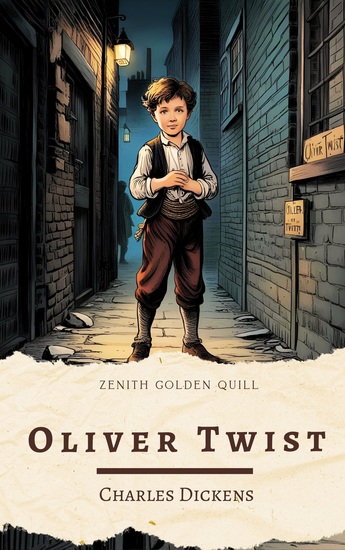
Oliver Twist - Charles Dickens's Gritty Tale of Poverty Orphans and Redemption - cover

Oliver Twist - Charles Dickens's Gritty Tale of Poverty Orphans and Redemption

Charles Dickens, Zenith Golden Quill

Publisher: Zenith Golden Quill

  • 0
  • 0
  • 0

Summary

"Please, sir, I want some more."

From these iconic words begins one of the most powerful social novels of the 19th century. Oliver Twist follows the journey of a poor orphan boy navigating the brutal underbelly of Victorian London. From workhouses and pickpockets to betrayal and belonging, Charles Dickens masterfully exposes the injustices of child labor, criminal underworlds, and class inequality.

With unforgettable characters like Fagin, the Artful Dodger, and Bill Sikes, Oliver Twist blends heart, suspense, and sharp social critique in one of the most enduring works in English literature.

📘 This Edition Features:
✔ Complete and unabridged text
✔ Kindle-optimized formatting with clickable table of contents
✔ Perfect for readers of classic literature, historical fiction, and social commentary

💬 What Readers Say:
"A gripping portrait of hardship and hope."
"Dickens's genius lies in giving voice to the voiceless."
"Still powerful, moving, and necessary today."

📥 Download Oliver Twist today and experience the story that helped ignite a conscience in Victorian England.
Available since: 05/07/2025.
Print length: 292 pages.

Other books that might interest you

  • The Wind in the Willows - cover

    The Wind in the Willows

    Kenneth Grahame

    • 0
    • 0
    • 0
    The Wind in the Willows is a children's novel by Kenneth Grahame, first published in 1908. Alternately slow moving and fast-paced, it focuses on four anthropomorphised animals in a pastoral version of Edwardian England. The novel is notable for its mixture of mysticism, adventure, morality and camaraderie, and celebrated for its evocation of the nature of the Thames Valley. 
    Narrated by Michael Ward.
    Show book
  • Great Expectations - Audiobook - cover

    Great Expectations - Audiobook

    Charles Dickens, Classic...

    • 0
    • 0
    • 0
    Great Expectations is a coming-of-age novel that tells the story of Pip, a young orphan raised by his harsh sister and her gentle husband in rural England. When Pip receives an unexpected fortune from an unknown benefactor, he is thrust into London society with dreams of becoming a gentleman. As he navigates this new world, he faces illusions, heartbreak, and hard lessons about identity, loyalty, and the true meaning of success.Through Pip's journey, Dickens explores the complexities of ambition, class, and moral growth. The novel is rich with unforgettable characters—like the eccentric Miss Havisham and the cold but captivating Estella—and it challenges the idea that wealth and status equate to happiness. Ultimately, Great Expectations is a powerful narrative of self-discovery, redemption, and what it means to grow up with integrity.
    Show book
  • Peter Pan - cover

    Peter Pan

    Saviour Pirotta

    • 0
    • 0
    • 0
    Wendy knows that all children have to grow up... all apart from the magical Peter Pan! When Peter flies through the nursery window and invites Wendy and her brothers, John and Michael, to come to Never-Never-Land, they set off on the adventure of a lifetime. J. M. Barrie's best-loved tale of Lost Boys, mermaids, pirates and a boy who will never grow up has been retold and adapted for younger readers aged 6+. 
     
    ABOUT THE SERIES: Abridged and retold in modern English, Arcturus Easy-to-Read Classics make 16 classic stories accessible to readers as young as six, while retaining all the charm, atmosphere, and sense of adventure that made the original tales world-famous.
    Show book
  • Water of Life The - Story Time Episode 57 (Unabridged) - cover

    Water of Life The - Story Time...

    Brothers Grimm

    • 0
    • 0
    • 0
    A king was dying. An old man told his sons that the water of life would save him. Each one set out in turn. The two older ones, setting out in hopes of being the heir, were rude to a dwarf on the way and became trapped in ravines. When the youngest son went the dwarf asked where he was going, and he told him. The dwarf told him it was in a castle, and gave him an iron wand to open the gates and two loaves to feed to the lions inside. Then he had to get the water before the clock struck 12 when the gates would shut again.
    Show book
  • Cup of Gold - cover

    Cup of Gold

    John Steinbeck

    • 0
    • 0
    • 0
    The first novel from American literary great John Steinbeck (Grapes of Wrath) tells the fictionalized story of the illustrious 17th century pirate Captain Henry Morgan  
    Henry Morgan is a young boy growing up in a small town in Wales. One day, a sailor returns to regale Henry with tales of the West Indies, and the glory that awaits those adventuresome enough to go. Henry, dazzled, quickly finds a place aboard a ship heading to the islands, thus setting himself on the path to becoming the brutal and fearsome pirate Captain Morgan.  
    The portrait Steinbeck paints of Morgan (with some artistic license taken) is of a complex, lustful, and largely unhappy man, set in evocative locales that are laced with traces of magical realism. Though Morgan’s life was filled with blood and violence, Steinbeck portrays him as a thoughtful and intelligent commander of men, whose tragic flaw is an unquenchable lust for great accomplishments combined with a misunderstanding of what great accomplishments actually are.  
    Through his cunning he repeatedly attains the ever-grander victories he seeks—but he quickly discovers what so many before and after him have discovered: that achievement is not always as satisfying as the quest to achieve.  
    Publisher's Note: Originally published in 1929, Cup of Gold is a literary work that reflects the time in which it was published—both its good and its ill. The original text contains wording and terminology that represent outdated cultural beliefs regarding race and ethnicity. In the interest of preserving and documenting both the faults and highlights of literary history—an instrumental, crucial function of works entering the public domain—this text is unedited and uncensored in this audiobook recording. Please proceed with discretion.
    Show book
  • The Metamorphosis - The Lost Manuscript - cover

    The Metamorphosis - The Lost...

    Franz Kafka

    • 0
    • 0
    • 0
    The Metamorphosis is a story, about a man who wakes up transformed into a bug and the repercussions it has on his life and the people around him. What does it all mean? It is most probably an autobiography of how Kafka himself experienced early life living with his parents. Kafka describes how he endured his mother and father's financial and emotional exploitation's, to the point of detaching from them and thereby ceasing to be their son (the real metamorphosis). Gregor’s metamorphosis is that of Kafka’s being an obedient son, subserviently paying for his parents’ narcissistic needs with his own life, into being a disobedient one—as if he had become a ‘piece of vermin’. Gregor’s parents possessed a large sum of money which symbolizes the needlessness of Gregor’s exploitation. Thus the parents did not love him for who he was, but for his loyal willingness to undergo this exploitation. Reduced to vermin, Gregor can no longer financially benefit his parents. It is the parents that caused Gregor’s/Kafka’s metamorphosis. The debt Gregor intended to repay his parents symbolizes the emotional debt many adult children continue to feel towards their elderly parents for the love and care they provided. 
    Show book