Join us on a literary world trip!
Add this book to bookshelf
Grey
Write a new comment Default profile 50px
Grey
Subscribe to read the full book or read the first pages for free!
All characters reduced
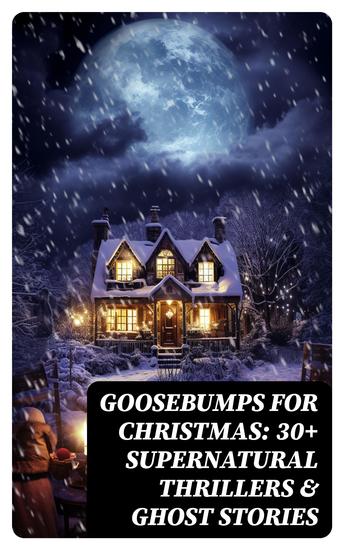
Goosebumps for Christmas: 30+ Supernatural Thrillers & Ghost Stories - cover

Goosebumps for Christmas: 30+ Supernatural Thrillers & Ghost Stories

Charles Dickens, Nathaniel Hawthorne, George MacDonald, Saki Saki, Robert Louis Stevenson, Grant Allen, John Kendrick Bangs, Bithia Mary Croker, Florence Marryat, J.M. Barrie, E.F. Benson, Jerome K, M.R. James, Algernon Blackwood, Mary Elizabeth Braddon, Arthur Conan Doyle, Sabine Baring-Gould, Frank R. Stockton, Fergus Hume, James Bowker, Thomas Hardy, Catherine Crowe, Katherine Rickford, William Douglas O'Connor, Leonard Kip, Catherine L. Pirkis, Lucie E. Jackson, Louisa M. Alcott, Joseph Sheridan Le Fanu

Publisher: DigiCat

  • 0
  • 0
  • 0

Summary

Goosebumps for Christmas: 30+ Supernatural Thrillers & Ghost Stories is a captivating anthology that transports readers into the unsettling realm of Christmas-themed supernatural narratives. Encompassing a wide range of literary styles, from the psychologically chilling to the whimsically eerie, this collection showcases the labyrinthine imaginations of some of the most esteemed authors from the Gothic and Victorian eras. Each tale intricately weaves themes of ghostly visitations, moral reckoning, and the ethereal unknown, with standout stories skillfully blending the festive ambiance with spectral thrills, ensuring readers are both enchanted and unnerved. The anthology features an eclectic assembly of writers, each contributing their unique voice to the overarching theme of Christmas and the supernatural. Renowned authors such as Dickens and Doyle, alongside lesser-known literary talents, draw from diverse cultural and historical backdrops, enriching the collection with varied interpretations of ghost lore and Victorian society's fascination with the paranormal. This convergence of voices offers a comprehensive exploration of how Christmas, often synonymous with light and joy, can unveil the dark, enigmatic corners of human psyche and morality. Goosebumps for Christmas invites readers on a mesmerizing journey through a kaleidoscope of supernatural tales, ideal for those eager to explore the intersection of festive cheer and otherworldly mystery. It presents an unparalleled opportunity to experience a confluence of storytelling mastery, providing both educational insights and a gripping read. Readers are encouraged to immerse themselves in this timeless collection, gaining a deeper understanding of the narrative techniques that make ghost stories resonate across generations, while fostering an appreciation for the rich tapestry of voices united within its pages.
Available since: 12/13/2023.
Print length: 1015 pages.

Other books that might interest you

  • Maktub - An Inspirational Companion to The Alchemist - cover

    Maktub - An Inspirational...

    Paulo Coelho

    • 0
    • 0
    • 0
    An essential companion to the inspirational classic The Alchemist, filled with timeless stories of reflection and rediscovery. 
    From one of the greatest writers of our age comes a collection of stories and parables unlocking the mysteries of the human condition. Gathered from Paulo Coelho’s daily column of the same name, Maktub, meaning “it is written,” invites seekers on a journey of faith, self-reflection, and transformation. As Paulo Coelho explains, “Maktub is not a book of advice—but an exchange of experiences.” 
    Each story offers an illuminated path to see life and the lives of our fellow people around the world in new ways, allowing us to tap into universal truths about our collective and individual humanity. As Coelho writes, “a man who seeks only the light, while shirking his responsibilities, will never find illumination. And one who keep his eyes fixed upon the sun . . . ends up blind.” These wise tales offer the perspective of talking snakes, old women climbing mountains, disciples querying their masters, Buddha in dialogue, mysterious hermits, and many saints addressing the mysteries of the universe. 
    Following the path of his previous internationally bestselling works, this thoughtful collection of short, inspirational pieces, introduced in a foreword by the author, will engage seekers of all ages and backgrounds.
    Show book
  • Maxim Gorky - A Short Story Collection - Nominated for the Nobel prize in literature 5 times Gorky was a truly special short story writer we implore you to see why in this collection - cover

    Maxim Gorky - A Short Story...

    Maxim Gorky

    • 0
    • 0
    • 0
    Alexei Maximovich Peshkov was born on 28th March 1868, in Nizhny Novgorod, Russia. 
     
    Better known as Maxim Gorky he was orphaned at 11 and ran away from home at 12.  At 19 he had already attempted suicide and thereafter travelled, by foot, across the Russian Empire for 5 years. 
     
    His first book ‘Essays & Stories’ in 1898 was a sensation and so began a long career as an author of short stories, novels and plays.  Gorky saw writing as a moral and political act that would help to change the unjust world around him.  He was an ardent early advocate of the emerging Marxist movement and publicly opposed the Tsarist regime leading several times to his arrest.  
     
    In 1904 he began his own theatre but the censor banned every play and Gorky was forced to abandon the project. 
     
    But Gorky was a financially successful author, editor, and playwright and gave monies to political parties as well as for civil rights and social reform.  The brutal shooting of workers, which set in motion the Revolution of 1905, pushed Gorky more decisively toward radical solutions.  
     
    In 1906 he went to the United States to raise funds for the Bolsheviks. Those experiences including a scandal over travelling with his lover and not his wife deepened his contempt for the ‘bourgeois soul.’ 
     
    Gorky now moved to Capri in Italy, both for health reasons and to escape the increasingly repressive times in Russia.  
     
    An amnesty for the 300th anniversary of the Romanov dynasty saw him return to Russia in 1914. His politics remained close to the Bolshevik cause.  But soon, after the 1918 revolution, his essays referred to Lenin as a tyrant for his senseless arrests and repression.  He was soon appealing to the outside world for food aid after the catastrophic crop failure. 
     
    In October 1921 Gorky returned to Italy, now in Fascist hands, and settled in Sorrento until 1932.  His health worsened with the onset of tuberculosis. 
     
    He wrote several successful books there but now decided to find an understanding with the communist regime. Stalin invited him home and his return was hailed as a major propaganda victory.  He was decorated with the Order of Lenin, and a province, a park, and various streets re-named in his honour. 
     
    But he had his faults too.  In 1933, Gorky co-edited a book on the White Sea-Baltic Canal and denied even a single prisoner died during its construction, but thousands had. As well, knowing that some Nazis were homosexual, a phrase was attributed to him that said ‘exterminate all homosexuals and fascism will vanish’.  Although he was himself was quoting another he was decidedly homophobic. 
     
    With the increase of Stalinist repression in 1935 Gorky was placed under unannounced house arrest. 
     
    Maxim Gorky died on the 18th June 1936 from pneumonia.  He was 68. 
     
    Stalin and Molotov were among those who carried Gorky's urn of ashes at his funeral. 
     
    01 - Maxim Gorky - A Short Story Collection - An Introduction 
    02 - Twenty-Six Men and a Girl by Maxim Gorky 
    03 - One Autumn Night by Maxim Gorky 
    04 - In The Steppe by Maxim Gorky 
    05 - Her Lover by Maxim Gorky 
    06 - Chelkash - Part 1 by Maxim Gorky 
    07 - Chelkash - Part 2 by Maxim Gorky 
    08 - Chelkash - Part 3 by Maxim Gorky
    Show book
  • The Blue Moccasins - cover

    The Blue Moccasins

    D H Lawrence

    • 0
    • 0
    • 0
    'The Blue Moccasins' has the charm of looking at some eternal human problems such as unequal marriage, the waning of sexual desire and a woman who cannot give herself wholly to her husband in a thoroughly English and local setting; the stage of an amateur dramatic society where all the passions and delusions come to a head.
    Show book
  • Dhoya - From their pens to your ears genius in every story - cover

    Dhoya - From their pens to your...

    W B Yeats

    • 0
    • 0
    • 0
    William Butler Yeats was born in Sandymount in County Dublin, Ireland on 13th June 1865. 
    His early years moved between Ireland and England. By his mid-teens he was writing but those works were described as ‘entirely Un-Irish’.  With Ernest Rhys he founded the Rhymers Club. Based at Ye Olde Cheshire Cheese in Fleet Street it’s best described as a drinking club for performing poets.  Yeats later cited them as ‘The Tragic Generation’.  By now Yeats was writing and publishing poetry and stories that were profoundly based in Irish folklore.   
    Yeats is perhaps best described as Ireland’s national poet in addition to being one of the major twentieth-century literary figures of the English tongue. He represents the ‘Romantic poet of modernism,’ with an extraordinary style created from the outward emphasis on the expression of emotions and the extensive use of symbolism, imagery and allusions.  
    In 1923 his fame was brought to an even wider audience when he received the Nobel Prize in Literature.  
    His personal life was driven by his many relationships in love and by his great interest in oriental mysticism and occultism.  Yeats also wrote prose and drama and, as an ardent Nationalist, established himself as a spokesman of the Irish cause and served as an Irish senator for two terms.  
    W B Yeats died at the Hôtel Idéal Séjour, in Menton, France, on 28th January 1939.  He was 73.
    Show book
  • Blood - From their pens to your ears genius in every story - cover

    Blood - From their pens to your...

    Hanns Heinz Ewers

    • 0
    • 0
    • 0
    Hanns Heinz Ewers was born on 3rd November 1871 in Düsseldorf, Germany. 
    His first published poem was at 17 on the death, after a reign of only 99 days, of the German Emperor Frederick III. 
    A stint in the German military was cut short after only 44 days because of his myopia.  Writing was to be the way forward for him with a book of satiric verse published in 1901. At the same time he co-founded a literary vaudeville troupe that toured central and eastern Europe before censors and expenses forced its closure.  An inveterate traveller he was in South America when the Great War enveloped Europe and he relocated to New York. 
    From here his story darkens. Although by now a successful and admired author he was arrested in the U S in 1918 as a German Agent on the pretext of his travels and a falsified Swiss passport. Interned, he was released in 1921 and returned to Germany.  He claimed only to be raising money for the German Red Cross. 
    His literary fame is decidedly easier to clarify. His novels beginning with ‘The Sorcerer’s Apprentice’ in 1910 are dark, they bristle with evil intent and are littered with characters who have a dubious moral compass and yet, along with his short stories, are brazen, brilliant feats of literary narrative. 
    He also wrote and published plays, fairy tales, opera librettos, critical essays and lectured for many years on ‘The Religion of Satan’ and was one of the first to write scripts for the cinema, which he considered a legitimate art form. 
    As the Weimar republic began its chaotic death throes Ewers became attracted to the rising Nazi Party.  At first he was warmly received despite disagreeing with its anti-semitism (his most famed literary character had a Jewish mistress) and he was even commissioned by Hitler to write a biography of the Nazi martyr Horst Wessel.  This together with his own homosexuality culminated with his works being banned in 1934 and his assets and property seized.  It took him many years to have the ban lifted.  This association rightfully clouds his personal reputation but has meant his literary contributions are also overlooked and neglected. 
    Hanns Heinz Ewers died of tuberculosis on 12th June 1943 in his Berlin apartment.
    Show book
  • Rising Fury - A Jesse McDermitt Novel - cover

    Rising Fury - A Jesse McDermitt...

    Wayne Stinnett

    • 0
    • 0
    • 0
    In the backcountry of the Florida Keys, you can see and hear trouble coming for miles in any direction. That is, if you're paying attention. 
    Jesse McDermitt lives in the backcountry and very little happens near him that he's not fully aware of. During a quiet moment, he watches a slow-moving shrimp trawler as it serenely cruises by, barely visible on the horizon at the edge of the three-mile limit. 
    The tranquility of the moment is shattered when the trawler is suddenly demolished in an enormous explosion. What caused the explosion? And why was a woman from Jesse's past on board? 
    To find the answers to these questions and more, Jesse and friends will work from Miami to Key West, then across the water to Fort Myers. When the bad guys hit too close to home, Jesse retaliates. Furiously.
    Show book