Join us on a literary world trip!
Add this book to bookshelf
Grey
Write a new comment Default profile 50px
Grey
Subscribe to read the full book or read the first pages for free!
All characters reduced
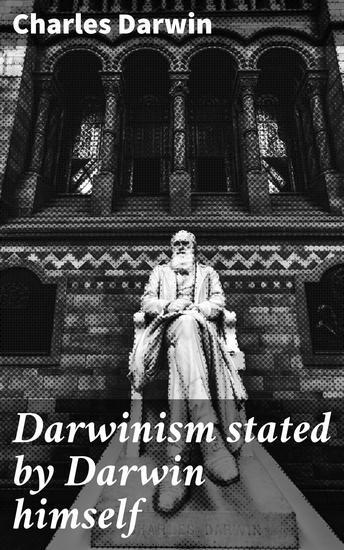
Darwinism stated by Darwin himself - Characteristic passages from the writings of Charles Darwin - cover

Darwinism stated by Darwin himself - Characteristic passages from the writings of Charles Darwin

Charles Darwin

Publisher: Good Press

  • 0
  • 0
  • 0

Summary

In "Darwinism stated by Darwin himself," Charles Darwin articulates the foundational concepts of his groundbreaking theory of evolution, emphasizing natural selection as the primary mechanism of gradual species change. The book is marked by a meticulous literary style that blends scientific rigor with accessible language, allowing both scholars and lay readers to engage with profound ideas. Contextually, this work emerges during the late 19th century, a period rife with scientific exploration and intellectual upheaval, marking a shift in understanding life sciences and challenging established beliefs about creation and species origin. Charles Darwin, an esteemed naturalist and biologist, meticulously observed diverse biological phenomena during his extensive voyages, most notably on the HMS Beagle. His exposure to various ecosystems and species diversity provided the impetus for formulating his theories on evolution. The synthesis of his empirical observations and introspective analysis culminated in this work, aiming to convey complex ideologies with clarity and precision. I wholeheartedly recommend "Darwinism stated by Darwin himself" to readers interested in the intersections of science, philosophy, and history. This essential text not only elucidates the principles of evolution but also sparks a deeper understanding of humanity's place within the natural world, making it a pivotal addition to any thoughtful reader's library.
Available since: 07/10/2023.
Print length: 269 pages.

Other books that might interest you

  • Astrophysics and High Energy Physics - The Extremes of the Universe (3 in 1) - cover

    Astrophysics and High Energy...

    Mark Hedges

    • 0
    • 0
    • 0
    "Astrophysics and High Energy Physics – The Extremes of the Universe" explores the most extreme phenomena in the cosmos, delving into the physics of stars, high-energy particles, and the frontiers of theoretical physics. The study of stars uncovers the complex processes driving their formation, evolution, and eventual death, from the fusion occurring in their cores to the creation of supernovae and black holes. High-energy physics looks beyond the stars, examining the behavior of subatomic particles at immense energies, seeking to understand the fundamental forces that govern the universe. Theoretical physics plays a critical role, offering mathematical frameworks and models to explain phenomena that cannot yet be directly observed, such as dark matter, dark energy, and the early universe. 
    This book bridges these fascinating areas of physics, providing a comprehensive understanding of how the most energetic and extreme environments in the universe shape the very fabric of reality. From the birth of stars to the mysteries of quantum fields and particle accelerators, it brings together the latest discoveries and theories, inviting readers into the realm of astrophysics and high-energy phenomena. The knowledge gained through this text sheds light on the origins of our universe, the nature of matter, and the potential future of both cosmic and subatomic exploration.
    Show book
  • Age of Invisible Machines - A Practical Guide to Creating a Hyperautomated Ecosystem of Intelligent Digital Workers - cover

    Age of Invisible Machines - A...

    Robb Wilson, Josh Tyson

    • 0
    • 0
    • 0
    In Age of Invisible Machines, Robb Wilson delivers an eye-opening and startlingly insightful blueprint for leveraging conversational AI in order to make your organization self-driving—with a growing ecosystem of interconnected automations accelerating all aspects of your business. 


    Conversational AI is changing the nature of every job at every company and this book is relevant for anyone who will be affected by the acceleration of these technologies. You'll learn how to develop a strategy for hyperautomation by identifying the outdated processes and systems holding your organization back. You'll discover ways of internalizing and orchestrating new technologies that are force-multipliers for rapid growth. A must-listen for every business leader, Wilson's book debunks common myths about conversational AI while laying bare the inevitable complexity of restructuring your business to unlock the massive opportunities this new era affords. 


    You'll also find: compelling discussions of the ethical dilemmas that lie in wait as mass adoption of conversational AI takes hold; fascinating explorations of what a self-driving organization looks like and how you can use conversational AI to create a durable competitive advantage; and strategies behind creating an ecosystem for hyperautomation that any company can begin implementing immediately.
    Show book
  • When the Ice is Gone - What a Greenland Ice Core Reveals About Earth's Tumultuous History and Perilous Future - cover

    When the Ice is Gone - What a...

    Paul Bierman

    • 0
    • 0
    • 0
    In 2018, lumps of frozen soil, collected from the bottom of the world's first deep ice core and lost for decades, reappeared in Denmark. When geologist Paul Bierman and his team first melted a piece of this unique material, they were shocked to find perfectly preserved leaves, twigs, and moss. That observation led them to a startling discovery: Greenland's ice sheet had melted naturally before, about 400,000 years ago. 


    In When the Ice Is Gone, Bierman traces the story of this extraordinary finding, revealing how it radically changes our understanding of the Earth and its climate. A longtime researcher in Greenland, he begins with a brief history of the island, both human and geological. For the origins of ice coring, Bierman brings us to Camp Century, a US military base built inside Greenland's ice sheet, where engineers first drilled through mile-thick ice and into the frozen soil beneath. Decades later, a few feet of that long-frozen earth would reveal its secrets—ancient warmth and melted ice. 


    Changes in Greenland reverberate around the world, with ice melting high in the arctic affecting people everywhere. Bierman explores how losing Greenland's ice will catalyze devastating events if we don't change course and address climate change now.
    Show book
  • Life Between the Tides - cover

    Life Between the Tides

    Adam Nicolson

    • 0
    • 0
    • 0
    Inside each rockpool, tucked into one of the infinite crevices of the tidal coastline, lies a rippling, silent, unknowable universe. Below the stillness of the surface course different currents of endless motion—the ebb and flow of the tide, the steady forward propulsion of the passage of time, and the tiny lifetimes of its creatures, all of which coalesce into the grand narrative of evolution. 


    In Life Between the Tides, Adam Nicolson investigates one of the most revelatory habitats on earth. Under his microscope, we see a prawn's head become a medieval helmet and a group of "winkles" transform a Dickensian social scene, with mollusks munching on Stilton and glancing at their pocket watches. Or, rather, is a winkle more like Achilles, an ancient hero, throwing himself toward death for the sake of glory? For Nicolson, the world of the rockpools is infinite and as intricate as our own. 


    As Nicolson journeys between the tides, both in the pools he builds along the coast of Scotland and through the timeline of scientific discovery, he is accompanied by great thinkers. We meet Virginia Woolf and her Waves; a young T. S. Eliot peering into his own rockpool in Massachusetts. And, of course, scientists populate the pages; not only their discoveries, but also their doubts and errors, their moments of quiet observation and their realizations.
    Show book
  • The Engineered Primate - Natures Blueprint for Optimal Nutrition - cover

    The Engineered Primate - Natures...

    Vaughn Hughes

    • 0
    • 0
    • 0
    What if the greatest mystery of Nutrition… has gone unnoticed? 
    For generations we have accepted tidy explanations: 
    Eat this, avoid that, follow the rules. 
    But beneath the surface, something just doesn’t add up. 
    The human body thrives without our conscious control: 
    Meals disappear, nutrients are sorted, and energy appears out of nowhere – with no chef, no control tower, no captain. 
    Which really begs the question: how does it all work? 
    The Engineered Primate is a journey into the logistics of life. It is an exploration of the hidden mechanisms that shape us from the inside out. Each chapter peels back a layer: 
    Why does digestion even exist? 
    What was the environmental pressure in deep time that made a digestive system necessary? 
    How does order arise in a body with no conscious overseer? 
    …and why have we rarely asked these questions when creating our nutritional models? 
    This is not another diet manual. 
    It is a trail of clues inviting you to reconsider what you thought you knew about the very act of eating.
    Show book
  • The Newton Wars & the Beginning of the French Enlightenment - cover

    The Newton Wars & the Beginning...

    J.B. Shank

    • 0
    • 0
    • 0
    Nothing is considered more natural than the connection between Isaac Newton’s science and the modernity that came into being during the eighteenth-century Enlightenment. Terms like “Newtonianism” are routinely taken as synonyms for “Enlightenment” and “modern” thought, yet the particular conjunction of these terms has a history full of accidents and contingencies. Modern physics, for example, was not the determined result of the rational unfolding of Newton’s scientific work in the eighteenth century, nor was the Enlightenment the natural and inevitable consequence of Newton’s eighteenth-century reception. Each of these outcomes, in fact, was a contingent event produced by the particular historical developments of the early eighteenth century. A comprehensive study of public culture, The Newton Wars and the Beginning of the French Enlightenment digsbelow the surface of the commonplace narratives that link Newton with Enlightenment thought to examine the actual historical changes that brought them together in eighteenth-century time and space. Drawing on the full range of early modern scientific sources, from studied scientific treatises and academic papers to book reviews, commentaries, and private correspondence, J. B. Shank challenges the widely accepted claim that Isaac Newton’s solitary genius is the reason for his iconic status as the father of modern physics and the philosophemovement.
    Show book