Junte-se a nós em uma viagem ao mundo dos livros!
Adicionar este livro à prateleira
Grey
Deixe um novo comentário Default profile 50px
Grey
Assine para ler o livro completo ou leia as primeiras páginas de graça!
All characters reduced
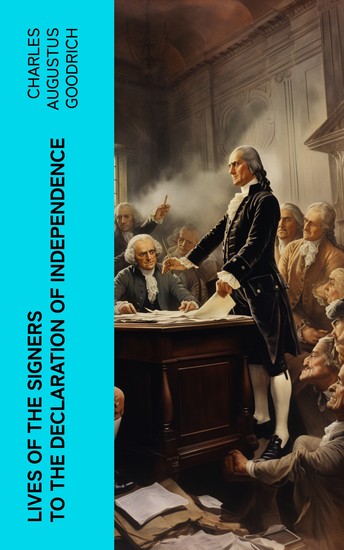
Lives of the Signers to the Declaration of Independence - cover
LER

Lives of the Signers to the Declaration of Independence

Charles Augustus Goodrich

Editora: e-artnow

  • 0
  • 0
  • 0

Sinopse

The venerated emigrants who first planted America, and most of their distinguished successors who laid the foundation of our civil liberty, have found a resting place in the peaceful grave. But the virtues which adorned both these generations; their patience in days of suffering; the courage and patriotic zeal with which they asserted their rights; and the wisdom they displayed in laying the foundations of our government; will be held in lasting remembrance. Table of Contents:  John Hancock Samuel Adams John Adams Robert Treat Paine Elbridge Gerry Josiah Bartlett William Whipple Matthew Thornton Stephen Hopkins William Ellery Roger Sherman Samuel Huntington William Williams Oliver Wolcott William Floyd Philip Livingston Francis Lewis Lewis Morris Henry Misner Richard Stockton John Witherspoon Francis Hopeinson John Hart Abraham Clark Robert Morris Benjamin Rush Benjamin Franklin John Morton Geoge Clymer James Smith George Taylor James Wilson George Ross Caesar Rodney George Read Thomas M'Kean Samuel Chase William Paca Thomas Stone Charles Carroll George Wythe Richard Henry Lee Thomas Jefferson Benjamin Harrison Thomas Nelson, Jun Francis Lightfoot Lee Carter Braxton William Hooper Joseph Hewes John Penn Edward Rutledge Thomas Heyward Thomas Lynch, Jun Arthur Middleton Button Gwinnett Lyman Hall George Walton
Disponível desde: 15/12/2023.
Comprimento de impressão: 432 páginas.

Outros livros que poderiam interessá-lo

  • How to Chain a Cheater: A Woman’s Guide to Controlling the Unfaithful Male - cover

    How to Chain a Cheater: A...

    A.A. Castor

    • 0
    • 0
    • 0
    What if love isn't enough to keep him loyal? What if discipline is the only language he respects? 
    How to Chain a Cheater is not a book for the soft-hearted or the blindly forgiving. It's for the woman who's tired of begging, bleeding, and blaming herself for a man's betrayal. This brutally honest, unapologetically strategic guide exposes what no therapist will tell you: some men don't stop cheating until they're trained, tamed—or replaced. 
    In these pages, you won't find fairy tale advice. You'll find a battle plan. 
    Discover:Why men cheat even when they "love" youHow to install fear, consequence, and accountability without raising your voiceThe psychological warfare that flips the power dynamic in your favorHow to chain a cheater emotionally, financially, sexually—and spirituallyWhen to walk away, when to punish, and when to reward consistency 
    This book is your weapon. It's your shield. It's the reality check every woman needs before wasting another tear on an unfaithful man. With dark humor, razor-sharp insights, and no sugarcoating, author A.A. Castor hands women the blueprint to take control, reclaim respect, and—if you choose to stay—make him fear the price of losing you more than he craves the thrill of betrayal. 
    If you've ever whispered, "He'll change if I love him harder," this book will scream back: 
    "He'll only change when it costs him more to lose you than to keep you."
    Ver livro
  • They'll Never Hold Me - cover

    They'll Never Hold Me

    Michael Adams

    • 0
    • 0
    • 0
    The life and crimes of Kevin John Simmonds, Australia's most daring fugitive. 
     
    In 1959, Australians thrilled to every move made by a new criminal underdog, a Ned Kelly for the rock 'n' roll era. 
    Kevin John Simmonds was a charismatic crook whose brazen crime spree had scored him a lengthy prison sentence. But as he was led from court, he boasted, 'They'll never hold me.' 
    Two months later, Simmo made good on his promise, staging a daring escape from Long Bay Gaol. When his bid for freedom took a deadly turn, legendary Detective Ray 'the Gunner' Kelly took charge of the search, putting the fugitive in the crosshairs of the biggest armed manhunt in Australian history. 
    They'll Never Hold Me is the true story of an antihero with a code of honour who captured the public's hearts and minds even as he enraged the cops and the establishment. Brilliantly researched and written by Michael Adams, of the Forgotten Australia podcast, this never-before-told tale takes us beyond the public adventures that made Simmo into Public Enemy No. 1 to reveal the haunting tragedies he was trying to outrun – and the terrible fate that even he might not escape.
    Ver livro
  • Egyptian Trade and Diplomacy - Relations with Neighboring Civilizations - cover

    Egyptian Trade and Diplomacy -...

    Omar Khalil

    • 0
    • 0
    • 0
    Ancient Egypt’s prosperity and cultural richness were significantly shaped by its early trade networks and exchanges with neighboring regions. From the very beginnings of Egyptian civilization, trade played a crucial role in building economic strength and fostering diplomatic relationships. The development of trade networks allowed Egypt not only to obtain essential resources but also to influence and be influenced by surrounding cultures. 
    The origins of Egyptian trade practices can be traced back to the Predynastic period, when local communities exchanged goods such as pottery, beads, and tools. As Egyptian society evolved and centralized under powerful pharaohs, trade became more organized, enabling long-distance interactions. By the time of the Old Kingdom, Egypt had established a network of trade routes that stretched beyond its borders, connecting it to various civilizations across the ancient world. 
    One of the earliest and most vital trade routes was the Nile River, serving as a natural highway that facilitated the movement of goods and people. The Nile connected southern and northern Egypt while also linking the civilization to Nubia and further into sub-Saharan Africa. This route allowed the exchange of gold, ivory, ebony, and exotic animal products, which were crucial to the Egyptian economy and the creation of luxury goods. Additionally, maritime trade across the Red Sea connected Egypt to the Arabian Peninsula and even the distant lands of Punt, where incense, spices, and other valuable commodities were sourced.
    Ver livro
  • America’s Defeat - A Revolutionary War Won by the British - cover

    America’s Defeat - A...

    Marcus Draysun

    • 0
    • 0
    • 0
    The American colonies in the mid-18th century were a thriving part of the British Empire, but tensions had been brewing for decades. What began as minor grievances over trade and governance escalated into a full-scale rebellion. British policies, aimed at tightening control over the colonies, ignited widespread dissatisfaction, planting the seeds of revolution. 
    One of the earliest sources of discontent was the British system of taxation. The Sugar Act of 1764 and the Stamp Act of 1765 imposed direct levies on the colonies, enraging merchants, publishers, and legal professionals. The colonists, who had no direct representation in the British Parliament, saw these taxes as a blatant overreach. Their rallying cry—“No taxation without representation”—became a defining slogan of the growing resistance. The Stamp Act’s repeal in 1766 provided temporary relief, but the British government soon followed with new policies, including the Townshend Acts, which further strained relations. 
    The presence of British troops in colonial cities only exacerbated tensions. Stationed to enforce British laws and maintain order, soldiers were often viewed as an occupying force. Clashes between civilians and the military became frequent, culminating in the infamous Boston Massacre of 1770, where British troops fired into a crowd of unarmed colonists, killing five. This event, heavily publicized by Patriot leaders, fueled anti-British sentiment and strengthened calls for defiance.
    Ver livro
  • Minoans and Mycenaeans The: The History of the Civilizations that First Developed Ancient Greek Culture - cover

    Minoans and Mycenaeans The: The...

    Editors Charles River

    • 0
    • 0
    • 0
    Nearly 2,500 years after the Golden Age of Athens, people across the world today continue to be fascinated by the Ancient Greeks. But who did the Ancient Greeks look up to? The answer to that question can be found in Homer’s The Odyssey, in which Odysseus makes note of “a great town there, Cnossus, where Minos reigned.” It was perhaps the earliest reference to the Minoan civilization, a mysterious ancient civilization that historians and archaeologists still puzzle over, but a civilization that renowned historian Will Durant described as "the first link in the European chain.” 
    Nearly 2,000 years before Homer wrote his epic poems, the Minoan civilization was centered on the island of Crete, a location that required the Minoans to be a regional sea power. And indeed they were, stretching across the Aegean Sea from about 2700-1500 BCE with trade routes extending all the way to Egypt. 
    The Minoans may have been the first link in the “European chain”, leading to the Ancient Greeks and beyond, but questions persist over the origins of the civilization, the end of the civilization, and substantial parts of their history inbetween, including their religion and buildings.  
    In the wake of the Minoans, a Greek culture flourished and spread its tentacles throughout the western Mediterranean region via trade and warfare. Scholars have termed this pre-Classical Greek culture the Mycenaean culture, which existed from about 2000-1200 BCE, when Greece, along with much of the eastern Mediterranean, was thrust into a centuries long dark age. However, before the Mycenaean culture collapsed, it was a vital part of the late Bronze Age Mediterranean system and stood on equal footing with some of the great powers of the region, such as the Egyptians and Hittites. At the same time, the Mycenaeans had more in common with their neighbors from the island of Crete.
    Ver livro
  • Walls of Constantinople The: The History of the Fortifications that Made the Byzantine Capital Nearly Impregnable - cover

    Walls of Constantinople The: The...

    Charles River Editors

    • 0
    • 0
    • 0
    In terms of geopolitics, perhaps the most seminal event of the Middle Ages was the successful Ottoman siege of Constantinople in 1453. Naturally, the Ottoman Empire would also use Constantinople as the capital of its empire after their conquest effectively ended the Byzantine Empire, and thanks to its strategic location, it has been a trading center for years and remains one today under the Turkish name of Istanbul. The end of the Byzantine Empire had a profound effect not only on the Middle East but Europe as well. Constantinople had played a crucial part in the Crusades, and the fall of the Byzantines meant that the Ottomans now shared a border with Europe. The Ottomans were viewed as a threat by the predominantly Christian continent to their west, and it took little time for different European nations to start clashing with them. In fact, the Ottomans would clash with Russians, Austrians, Venetians, Polish, and more before collapsing as a result of World War I, when they were part of the Central Powers.  
    Of course, it wasn’t an accident that Constantinople survived for so long. Since ancient times, settlements have been protected by walls, ranging from simple earth fortifications, mounds, and ditches to sophisticated structures incorporating gates and watchtowers. The globe is replete with famous walls such as that built by Hadrian in the north of England and the Great Wall of China, which spans hundreds of miles across a vast landscape. Some of the earliest evidence of defensive walling can be found in Africa, and the Bible includes references to the walls of Jericho, dating back to at least the 8th century BCE. Walls have protected great civilizations and occasionally been their downfall, and the Byzantine Empire relied on Constantinople’s extensive, sophisticated walls, among the greatest engineering achievements of the ancient world and Early Middle Ages, to survive as long as it did. 
    Ver livro