Join us on a literary world trip!
Add this book to bookshelf
Grey
Write a new comment Default profile 50px
Grey
Subscribe to read the full book or read the first pages for free!
All characters reduced
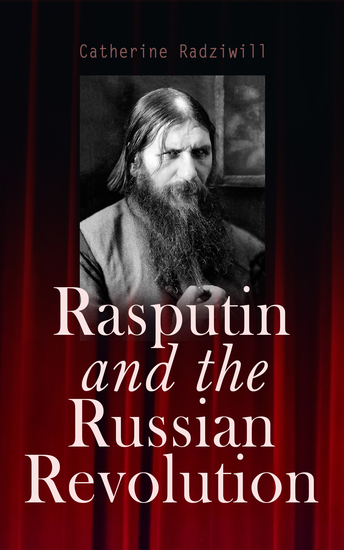
Rasputin and the Russian Revolution - By A Contemporary Observer (Illustrated Edition) - cover

Rasputin and the Russian Revolution - By A Contemporary Observer (Illustrated Edition)

Catherine Radziwill

Publisher: e-artnow

  • 0
  • 0
  • 0

Summary

Rasputin and the Russian Revolution is an exciting look at the personality of Rasputin by a contemporary observer of the last days of the Romanov monarchy and the revolution. Princess Radziwill was an intimate of royals and witnessed Rasputin's deeds. She was one of few people surviving the revolution who could share the intimate details of the royal family's lives and the role of Rasputin in the upcoming political turmoil. Radziwill accuses Nicholas II and Empress Alexandra of too much fascination with Rasputin, which negatively affected further country development.
Available since: 03/21/2022.
Print length: 196 pages.


Other books that might interest you

  • Becoming a Philosopher - Spinoza to Sartre - cover

    Becoming a Philosopher - Spinoza...

    Jonathan Rée

    • 0
    • 0
    • 0
    In 'Becoming a Philosopher' Jonathan Rée describes the extraordinary lives of some of most influential thinkers of the past four hundred years and the radical and sometimes bizarre ideas that emerged from them. In so doing he challenges the notion of philosophy as a set of fixed ideas to be arranged and catalogued like botanical specimens. Rather, the philosophical life is revealed, as Kierkegaard has described, as one of relentless struggle, a never-ending 'dance in the service of thought' which might, with luck, result in a single fresh idea.This collection of ten biographical pieces, originally published as book reviews in the London Review of Books, begins with Spinoza, the excommunicated lens grinder who sought as little attention as possible for his anonymously published work; and ends with Sartre, the most public of public intellectuals whose funeral was marked by thousands on the streets of Paris. In between we find Newton working tirelessly to establish a chronology of the ancient world; Hegel gazing on Napoleon as he marches through Jena in 1806; and Wittgenstein drawing up plans for a new kind of propeller before writing his landmark Tractatus in the trenches of the First World War. Alongside them we also meet Leibniz, Hume, Lessing, Kierkegaard and Collingwood.This audiobook also features an introductory conversation between Jonathan Rée and Thomas Jones, an editor at the LRB and presenter of the LRB Podcast.Subjects covered: Spinoza, Newton, Leibniz, Hume, Lessing, Hegel, Kierkegaard, Wittgenstein, Collingwood, Sartre.These pieces have been amended in places from the original for the purposes of recording.
    Show book
  • Black Lives Native Lands White Worlds - A History of Slavery in New England - cover

    Black Lives Native Lands White...

    Jared Ross Hardesty

    • 0
    • 0
    • 0
    Shortly after the first Europeans arrived in seventeenth-century New England, they began to import Africans and capture the area's indigenous peoples as slaves. By the eve of the American Revolution, enslaved people comprised only about 4 percent of the population, but slavery had become instrumental to the region's economy and had shaped its cultural traditions. This story of slavery in New England has been little told. 


    In this concise yet comprehensive history, Jared Ross Hardesty focuses on the individual stories of enslaved people, bringing their experiences to life. He also explores larger issues such as the importance of slavery to the colonization of the region and to agriculture and industry, New England's deep connections to Caribbean plantation societies, and the significance of emancipation movements in the era of the American Revolution. Thoroughly researched and engagingly written, Black Lives, Native Lands, White Worlds is a must-listen for anyone interested in the history of New England.
    Show book
  • Where Stands a Wingèd Sentry - cover

    Where Stands a Wingèd Sentry

    Margaret Kennedy

    • 0
    • 0
    • 0
    Margaret Kennedy was an acclaimed novelist and playwright best-known for The Constant Nymph. In this autobiographical account, taken from her war diaries, she conveys the tension, frustration, and bewilderment of the progression of the war, and the terror of knowing that the worst is to come, but not yet knowing what the worst will be. 


    English bravery, confusion, stubbornness, and dark humor provide the positive, more hopeful side of her experiences, in which she and her children move from Surrey to Cornwall, to sit out the war amidst a quietly efficient Home Guard and the most scandalous rumors. 


    "Most people knew in their hearts that the lid had been taken off hell, and that what had been done in Guernica would one day be done in London, Paris and Berlin." Margaret Kennedy's prophetic words, written about the pre-war mood in Europe, give the tone of this riveting 1941 wartime memoir: it is Mrs. Miniver with the gloves off. 


    Where Stands A Wingèd Sentry, the title comes from a seventeenth-century poem by Henry Vaughan, was only published in the USA in 1942, and was never published in the UK, until now.
    Show book
  • A World Rewritten - cover

    A World Rewritten

    Santiago Machain

    • 0
    • 0
    • 0
    In the aftermath of ideological collapse and technological overreach, humanity stands at a critical crossroads. The old empires have fallen, the myths of progress lie shattered, and yet a new vision begins to rise from the ashes. In this sweeping narrative of political reinvention, cultural restoration, and cognitive evolution, Book Three: A World Rewritten explores a world where history is rewritten, myth and memory merge, and a new civilization struggles to define itself. 
    Through alternate histories, radical diplomacy, decentralized knowledge systems, and deeply human questions, this book challenges readers to confront what it means to belong in a world unmoored from its past—but alive with possibility. 
    From the fall of Athens to the simulated mind of Alexander the Great, from a world without Columbus to the emergence of unified languages and fractured technologies, this book is both a cautionary tale and a hopeful blueprint. Could a better future still be possible? The answer lives in the stories we choose to tell.
    Show book
  • Fighting Back - Stan Andrews and the Birth of the Israeli Air Force - cover

    Fighting Back - Stan Andrews and...

    Jeffrey Weiss, Craig Weiss

    • 0
    • 0
    • 0
    Fighting Back is the story of Stan Andrews, an assimilated American Jew and World War II veteran who became one of the first fighter pilots in the history of the Israeli Air Force. 


    In 1948, Stan Andrews left a comfortable postwar life in Los Angeles to travel to the war-torn Middle East, where a four-front Arab invasion threatened to destroy the newly-declared State of Israel. There he joined the Israeli Air Force and became one of its first fighter pilots. Andrews was an unexpected volunteer for the fight for a Jewish state. He was many things—an artist, writer, assimilated Jew, ladies' man, pilot, and combat veteran of the Pacific War. He had previously been aloof from the struggle for Jewish independence but found himself so roused by the anti-Semitism of 1940s America that he decided to go to Israel and risk everything. Stan made the most of his time in Israel, serving in fighter and bomber squadrons and leaving his mark on an Israeli Air Force that has since become the stuff of legend.
    Show book
  • Inside the Gas Chambers - Eight Months in the Sonderkommando of Auschwitz - cover

    Inside the Gas Chambers - Eight...

    Shlomo Venezia

    • 0
    • 0
    • 0
    Slomo Venezia was born into a poor Jewish-Italian community living in Thessaloniki, Greece. At first, the occupying Italians protected his family; but when the Germans invaded, the Venezias were deported to Auschwitz. His mother and sisters disappeared on arrival, and he learned, at first with disbelief, that they had almost certainly been gassed. Given the chance to earn a little extra bread, he agreed to become a 'Sonderkommando', without realizing what this entailed. He soon found himself a member of the 'special unit' responsible for removing the corpses from the gas chambers and burning their bodies. 


    Dispassionately, he details the grim round of daily tasks, evokes the terror inspired by the man in charge of the crematoria, 'Angel of Death' Otto Moll, and recounts the attempts made by some of the prisoners to escape, including the revolt of October 1944. 


    It is usual to imagine that none of those who went into the gas chambers at Auschwitz ever emerged to tell their tale—but, as a member of a 'Sonderkommando', Shlomo Venezia was given this horrific privilege. He knew that, having witnessed the unspeakable, he in turn would probably be eliminated by the SS in case he ever told his tale. He survived: this is his story.
    Show book